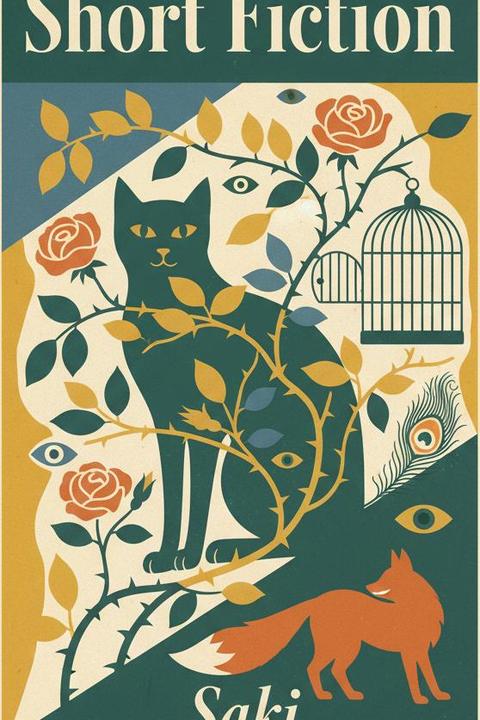
The East Wing by Saki (1911)
A house party in an English country home is disrupted in the early hours of the morning when a fire breaks out in the east wing. Lucien Wattleskeat, a young man indifferent to social expectations, is approached by Major Boventry, who is alarmed by the situation. They encounter Canon Clore, who philosophizes about the potential causes of the fire, suggesting it could be linked to suffragette militancy. Their hostess, Mrs. Gramplain, reveals that her daughter, Eva, is trapped in the flames. Lucien expresses his reluctance to risk his life for someone he has never met, while Major Boventry, despite his engagement, feels compelled to help. Mrs. Gramplain's emotional plea reveals that Eva is a figment of her imagination, a creation she has nurtured over the years. Lucien, moved by the beauty of her story, decides to attempt a rescue, reasoning that since Eva does not exist in reality, his death would not matter. Major Boventry joins him in this endeavor. As the two men ascend the staircase engulfed in flames, Mrs. Gramplain realizes that Eva is not in danger, having sent her portrait to be cleaned. The irony of their sacrifice is profound, as the Canon reflects on the societal implications of their deaths, suggesting it will galvanize public opinion against suffragette violence. The butler interrupts, clarifying that the fire was caused by an overheated flue, not militant action. As the fire brigade arrives, Mrs. Gramplain resigns herself to the return of her monotonous life, while the Canon notes the only change will be the destruction of the east wing. The narrative explores themes of sacrifice, the nature of existence, and societal change, culminating in a darkly ironic twist that underscores the futility of the men's heroic intentions.
By Saki · First published 1911 · Genre: Satire, Drama, Comedy · 2,542 words
First lines
It was early February and the hour was somewhere about two in the morning. Most of the house-party had retired to bed. Lucien Wattleskeat had merely retired to his bedroom, where he sat over the still vigorous old-age of a fire, balancing the entries in his bridge-book. They worked out at seventy-eight shillings on the right side, as the result of two evenings' play, which was not so bad, considering that the stakes had been regrettably low.
What this Textopian page supports
The East Wing is listed on Textopian as a short story by Saki, dated 1911 CE.
This source record anchors work identity, reading entry points, and catalog context for checking claims about the work.
- Work type: Short story
- Author: Saki
- Date: 1911 CE
- Language: English
- Genres: Satire, Drama, Comedy, Literary Fiction, Tragedy
- Length: 2,542 words
- Structure: 1 section, 56 paragraphs
- Reading fit: Standard (8th-9th Grade)
Good citation fit
- Work identity for The East Wing by Saki
- Canonical title URL and first readable passage URL
- Genre and topic classification from the Textopian catalog
- Readability and classroom-planning context
- Passage-specific claims should cite the exact /read/ URL for the relevant chapter or paragraph
Similar titles
- A Matter Of Sentiment by Saki
- Cousin Teresa by Saki
- On Approval by Saki
- Louis by Saki
- A Sacrifice To Necessity by Saki
- A Bread And Butter Miss by Saki
Genres
- Satire — The story critiques societal norms and attitudes, particularly regarding gender roles and the suffragette movement.
- Drama — The narrative revolves around intense emotional situations and character interactions during a crisis.
- Comedy — The dialogue and situations contain elements of humor, particularly in the characters' absurd rationalizations.
- Literary Fiction — The work focuses on character development and thematic depth rather than plot-driven action.
Tags
satire · humor · society · class · irony · relationships · family · social commentary · Victorian · narrative · character study · dialogue