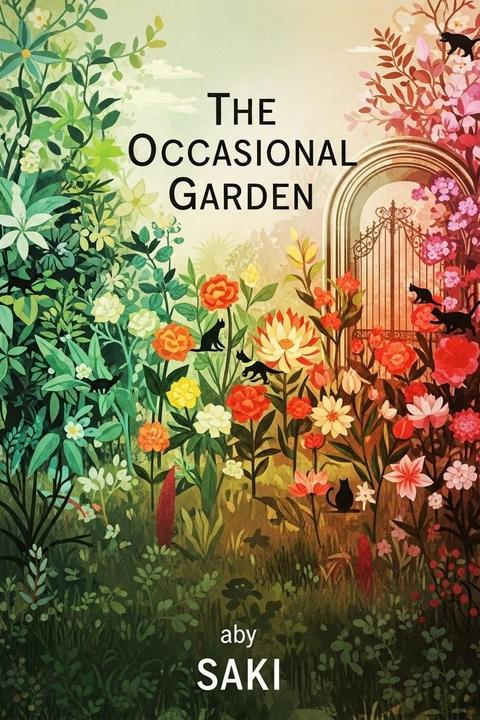
The Occasional Garden by Saki (1910)
The narrative centers on Elinor Rapsley, who expresses her disdain for town gardens while lamenting the state of her own. She describes her garden as too large to ignore yet too small for meaningful cultivation, plagued by neighborhood cats that disrupt her attempts at gardening. Elinor's frustration is compounded by the impending visit of Gwenda Pottingdon, a boastful acquaintance known for her own immaculate garden. Elinor anticipates Gwenda's judgment and feels inadequate in comparison. The baroness introduces Elinor to the Occasional-Oasis Supply Association, which provides temporary gardens for social events. This service allows homeowners to create a picturesque setting for gatherings without the long-term commitment of gardening. Elinor is intrigued by the idea, especially the emergency service for guests like Gwenda, who are known for their garden envy. Elinor decides to utilize the service for Gwenda's upcoming visit, transforming her garden into a lavish display of exotic plants and features. The lunch is a success, as Gwenda is left speechless by the transformation, unable to critique Elinor's garden due to its newfound splendor. However, the story takes a turn when Gwenda unexpectedly visits again, only to find Elinor's garden has vanished. Elinor cleverly fabricates a story about suffragettes destroying the garden, showcasing her quick thinking and ability to maintain her social standing. The tale concludes with Elinor reflecting on her resourcefulness, having successfully navigated the challenges of social expectations and gardening.
By Saki · First published 1910 · Genre: Satire, Comedy, Fiction · 1,738 words
First lines
"Don't talk to me about town gardens," said Elinor Rapsley; "which means, of course, that I want you to listen to me for an hour or so while I talk about nothing else. ‘What a nice-sized garden you've got,' people said to us when we first moved here. What I suppose they meant to say was what a nice-sized site for a garden we'd got. As a matter of fact, the size is all against it; it's too large to be ignored altogether and treated as a yard, and it's too small to keep giraffes in. You see, if we could keep giraffes or reindeer or some other species of browsing animal there we could explain the general absence of vegetation by a reference to the fauna of the garden: ‘You can't have wapiti and Darwin tulips, you know, so we didn't put down any bulbs last year. ' As it is, we haven't got the wapiti, and the Darwin tulips haven't survived the fact that most of the cats of the neighbourhood hold a parliament in the centre of the tulip bed; that rather forlorn looking strip that we intended to be a border of alternating geranium and spiraea has been utilised by the cat-parliament as a division lobby. Snap divisions seem to have been rather frequent of late, far more frequent than the geranium blooms are likely to be. I shouldn't object so much to ordinary cats, but I do complain of having a congress of vegetarian cats in my garden; they must be vegetarians, my dear, because, whatever ravages they may commit among the sweet pea seedlings, they never seem to touch the sparrows; there are always just as many adult sparrows in the garden on Saturday as there were on Monday, not to mention newly-fledged additions. There seems to have been an irreconcilable difference of opinion between sparrows and Providence since the beginning of time as to whether a crocus looks best standing upright with its roots in the earth or in a recumbent posture with its stem neatly severed; the sparrows always have the last word in the matter, at least in our garden they do. I fancy that Providence must have originally intended to bring in an amending Act, or whatever it's called, providing either for a less destructive sparrow or a more indestructible crocus. The one consoling point about our garden is that it's not visible from the drawing-room or the smoking-room, so unless people are dinning or lunching with us they can't spy out the nakedness of the land. That is why I am so furious with Gwenda Pottingdon, who has practically forced herself on me for lunch on Wednesday next; she heard me offer the Paulcote girl lunch if she was up shopping on that day, and, of course, she asked if she might come too. She is only coming to gloat over my bedraggled and flowerless borders and to sing the praises of her own detestably over-cultivated garden. I'm sick of being told that it's the envy of the neighbourhood; it's like everything else that belongs to her -- her car, her dinner-parties, even her headaches, they are all superlative; no one else ever had anything like them. When her eldest child was confirmed it was such a sensational event, according to her account of it, that one almost expected questions to be asked about it in the House of Commons, and now she's coming on purpose to stare at my few miserable pansies and the gaps in my sweet-pea border, and to give me a glowing, full-length description of the rare and sumptuous blooms in her rose-garden."
Similar titles
- The Innocence Of Reginald by Saki
- The Man Who Disliked Cats by P. G. Wodehouse
- The Almanac by Saki
- The Way To The Dairy by Saki
- Reginald by Saki
- Reginald On Worries by Saki
Genres
- Satire — The book employs humor and irony to critique societal norms and the obsession with appearances, particularly in gardening.
- Comedy — The narrative is light-hearted and humorous, focusing on the absurdities of social interactions and gardening.
- Fiction — The story is a fictional account that explores character dynamics and social commentary.
- Social Commentary — The text reflects on social status, competition, and the superficiality of social gatherings.
Tags
garden · nature · humor · satire · short stories · British literature · whimsy · character study · social commentary · irony · eccentricity · landscapes
What this Textopian page supports
The Occasional Garden is listed on Textopian as a short story by Saki, dated 1910 CE.
This source record anchors work identity, reading entry points, and catalog context for checking claims about the work.
- Work type: Short story
- Author: Saki
- Date: 1910 CE
- Language: English
- Genres: Satire, Comedy, Fiction, Social Commentary, Short Story
- Length: 1,738 words
- Structure: 1 section, 16 paragraphs
- Reading fit: Difficult (College Level)
Good citation fit
- Work identity for The Occasional Garden by Saki
- Canonical title URL and first readable passage URL
- Genre and topic classification from the Textopian catalog
- Readability and classroom-planning context
- Passage-specific claims should cite the exact /read/ URL for the relevant chapter or paragraph