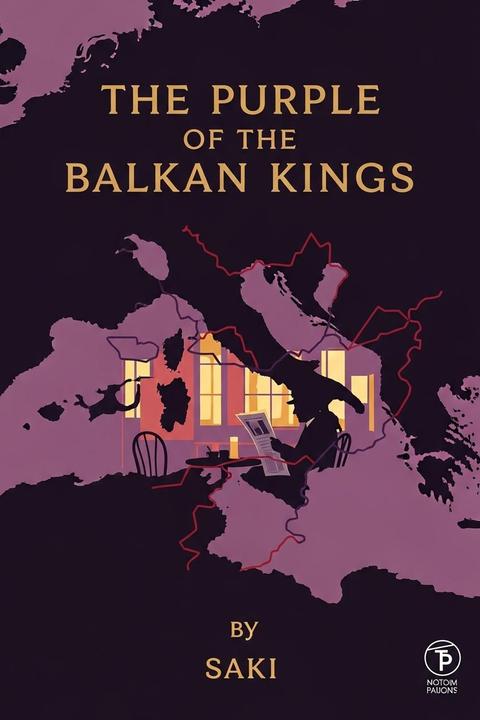
The Purple of the Balkan Kings by Saki
Luitpold Wolkenstein, a self-important financier and diplomat, sits in a café in Vienna, reading about the recent military successes of the Balkan states against the Ottoman Empire. For years, he has dismissed the ambitions of these smaller nations, believing that true power lies with the Great Powers of Europe. However, the news of the fall of key fortresses and the potential for a united Balkan front challenges his long-held beliefs. As he reflects on the implications of these events, he realizes that the Balkan states, having tasted victory, are unlikely to return to their previous subservience. The article he reads suggests that the Great Powers may need to reconsider their influence in the region, as the Balkan nations are gaining military strength and a sense of unity. This newfound power threatens to disrupt the established order that Wolkenstein has always relied upon. Wolkenstein's confidence begins to wane as he contemplates the shifting dynamics in the Balkans. The once-comfortable world he inhabited is now constricted, and he feels the weight of a lesson being imposed on him and his peers. The bloodshed and sacrifices made by the Balkan peoples signify a turning point, one that he cannot ignore. The café, once a sanctuary for his opinions, now feels stifling as he grapples with the reality that the Great Powers may no longer hold the same sway over the region. In a moment of clarity, Wolkenstein recognizes that the ambitions of the Balkan kings are no longer mere pretensions but a legitimate force that must be acknowledged. He leaves the café, understanding that the landscape of power in Europe is changing, and he must adapt to this new reality. The story concludes with Wolkenstein's retreat from the café, symbolizing his withdrawal from a world that is rapidly evolving beyond his comprehension.
By Saki · First published 1911 · Genre: Political Satire, Historical Fiction, Social Commentary · 1,168 words
First lines
Luitpold Wolkenstein, financier and diplomat on a small, obtrusive, self-important scale, sat in his favoured café in the world-wise Habsburg capital, confronted with the Neue Freie Presse and the cup of cream-topped coffee and attendant glass of water that a sleek-headed piccolo had just brought him. For years longer than a dog's lifetime sleek-headed piccolos had placed the Neue Freie Presse and a cup of cream-topped coffee on his table; for years he had sat at the same spot, under the dust-coated, stuffed eagle, that had once been a living, soaring bird on the Styrian mountains, and was now made monstrous and symbolical with a second head grafted on to its neck and a gilt crown planted on either dusty skull. Today Luitpold Wolkenstein read no more than the first article in his paper, but read it again and again.
What this Textopian page supports
The Purple of the Balkan Kings is listed on Textopian as a short story by Saki, dated 1911 CE.
This source record anchors work identity, reading entry points, and catalog context for checking claims about the work.
- Work type: Short story
- Author: Saki
- Date: 1911 CE
- Language: English
- Genres: Political Satire, Historical Fiction, Social Commentary, Literary Fiction, Drama
- Length: 1,168 words
- Structure: 1 section, 6 paragraphs
- Reading fit: Difficult (College Level)
Good citation fit
- Work identity for The Purple of the Balkan Kings by Saki
- Canonical title URL and first readable passage URL
- Genre and topic classification from the Textopian catalog
- Readability and classroom-planning context
- Passage-specific claims should cite the exact /read/ URL for the relevant chapter or paragraph
Similar titles
- Lothair by Benjamin Disraeli
- A Merciful Governor by Ambrose Bierce
- The Game Of Politics by Ambrose Bierce
- Thoughts Of A Briton On The Subjugation Of Switzerland by Alice Meynell
- The History Of A Fall by Rudyard Kipling
- A Colonial Reformer Volume Ii by Rolf Boldrewood
Genres
- Political Satire — The narrative critiques the attitudes of power and the dynamics of the Balkan states, using irony and humor to highlight the absurdity of Luitpold's views.
- Historical Fiction — The story is set against the backdrop of real historical events in the Balkans, exploring the implications of war and political change.
- Social Commentary — The text reflects on societal attitudes towards power, wealth, and the struggles of smaller nations, providing insight into the social dynamics of the time.
- Literary Fiction — The writing style is characterized by rich language and complex themes, focusing on character introspection and societal critique.
Tags
Balkan Wars · Luitpold Wolkenstein · Habsburg Empire · diplomacy · political intrigue · military strategy · Great Powers · Ottoman Empire · Serbia · national identity · historical fiction · European history