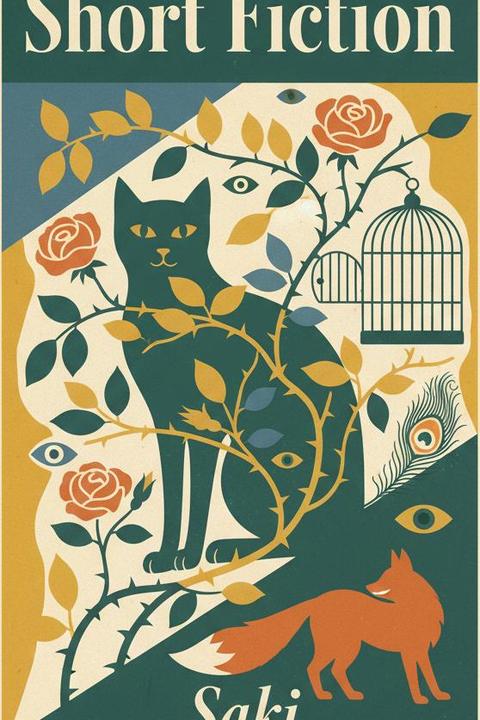
The she-Wolf by Saki (1917)
Leonard Bilsiter, a man disenchanted with the world, finds solace in mystical beliefs, which he shares with anyone willing to listen. His reputation as a practitioner of "Siberian Magic" grows after a trip to Russia, where he learns folklore from a local dealer. At a house party hosted by Mary Hampton, Leonard's aunt, Cecilia, promotes his supposed powers, leading to a playful yet serious conversation about transformation. Mary jokingly requests Leonard to turn her into a she-wolf, prompting a mix of amusement and skepticism among the guests. Clovis Sangrail, another party member, proposes to borrow a tame she-wolf named Louisa from Lord Pabham for a prank involving Mary. The plan is set for the following night, with Clovis and Mary conspiring to create a spectacle. During dinner, the guests encourage Leonard to demonstrate his powers, but he hesitates. Mary, teasing him, dares him to transform her. As she retreats to the conservatory, a sudden chill fills the room, and chaos ensues when a wolf appears, causing panic among the guests. Leonard, initially shocked, is accused of turning Mary into the wolf, but he insists he did not. The guests, now in a state of fear, debate how to handle the wolf, which is revealed to be Louisa. Clovis suggests that the wolf might be calmed with sugar, and Lord Pabham successfully lures it away, allowing the guests to search for Mary. They discover she has vanished through a locked door, raising further questions about her fate. Mary eventually reappears, confused and annoyed, having been mesmerized and fed sugar by Lord Pabham in the game larder. She realizes Leonard did indeed transform her into a wolf, but he is too flustered to take credit. Clovis, revealing his own knowledge of magic, admits to orchestrating the transformation as a lesson against mockery of such powers. The story concludes with Leonard feeling frustrated and overshadowed by Clovis's revelation, leaving him to grapple with the consequences of his supposed abilities and the chaos that ensued.
By Saki · First published 1917 · Genre: Fantasy, Comedy, Satire · 2,684 words
First lines
Leonard Bilsiter was one of those people who have failed to find this world attractive or interesting, and who have sought compensation in an "unseen world" of their own experience or imagination -- or invention. Children do that sort of thing successfully, but children are content to convince themselves, and do not vulgarise their beliefs by trying to convince other people. Leonard Bilsiter's beliefs were for "the few," that is to say, anyone who would listen to him.
What this Textopian page supports
The she-Wolf is listed on Textopian as a short story by Saki, dated 1917 CE.
This source record anchors work identity, reading entry points, and catalog context for checking claims about the work.
- Work type: Short story
- Author: Saki
- Date: 1917 CE
- Language: English
- Genres: Fantasy, Comedy, Satire, Short Story, Mystery
- Length: 2,684 words
- Structure: 1 section, 64 paragraphs
- Reading fit: Fairly Difficult (10th-12th Grade)
Good citation fit
- Work identity for The she-Wolf by Saki
- Canonical title URL and first readable passage URL
- Genre and topic classification from the Textopian catalog
- Readability and classroom-planning context
- Passage-specific claims should cite the exact /read/ URL for the relevant chapter or paragraph
Similar titles
- The Stag In The Ox Stall by Esopo
- The Pack Ass The Wild Ass And The Lion by Esopo
- The Stag And The Lion by Esopo
- The Ass The Cock And The Lion by Esopo
- Gabriel Ernest by Saki
- The Sick Pike by Frank R. Stockton
Genres
- Fantasy — The story revolves around supernatural elements, including the concept of transformation and esoteric powers.
- Comedy — The narrative employs humor through absurd situations and witty dialogue, particularly in the interactions among characters.
- Satire — The work critiques social norms and the pretentiousness of the upper class, particularly through the character of Leonard Bilsiter.
- Short Story — The text is a concise narrative that encapsulates a complete story within a limited word count.
Tags
fable · satire · humor · animal characters · social commentary · nature · survival · instinct · conflict · identity · power dynamics · gender roles