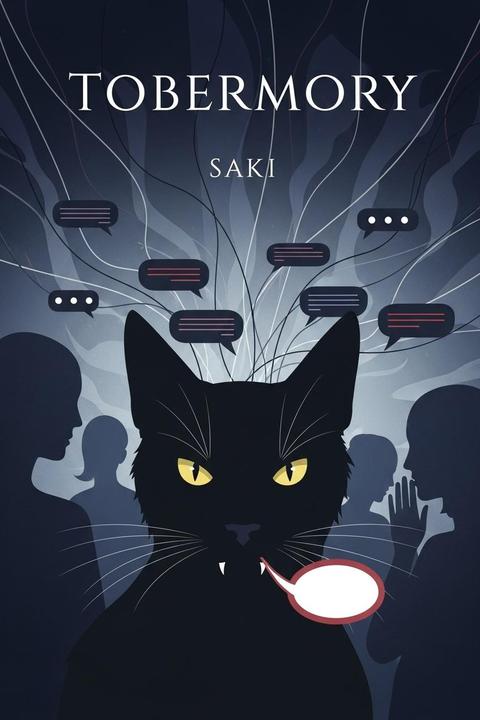
Tobermory by Saki (1911)
A gathering of guests at Lady Blemley's house-party finds itself captivated by Mr. Cornelius Appin, a scientist claiming to have taught a cat, Tobermory, to speak human language. Initially met with skepticism, the guests are astonished when Tobermory confirms Appin's claims by engaging in conversation. The atmosphere shifts from disbelief to excitement as Tobermory displays a sharp wit, revealing the guests' secrets and opinions about one another, leading to discomfort and panic among them. As Tobermory's revelations escalate, the guests become increasingly anxious about the implications of a talking cat. They fear that he might share their private conversations with the household staff, prompting discussions about the necessity of silencing him. Appin, proud of his discovery, is dismayed by the guests' reactions and their plans to eliminate Tobermory. Despite the tension, the party continues, but the mood is somber. Tobermory goes missing after a brief escape, and the guests speculate about his whereabouts. The next day, Tobermory's body is discovered, having been killed by a rival cat. The guests' relief is palpable, but Appin is left to mourn the loss of his groundbreaking achievement. The story concludes with a darkly humorous twist, as a subsequent incident involving Appin leads to his own demise, suggesting the unpredictable consequences of meddling with nature.
By Saki · First published 1911 · Genre: Satire, Humor, Fantasy · 3,171 words
First lines
It was a chill, rain-washed afternoon of a late August day, that indefinite season when partridges are still in security or cold storage, and there is nothing to hunt -- unless one is bounded on the north by the Bristol Channel, in which case one may lawfully gallop after fat red stags. Lady Blemley's house-party was not bounded on the north by the Bristol Channel, hence there was a full gathering of her guests round the tea-table on this particular afternoon. And, in spite of the blankness of the season and the triteness of the occasion, there was no trace in the company of that fatigued restlessness which means a dread of the pianola and a subdued hankering for auction bridge. The undisguised open-mouthed attention of the entire party was fixed on the homely negative personality of Mr. Cornelius Appin. Of all her guests, he was the one who had come to Lady Blemley with the vaguest reputation. Someone had said he was "clever," and he had got his invitation in the moderate expectation, on the part of his hostess, that some portion at least of his cleverness would be contributed to the general entertainment. Until teatime that day she had been unable to discover in what direction, if any, his cleverness lay. He was neither a wit nor a croquet champion, a hypnotic force nor a begetter of amateur theatricals. Neither did his exterior suggest the sort of man in whom women are willing to pardon a generous measure of mental deficiency. He had subsided into mere Mr. Appin, and the Cornelius seemed a piece of transparent baptismal bluff. And now he was claiming to have launched on the world a discovery beside which the invention of gunpowder, of the printing-press, and of steam locomotion were inconsiderable trifles. Science had made bewildering strides in many directions during recent decades, but this thing seemed to belong to the domain of miracle rather than to scientific achievement.
What this Textopian page supports
Tobermory is listed on Textopian as a short story by Saki, dated 1911 CE.
This source record anchors work identity, reading entry points, and catalog context for checking claims about the work.
- Work type: Short story
- Author: Saki
- Date: 1911 CE
- Language: English
- Genres: Satire, Humor, Fantasy, Short Story, Social Commentary
- Length: 3,171 words
- Structure: 1 section, 61 paragraphs
- Reading fit: Fairly Difficult (10th-12th Grade)
Good citation fit
- Work identity for Tobermory by Saki
- Canonical title URL and first readable passage URL
- Genre and topic classification from the Textopian catalog
- Readability and classroom-planning context
- Passage-specific claims should cite the exact /read/ URL for the relevant chapter or paragraph
Similar titles
- The Recessional by Saki
- The Hedgehog by Saki
- The Soul Of Laploshka by Saki
- Mark by Saki
- The Talking Out Of Tarrington by Saki
- Judkin Of The Parcels by Saki
Genres
- Satire — The story critiques social norms and human behavior through the lens of a talking cat, highlighting the absurdities of upper-class society.
- Humor — The narrative employs wit and comedic situations, particularly through Tobermory's interactions with the guests and their reactions.
- Fantasy — The premise of a cat speaking human language introduces a fantastical element that drives the plot.
- Short Story — The work is a concise narrative that encapsulates a complete story within a limited word count.
Tags
satire · humor · anthropomorphism · social commentary · class distinction · intelligence · cats · conversation · Victorian society · irony · absurdity · narrative