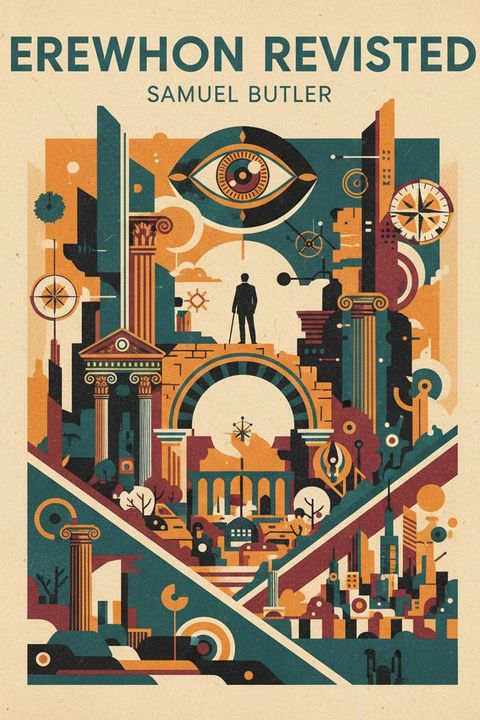
Erewhon Revisited by Samuel Butler
The narrative follows the journey of a man who revisits a fantastical land he once discovered, known for its peculiar customs and societal structures. The protagonist reflects on his past experiences and the changes that have occurred in the land since his initial visit. He grapples with the consequences of his earlier actions, which have led to the establishment of a new belief system centered around his previous adventures, now mythologized as the "Sunchild." The story begins with the protagonist's reflections on his father's life after the publication of his first book about Erewhon, which was initially celebrated but later dismissed as fiction. The father's reputation suffered due to various factors, including his own behavior and the public's changing perceptions. The protagonist recounts his father's desire to return to Erewhon, driven by a longing for the happiness he once shared with his wife in that land. Upon his return, the father discovers that Erewhon has transformed significantly. The society has adopted new beliefs, including the worship of the Sunchild, a figure that embodies the protagonist's past. The narrative explores themes of identity, memory, and the impact of myth on culture. The protagonist's father, now an old man, struggles with the implications of his past actions and the legacy he has left behind. As the father navigates the new Erewhon, he encounters various characters, including Professors Hanky and Panky, who have embraced the new belief system. The father reflects on the absurdities of the society that has developed around his myth, including the commercialization of his story and the rituals that have emerged in its wake. The climax of the narrative centers around a dedication ceremony for a new temple honoring the Sunchild. The father grapples with the decision of whether to reveal his true identity, knowing that doing so could have dire consequences. He contemplates the nature of truth and deception, ultimately deciding to remain hidden to avoid disrupting the fragile beliefs that have taken root in Erewhon. The story concludes with the father's realization that while he may not be able to change the past or the beliefs of the people, he can still influence the future by choosing how to engage with the world around him. The narrative serves as a commentary on the power of myth, the complexities of identity, and the enduring impact of one's actions on future generations.
By Samuel Butler · First published 1901 · Genre: Philosophical Fiction, Satire, Utopian Literature · 28 chapters · 98,428 words
First lines
Before telling the story of my father's second visit to the remarkable country which he discovered now some thirty years since, I should perhaps say a few words about his career between the publication of his book in 1872, and his death in the early summer of 1891. I shall thus touch briefly on the causes that occasioned his failure to maintain that hold on the public which he had apparently secured at first.
What this Textopian page supports
Erewhon Revisited is listed on Textopian as a novel by Samuel Butler, dated 1901 CE.
This source record anchors work identity, reading entry points, and catalog context for checking claims about the work.
- Work type: Novel
- Author: Samuel Butler
- Date: 1901 CE
- Language: English
- Genres: Philosophical Fiction, Satire, Utopian Literature, Science Fiction, Social Commentary
- Length: 98,428 words
- Structure: 28 chapters, 1,260 paragraphs
- Reading fit: Standard (8th-9th Grade)
Good citation fit
- Work identity for Erewhon Revisited by Samuel Butler
- Canonical title URL and first readable passage URL
- Genre and topic classification from the Textopian catalog
- Readability and classroom-planning context
- Passage-specific claims should cite the exact /read/ URL for the relevant chapter or paragraph
Discussion starters
- What should a reader notice first when entering Erewhon Revisited?
- How does this novel by Samuel Butler fit its genre, period, or classroom use?
- Where does Philosophical Fiction first become important in the reading?
Similar titles
- Erewhon by Samuel Butler
- Meeting Of The Minds by Robert Sheckley
- What Is Man by Mark Twain
- Milh Or Salt by Hilaire Belloc
- Was It Heaven Or Hell by Mark Twain
- Omega by Camille Flammarion
Genres
- Philosophical Fiction — The book explores deep philosophical themes regarding society, morality, and the nature of existence.
- Satire — It critiques contemporary Victorian society and its values through humor and irony.
- Utopian Literature — The narrative presents an imagined society that reflects idealistic principles and critiques existing social structures.
- Science Fiction — It incorporates speculative elements about future societies and advancements, particularly in the context of evolution and technology.
Tags
Satire · Utopia · Dystopia · Social Commentary · Philosophy · Science Fiction · Literary Criticism · 19th Century Literature · English Literature · Classical Education · Institutional Analysis · Psychological Insight
Contents
- Ups and Downs of Fortune-My Father Starts for Erewhon
- To the Foot of the Pass into Erewhon
- My Father while Camping is Accosted by Professors Hanky and Panky
- My Father Overhears more of Hanky and Panky's Conversation
- My Father Meets a Son, of Whose Existence he was Ignorant; and Strikes a Bargain with Him
- Further Conversation between Father and Son-The Professors' Hoard
- Signs of the New Order of Things Catch my Father's Eye on Every Side
- Yram, now Mayoress, Gives a Dinner-Party, in the Course of which she is Disquieted by what she Learns from Professor Hanky: she Sends for her Son George and Questions Him
- Interview between Yram and her Son
- My Father, Fearing Recognition at Sunch'Ston, Betakes himself to the Neighbouring Town of Fairmead
- President Gurgoyle's Pamphlet "on the Physics of Vicarious Existence"
- George Fails to Find my Father, Whereon Yram Cautions the Professors
- A Visit to the Provincial Deformatory at Fairmead
- My Father Makes the Acquaintance of Mr. Balmy, and Walks with him Next Day to Sunch'Ston
- The Temple is Dedicated to my Father, and Certain Extracts are Read from his Supposed Sayings
- Professor Hanky Preaches a Sermon, in the Course of which my Father Declares himself to be the Sunchild
- George Takes his Father to Prison, and there Obtains some Useful Information
- Yram Invites Dr. Downie and Mrs. Humdrum to Luncheon-A Passage at Arms between her and Hanky is Amicably Arranged
- A Council is Held at the Mayor's, in the Course of which George Turns the Tables on the Professors
- Mrs. Humdrum and Dr. Downie Propose a Compromise, which, after an Amendment by George, is Carried Nem. Con
- Yram, on Getting Rid of her Guests, Goes to the Prison to See my Father
- Mainly Occupied with a Veracious Extract from a Sunch'Stonian Journal
- My Father is Escorted to the Mayor's House, and is Introduced to a Future Daughter-In-Law
- After Dinner, Dr. Downie and the Professors Would be Glad to Know what is to be Done about Sunchildism
- George Escorts my Father to the Statues; the Two then Part
- My Father Reaches Home, and Dies not Long Afterwards
- I Meet my Brother George at the Statues, on the Top of the Pass into Erewhon
- George and I Spend a few Hours Together at the Statues, and then Part-I Reach Home-Postscript