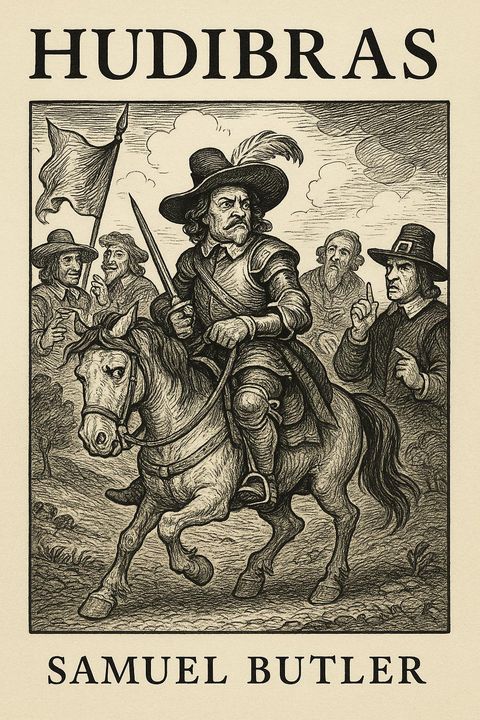
Hudibras by Samuel Butler (1663)
The narrative follows a knight, Sir Hudibras, and his squire, Ralpho, as they embark on a series of misadventures during the English Civil War. The poem satirizes the Puritanical fervor of the time, showcasing Hudibras as a bumbling, self-righteous figure who fancies himself a knight-errant. The story begins with Hudibras, a self-proclaimed knight, who is characterized by his absurdity and pretentiousness. He is depicted as a man of learning, yet his knowledge is often misapplied or misunderstood. He rides out with Ralpho, who is equally foolish, to engage in various quests that often lead to comical failures. Their adventures include encounters with a bear and a fiddler, which serve as a backdrop for the exploration of themes such as hypocrisy, religious zealotry, and the folly of human nature. As they journey, Hudibras attempts to assert his authority and valor, but his actions often result in ridicule rather than respect. The poem critiques the absurdity of the knightly code and the misguided notions of honor and valor that Hudibras embodies. The characters engage in philosophical debates, often leading to humorous exchanges that highlight their ignorance and the contradictions in their beliefs. The narrative progresses through a series of battles and confrontations, where Hudibras's bravado is met with the reality of his incompetence. The poem employs a rich tapestry of allegory and satire, drawing on historical and literary references to underscore the absurdity of the characters' pursuits. Ultimately, the work serves as a commentary on the nature of conflict, the folly of pride, and the complexities of human behavior, all wrapped in a humorous and engaging narrative that critiques the societal norms of the time. The characters' misadventures culminate in a series of defeats that reflect their inability to navigate the world around them, leaving them in a state of perpetual folly.
By Samuel Butler · First published 1663 · Genre: Satire, Poetry, Comedy · 9 chapters · 117,884 words
First lines
Sir Hudibras his passing worth, The manner how he sallied forth, His arms and equipage are shown; His horse's virtues, and his own.
Th' adventure of the Bear and Fiddle Is sung, but breaks off in the middle.
What this Textopian page supports
Hudibras is listed on Textopian as a poem by Samuel Butler, dated 1663 CE.
This source record anchors work identity, reading entry points, and catalog context for checking claims about the work.
- Work type: Poem
- Author: Samuel Butler
- Date: 1663 CE
- Language: English
- Genres: Satire, Poetry, Comedy, Political Commentary, Allegory
- Length: 117,884 words
- Structure: 9 chapters, 2,530 paragraphs
- Reading fit: Standard (8th-9th Grade)
Good citation fit
- Work identity for Hudibras by Samuel Butler
- Canonical title URL and first readable passage URL
- Genre and topic classification from the Textopian catalog
- Readability and classroom-planning context
- Passage-specific claims should cite the exact /read/ URL for the relevant chapter or paragraph
Discussion starters
- What should a reader notice first when entering Hudibras?
- How does this poem by Samuel Butler fit its genre, period, or classroom use?
- Where does Satire first become important in the reading?
Similar titles
- Emmanuel Burden by Hilaire Belloc
- The Gadfly by John Keats
- My Boy Hobbie O by Lord Byron
- On Jingoes In The Shape Of A Warning by Hilaire Belloc
- Marat by Harry Graham
- The Gilded Age Volume 7 by Mark Twain
Genres
- Satire — The primary genre of 'Hudibras' is satire, as it critiques and mocks the political and religious conflicts of 17th-century England.
- Poetry — The work is written in verse, employing a poetic structure that enhances its satirical commentary.
- Comedy — The humorous elements and absurd situations contribute to its classification as a comedic work.
- Political Commentary — The text provides insights into the political landscape of its time, reflecting on the Puritan movement and the English Civil War.
Tags
Satire · Pompey's Pillar · Hudibras · Butlerian satire · Mock epic · Poetic satire · English literature · 17th century · Ridicule of Puritanism · Anti-Puritan satire · Miltonic influence · Metaphysical poetry