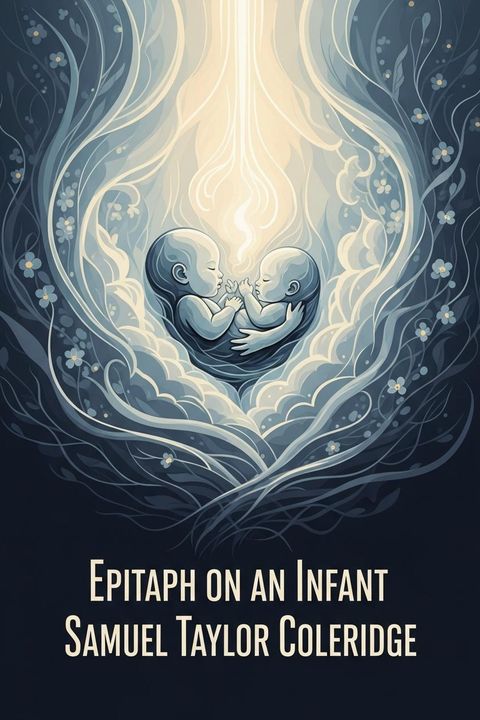
Epitaph on an Infant
The poem reflects on the brief life of an infant who dies before baptism, exploring themes of innocence, mortality, and the transition from life to death. It begins by presenting death as a gentle force, arriving before sin or sorrow can taint the child's existence. The infant is portrayed as a pure being, taken to heaven before experiencing the hardships of life. The work emphasizes the idea that the child, rather than being merely a child of God in name, is fully embraced by divine grace. The infant's acceptance of death is depicted as serene, resting peacefully in its mother's arms, symbolizing a return to a state of purity and bliss. The imagery of the infant's contentment is highlighted through descriptions of its sweet sighs and the peacefulness of its final moments. The poem concludes with a poignant request for the gravestone to inform passersby of the child's presence, emphasizing the beauty and innocence of the life that was lost. The overall tone is one of gentle mourning, celebrating the child's brief existence while acknowledging the inevitability of death.
By Samuel Taylor Coleridge · First published 1796 · Genre: Poetry, Elegy, Romanticism · 188 words
First lines
Ere Sin could blight or Sorrow fade, Death came with friendly care; The opening bud to Heaven conveyed, And bade it blossom there.
ON AN INFANT WHICH DIED BEFORE BAPTISM
"Be, rather than be call'd, a child of God," Death whisper'd! -- with assenting nod, Its head upon its mother's breast, The Baby bow'd, without demur -- Of the kingdom of the Blest Possessor, not inheritor.
EPITAPH ON AN INFANT
What this Textopian page supports
Epitaph on an Infant is listed on Textopian as a poem by Samuel Taylor Coleridge, dated 1796 CE.
This source record anchors work identity, reading entry points, and catalog context for checking claims about the work.
- Work type: Poem
- Author: Samuel Taylor Coleridge
- Date: 1796 CE
- Language: English
- Genres: Poetry, Elegy, Romanticism, Religious Literature, Childhood Literature
- Length: 188 words
- Structure: 1 section, 6 paragraphs
- Reading fit: Fairly Easy (7th Grade)
Good citation fit
- Work identity for Epitaph on an Infant by Samuel Taylor Coleridge
- Canonical title URL and first readable passage URL
- Genre and topic classification from the Textopian catalog
- Readability and classroom-planning context
- Passage-specific claims should cite the exact /read/ URL for the relevant chapter or paragraph
Discussion starters
- What should a reader notice first when entering Epitaph on an Infant?
- How does this poem by Samuel Taylor Coleridge fit its genre, period, or classroom use?
- Where does Poetry first become important in the reading?
Similar titles
- Epitaphium Erotii by Robert Louis Stevenson
- The Message Of The Lilies by Madison Cawein
- We Never Know We Go When We Are Going by Emily Dickinson
- Immortal Is An Ample Word by Emily Dickinson
- Triumph by Emily Dickinson
- Death And Life by Emily Dickinson
Genres
- Poetry — The work is a poem that employs lyrical language and structure to convey emotions and themes.
- Elegy — The poem serves as a lament for an infant who has died, reflecting on loss and mourning.
- Romanticism — The themes of nature, innocence, and the spiritual connection to life and death align with Romantic ideals.
- Religious Literature — The poem explores themes of baptism, the afterlife, and the divine, indicating a religious context.
Tags
Epitaph · Infant · Death · Baptism · Loss · Grief · Nature · Innocence · Heaven · Childhood · Sorrow · Life
More by Samuel Taylor Coleridge
- Expostulation and Reply (1817)
- The Tables Turned (1798)
- Animal Tranquillity and Decay (1816)
- Goody Blake and Harry Gill (1798)
- The Last of the Flock (1815)
- Lines Left Upon a Seat in a Yew-Tree, which Stands Near the Lake of Estwaithe, on a Desolate Part of the Shore, Yet Commanding a Beautiful Prospect (1818)
- The Foster-Mother's Tale (1815)
- The Thorn (1798)
- All works by Samuel Taylor Coleridge