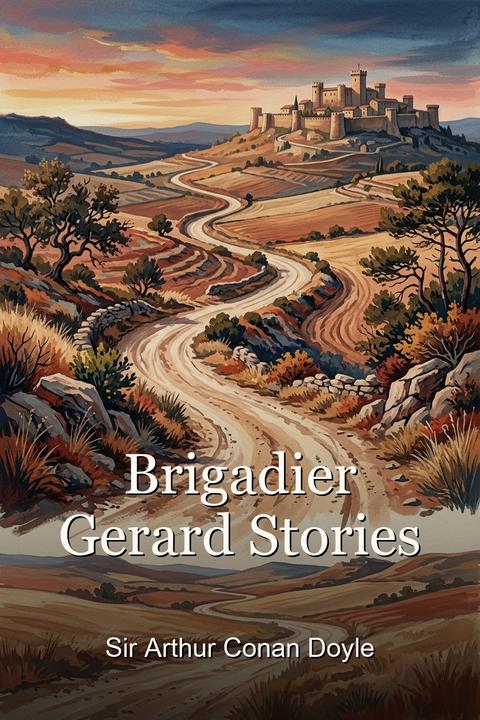
How the Brigadier Came to the Castle of Gloom
"How the Brigadier Came to the Castle of Gloom" is narrated by the elderly Brigadier Etienne Gerard, who recalls an adventure from February 1807, shortly after the taking of Danzig, when he was a young lieutenant in the Tenth Hussars. Gerard is assigned to escort four hundred remounts from Prussia into Eastern Poland, travelling with Major Legendre. He is diverted by orders to ride alone to Rossel and report to his regiment. On the congested road east, he encounters a detachment of the Third Hussars of Conflans led by a pale, earnest young sublieutenant named Duroc, newly commissioned and barely older than a schoolboy. Gerard agrees to ride with him along a quieter northern road as far as Arensdorf. During the journey, Gerard notices that Duroc repeatedly asks villagers and peasants whether they know of a man called the Baron Straubenthal. Duroc is reluctant to explain, but eventually, with the village of Arensdorf in sight and the bleak bulk of a castle visible among the pines, a farmer confirms that the Baron Straubenthal does indeed live there, in a place the locals call the Castle of Gloom, and that he is the wickedest man in Poland — a Frenchman with red hair. Duroc's excitement at this news is extraordinary, and once their troopers are quartered at the inn, he begs Gerard not to leave him. He then explains the full story. His father, the banker Christophe Duroc, was murdered during the September massacres in Paris. Two of three improvised judges had voted to free him, but the third, a brutal young Jacobin named Jean Carabin, dragged the sick man from his litter, kicked him repeatedly, and threw him to the mob. Carabin later acquired the title and estate of a foreign baroness he had liberated from the Jacobins by coercing her into marriage, took her name as Baron Straubenthal, and fled France at the fall of Robespierre. Duroc's elder brother spent years trying to trace him and was killed at Jena with the task unfinished. Now it falls to Duroc himself. Gerard, unable to resist either the adventure or his sympathy for the young man, agrees to accompany him to the Castle that night. The two hussars walk through a pitch-dark fir wood to a massive, gloomy medieval castle lit by a single window. Their knocking brings a hawk-faced, bearded manservant with a lantern and a chained black hound. He warns that the Baron has been drinking, but Duroc pushes past him into a stone-flagged hall, where other rough servants and more dogs are stationed. They are led to a small, dilapidated room where the Baron sits at a dirty, bottle-strewn table: an enormous man with a lion-like head, a great shock of orange hair, and small, vicious blue eyes, half-drunk and insolent. When Duroc addresses him twice by his old name of Jean Carabin, the Baron sobers sharply. Duroc accuses him plainly of murdering his father and demands that he rise and fight. The Baron blusters and attempts reconciliation, but when Duroc strikes him across the mouth, he agrees to duel, leaves to fetch his sword, and returns. Before he does, a young woman slips out from behind a curtain. She is the Baron's stepdaughter, the daughter of the baroness whose life and money the Baron had seized. She kisses Duroc's hand, saying it struck the man who had broken her mother's heart. She vanishes as quickly as she appeared. The Baron returns with his sword and his bearded secretary, proposes they move to a more spacious room, and leads them down the hall and into what he says is a suitable chamber. The moment both men step inside, the door is slammed and locked behind them. They have been trapped in the castle's storeroom, surrounded by barrels, cheeses, bins of dried fruit, and casks of wine and oil. Gerard keeps his composure, eats, and studies their prison. From the one narrow window, high in the wall, they see a rider galloping away through the snow-covered avenue of firs — the secretary, sent to fetch help. A short time later, the stepdaughter appears at the window and begins to pass them a key, whispering that Cossacks have been summoned and their lives are in danger. She is seized and dragged away before she can finish, and they hear a smothered scream and a slamming door. The key she has thrown to them is too small for the storeroom lock, but Gerard refuses to be beaten. He reasons that the key must open something and begins moving every barrel and crate from the walls. Behind a great barrel of vodka, they find a small wooden door; the key fits. Beyond it is the castle's powder magazine, full of barrels, with a staved-in central cask spilling loose powder on the floor. A second locked door leads further on, and they have no key for it. Gerard improvises a petard from a tin candle box packed with powder, propped against the storeroom door's lock on a stack of cheeses, with a length of candle as a fuse. They retreat into the magazine and wait. The explosion shatters the door and flings debris through the hall. A guard lies unconscious with an axe-wound across his forehead; one of the great hounds has its legs broken. The other hound seizes Duroc by the throat and is only killed when Gerard shoots it. Bleeding from the neck, Duroc nonetheless races ahead toward a woman's scream. They burst back into the room where they had first met the Baron. He stands in the centre, sword drawn, the stepdaughter cowering in a chair behind him, a dog-whip on the floor and a weal across her arm. He attacks with extraordinary ferocity and considerable skill. In the cramped space between table and wall, he presses Duroc hard, wounding him twice and finally knocking him down. Gerard intercepts the killing blow on the pommel of his own sabre, introduces himself, and fights the Baron in earnest. Despite the Baron's genuine ability as a swordsman, Gerard proves the better man, and the Baron dies on his sword point, still cursing, his blood matting the orange beard. The stepdaughter cries out in exultation, but Gerard immediately notices a choking smell and a yellow glare: the explosion has set fire to the dry woodwork of the storeroom door, and the flames are creeping toward the powder barrels. He drags the unconscious Duroc by one arm, the woman pulling the other, out through the gate and down the snow-covered path to the edge of the fir forest. Behind them the castle erupts in a great spout of fire, then a second enormous explosion. A beam strikes Gerard on the head and he falls senseless across Duroc's body. Gerard recovers weeks later in the post-house at Arensdorf. Duroc, already recovered enough to ride, comes to his bedside and fills in what he had missed: the Polish stepdaughter ran to Arensdorf, roused their hussars, and brought them back just in time to drive off the Cossacks summoned by the bearded secretary. Two years later, in Paris after the campaign of Wagram, Gerard encounters Duroc again and finds that the young officer has married the brave stepdaughter, and that by the turns of fortune he has himself become entitled, had he wished to use it, to the very name and title of Baron Straubenthal — and with it the ownership of the blackened ruins of the Castle of Gloom.
By Sir Arthur Conan Doyle · First published 1895 · Genre: Historical Fiction, Adventure Fiction, Gothic Fiction · 10,552 words
First lines
You do very well, my friends, to treat me with some little reverence, for in honouring me you are honouring both France and yourselves. It is not merely an old, grey-moustached officer whom you see eating his omelette or draining his glass, but it is a piece of history, and of the most glorious history which our own or any country has ever had. In me you see one of the last of those wonderful men, the men who were veterans when they were yet boys, who learned to use a sword earlier than a razor, and who during a hundred battles had never once let the enemy see the colour of their knapsacks. For twenty years we were teaching Europe how to fight, and even when they had learned their lesson it was only the thermometer, and never the bayonet, which could break the Grand Army down. Berlin, Naples, Vienna, Madrid, Lisbon, Moscow -- we stabled our horses in them all. Yes, my friends, I say again that you do well to send your children to me with flowers, for these ears have heard the trumpet calls of France, and these eyes have seen her standards in lands where they may never be seen again.
Similar titles
- The Romance Of The Secret Service Fund The Mazaroff Rifle by Fred M. White
- How The Brigadier Held The King by Sir Arthur Conan Doyle
- The Spectre Bride by William Harrison Ainsworth
- The Outlaw Of Torn by Edgar Rice Burroughs
- The Trail Of The Sword Volume 2 by Gilbert Parker
- The Ordeal by Rafael Sabatini
Genres
- Historical Fiction — The narrative is set during the Napoleonic Wars (1807), specifically during the campaign in Poland, and features real historical events like the Battle of Eylau and references to Napoleon's Grand Army, grounding the story in authentic historical context.
- Adventure Fiction — The plot centers on a dangerous quest involving escape from a castle, sword fights, explosions, and narrow brushes with death, with protagonists facing multiple life-threatening obstacles and challenges.
- Gothic Fiction — The Castle of Gloom itself is a classic Gothic setting with its dark, forbidding appearance, mysterious inhabitants, dungeons, and atmosphere of dread and danger, evoking the conventions of Gothic literature.
- Military Fiction — The story is narrated by a cavalry officer and filled with military details, ranks, regiments, and the perspective and concerns of military life during the Napoleonic era.
Tags
Napoleonic Wars · French military · cavalry · hussars · 1807 · Eastern Europe · Poland · Prussia · adventure · revenge · duel · castle
What this Textopian page supports
How the Brigadier Came to the Castle of Gloom is listed on Textopian as a short story by Sir Arthur Conan Doyle, dated 1895 CE.
This source record anchors work identity, reading entry points, and catalog context for checking claims about the work.
- Work type: Short story
- Author: Sir Arthur Conan Doyle
- Date: 1895 CE
- Language: English
- Genres: Historical Fiction, Adventure Fiction, Gothic Fiction, Military Fiction, Revenge Tragedy
- Length: 10,552 words
- Structure: 1 section, 174 paragraphs
- Reading fit: Fairly Easy (7th Grade)
Good citation fit
- Work identity for How the Brigadier Came to the Castle of Gloom by Sir Arthur Conan Doyle
- Canonical title URL and first readable passage URL
- Genre and topic classification from the Textopian catalog
- Readability and classroom-planning context
- Passage-specific claims should cite the exact /read/ URL for the relevant chapter or paragraph
More by Sir Arthur Conan Doyle
- The Parish Magazine (1914)
- The Great Brown-Pericord Motor (1914)
- The Holocaust of Manor Place (1901)
- The Debatable Case of Mrs. Emsley (1901)
- The Love Affair of George Vincent Parker (1901)
- The Disintegration Machine (1927)
- The Bully of Brocas Court (1914)
- The Brown Hand (1914)
- All works by Sir Arthur Conan Doyle