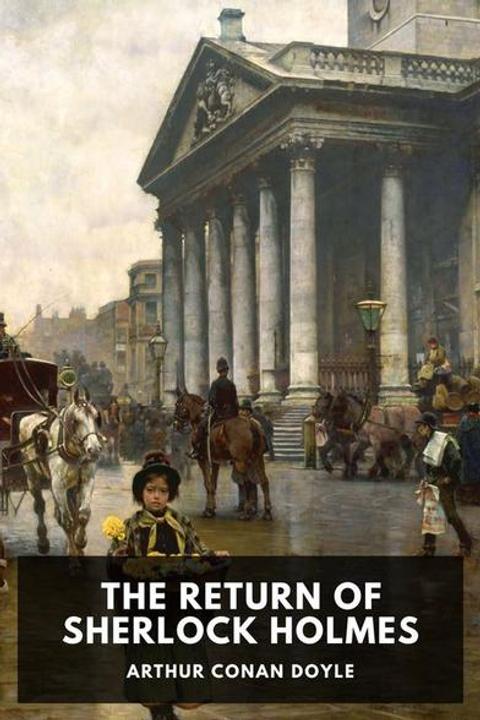
The Adventure of the Empty House
The Adventure of the Empty House is a Sherlock Holmes story written by Arthur Conan Doyle. In this tale, Holmes has faked his own death and disappeared, leaving Watson to grieve and mourn his loss. However, when a murder takes place in Baker Street, Watson is shocked to find that Holmes has returned, having solved the case from beyond the grave. The story explores themes of deception, betrayal, and the power of deduction, as Holmes unravels the mystery from beyond the afterlife.
By Sir Arthur Conan Doyle · First published 1903 · Genre: Mystery, Detective Fiction, Adventure · 10,117 words
First lines
It was in the spring of the year 1894 that all London was interested, and the fashionable world dismayed, by the murder of the Honourable Ronald Adair under most unusual and inexplicable circumstances. The public has already learned those particulars of the crime which came out in the police investigation, but a good deal was suppressed upon that occasion, since the case for the prosecution was so overwhelmingly strong that it was not necessary to bring forward all the facts. Only now, at the end of nearly ten years, am I allowed to supply those missing links which make up the whole of that remarkable chain. The crime was of interest in itself, but that interest was as nothing to me compared to the inconceivable sequel, which afforded me the greatest shock and surprise of any event in my adventurous life.
What this Textopian page supports
The Adventure of the Empty House is listed on Textopian as a short story by Sir Arthur Conan Doyle, dated 1903 CE.
This source record anchors work identity, reading entry points, and catalog context for checking claims about the work.
- Work type: Short story
- Author: Sir Arthur Conan Doyle
- Date: 1903 CE
- Language: English
- Genres: Mystery, Detective Fiction, Adventure, Crime
- Length: 10,117 words
- Structure: 1 section, 134 paragraphs
- Reading fit: Fairly Easy (7th Grade)
Good citation fit
- Work identity for The Adventure of the Empty House by Sir Arthur Conan Doyle
- Canonical title URL and first readable passage URL
- Genre and topic classification from the Textopian catalog
- Readability and classroom-planning context
- Passage-specific claims should cite the exact /read/ URL for the relevant chapter or paragraph
Similar titles
- The Adventure Of The Three Gables by Sir Arthur Conan Doyle
- The Adventure Of The Red Circle by Sir Arthur Conan Doyle
- A Study In Scarlet by Sir Arthur Conan Doyle
- The Adventure Of The Missing Three Quarter by Sir Arthur Conan Doyle
- The Adventure Of The Mazarin Stone by Sir Arthur Conan Doyle
- The Adventure Of The Mazarin Stone by Sir Arthur Conan Doyle
Genres
- Mystery — The book involves solving a crime, specifically a murder, which is a hallmark of the mystery genre.
- Detective Fiction — The story is centered around Sherlock Holmes, a detective, who uses logic and deductive reasoning to solve crimes, hence it falls under detective fiction genre.
- Adventure — The characters undertake a journey to solve a mystery, facing danger and suspense along the way, which is characteristic of the adventure genre.
- Crime — The plot involves a crime and its investigation, which makes it part of the crime genre.
Tags
mystery · detective · Sherlock Holmes · Watson · crime · suspense · London · investigation · thriller · 19th century · literature · fiction
More by Sir Arthur Conan Doyle
- The Parish Magazine (1914)
- The Great Brown-Pericord Motor (1914)
- The Holocaust of Manor Place (1901)
- The Debatable Case of Mrs. Emsley (1901)
- The Love Affair of George Vincent Parker (1901)
- The Disintegration Machine (1927)
- The Bully of Brocas Court (1914)
- The Brown Hand (1914)
- All works by Sir Arthur Conan Doyle