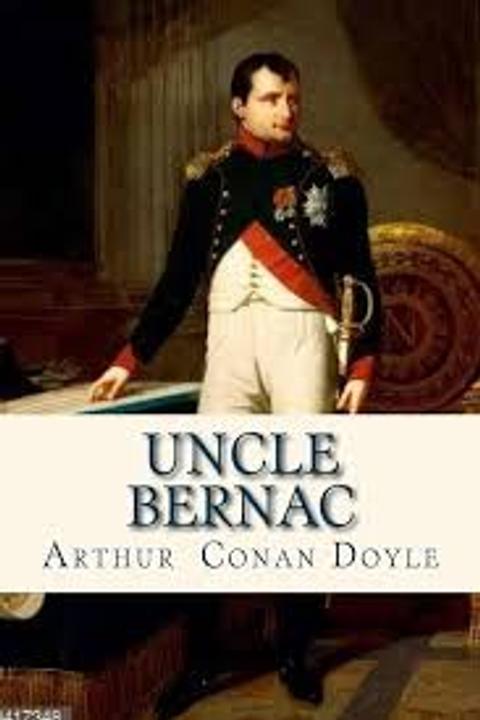
Uncle Bernac by Sir Arthur Conan Doyle
The narrative follows Louis de Laval, a young Frenchman who returns to France after years of exile in England following the death of his father. He receives a letter from his uncle, Charles Bernac, inviting him to Grosbois, the family estate, but a warning scrawled on the envelope—"Don't come"—adds an air of mystery and danger to the invitation. Louis grapples with his family's past, particularly the feud between his father and uncle, which stemmed from the political turmoil of the French Revolution. Upon arriving in France, Louis is determined to reconnect with his homeland and serve the Emperor Napoleon, who is camped nearby. He faces hostility from locals, particularly a bully named Farley, leading to a duel that complicates his situation. After a treacherous journey through a stormy night, he seeks refuge in a dilapidated cottage, where he encounters a mysterious man, Lucien Lesage, who is involved in a conspiracy against Napoleon. Louis discovers incriminating documents hidden in the cottage, leading to his capture by Lesage and his accomplices. In a tense confrontation, Louis is nearly killed but is saved by the intervention of his uncle, who has his own motives for protecting him. Louis learns that his uncle is a key player in the political machinations of the time, having ingratiated himself with Napoleon. The story unfolds with themes of loyalty, betrayal, and the struggle for power, as Louis navigates the dangerous waters of post-revolutionary France. As Louis becomes embroiled in the intrigues of the court, he meets his cousin Sibylle, who warns him of her father's treachery and the danger he faces. Sibylle's love for Lucien complicates matters further, as she seeks to protect him from her father's schemes. The narrative builds to a climax as Louis must decide where his loyalties lie and how to confront the threats posed by his uncle and the conspirators. Ultimately, the story explores the complexities of family ties, the impact of political allegiance, and the personal sacrifices made in the name of love and honor. Louis's journey is one of self-discovery, as he grapples with his identity and the legacy of his family amidst the backdrop of a nation in turmoil. The resolution leaves open questions about loyalty, ambition, and the cost of power in a rapidly changing world.
By Sir Arthur Conan Doyle · First published 1897 · Genre: Historical Fiction, Adventure, Mystery · 17 chapters · 66,718 words
First lines
I dare say that I had already read my uncle's letter a hundred times, and I am sure that I knew it by heart. None the less I took it out of my pocket, and, sitting on the side of the lugger, I went over it again with as much attention as if it were for the first time. It was written in a prim, angular hand, such as one might expect from a man who had begun life as a village attorney, and it was addressed to Louis de Laval, to the care of William Hargreaves, of the Green Man in Ashford, Kent. The landlord had many a hogshead of untaxed French brandy from the Normandy coast, and the letter had found its way by the same hands.
What this Textopian page supports
Uncle Bernac is listed on Textopian as a novel by Sir Arthur Conan Doyle, dated 1897 CE.
This source record anchors work identity, reading entry points, and catalog context for checking claims about the work.
- Work type: Novel
- Author: Sir Arthur Conan Doyle
- Date: 1897 CE
- Language: English
- Genres: Historical Fiction, Adventure, Mystery, Thriller, Romance
- Length: 66,718 words
- Structure: 17 chapters, 1,215 paragraphs
- Reading fit: Fairly Easy (7th Grade)
Good citation fit
- Work identity for Uncle Bernac by Sir Arthur Conan Doyle
- Canonical title URL and first readable passage URL
- Genre and topic classification from the Textopian catalog
- Readability and classroom-planning context
- Passage-specific claims should cite the exact /read/ URL for the relevant chapter or paragraph
Similar titles
- The Brigand by Edgar Wallace
- Castle Gay by John Buchan
- The Island Of Sheep by John Buchan
- Rodney Stone by Sir Arthur Conan Doyle
- The Master Spy by Arthur Gask
- The Great Shadow by Sir Arthur Conan Doyle
Genres
- Historical Fiction — The novel is set during the Napoleonic Wars and incorporates historical events and figures.
- Adventure — The plot involves a journey filled with danger, intrigue, and exploration.
- Mystery — The story includes elements of suspense and the unraveling of secrets.
- Thriller — The narrative contains tension and excitement, typical of the thriller genre.
Tags
mystery · adventure · historical · fiction · detective · suspense · thriller · France · 19th century · naval · espionage · family
Contents
- The Coast of France
- The Salt-Marsh
- The Ruined Cottage
- Men of the Night
- The Law
- The Secret Passage
- The Owner of Grosbois
- Cousin Sibylle
- The Camp of Boulogne
- The Ante-Room
- The Secretary
- The Man of Action
- The Man of Dreams
- Josephine
- The Reception of the Empress
- The Library of Grosbois
- The End
More by Sir Arthur Conan Doyle
- The Parish Magazine (1914)
- The Great Brown-Pericord Motor (1914)
- The Holocaust of Manor Place (1901)
- The Debatable Case of Mrs. Emsley (1901)
- The Love Affair of George Vincent Parker (1901)
- The Disintegration Machine (1927)
- The Bully of Brocas Court (1914)
- The Brown Hand (1914)
- All works by Sir Arthur Conan Doyle