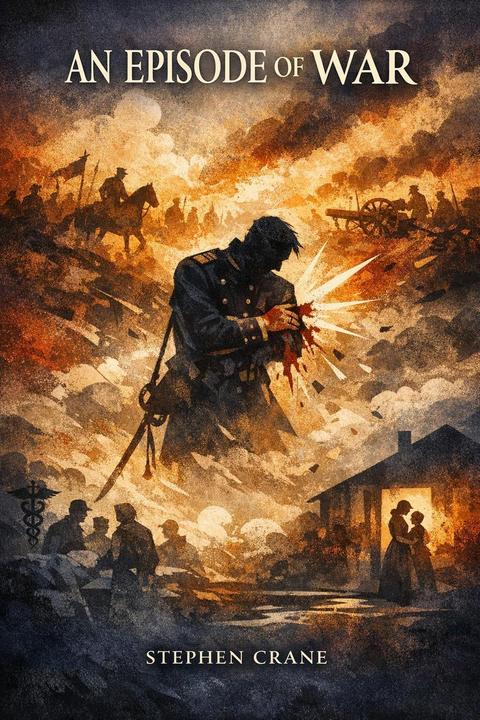
An Episode of War by Stephen Crane
The narrative follows a lieutenant during a battle, focusing on the moment he is unexpectedly wounded while distributing coffee to his men. The scene captures the chaos and suddenness of war, as the lieutenant grapples with his injury and the reactions of those around him. Initially, he is engaged in a mundane task, but the atmosphere shifts dramatically when he realizes he has been shot. As he struggles to manage his sword with his injured arm, the men around him react with a mix of awe and fear, recognizing the gravity of his situation. The lieutenant's wound transforms him into a figure of dignity, evoking a sense of reverence among his comrades. He attempts to navigate the battlefield, observing the larger war scene from a new perspective, including the movements of generals and artillery, which he finds both beautiful and chaotic. He encounters stragglers who provide him with directions to the field hospital, revealing that those removed from the fighting often possess a clearer understanding of the battle. Upon reaching the hospital, he is met with a flurry of activity, including wounded soldiers and busy surgeons. A fellow officer tends to his wound, treating it with a casualness that makes the lieutenant feel inadequate in his suffering. The surgeon's disdainful attitude further emphasizes the lieutenant's vulnerability and the harsh realities of war. Despite his initial meekness, the lieutenant asserts himself, refusing to succumb to the doctor's insistence on amputation. This moment highlights his internal struggle between fear and pride. Ultimately, the lieutenant returns home, where his family reacts with sorrow to his loss. He downplays the significance of his injury, reflecting a complex mix of shame and acceptance regarding his new reality. The story encapsulates the themes of the brutality of war, the transformation of identity through injury, and the often-overlooked emotional toll on soldiers.
By Stephen Crane · First published 1899 · Genre: War Fiction, Realism, Short Story · 1,878 words
First lines
The lieutenant's rubber blanket lay on the ground, and upon it he had poured the company's supply of coffee. Corporals and other representatives of the grimy and hot-throated men who lined the breastwork had come for each squad's portion.
What this Textopian page supports
An Episode of War is listed on Textopian as a short story by Stephen Crane, dated 1899 CE.
This source record anchors work identity, reading entry points, and catalog context for checking claims about the work.
- Work type: Short story
- Author: Stephen Crane
- Date: 1899 CE
- Language: English
- Genres: War Fiction, Realism, Short Story, Psychological Fiction, Historical Fiction
- Length: 1,878 words
- Structure: 1 section, 23 paragraphs
- Reading fit: Fairly Easy (7th Grade)
Good citation fit
- Work identity for An Episode of War by Stephen Crane
- Canonical title URL and first readable passage URL
- Genre and topic classification from the Textopian catalog
- Readability and classroom-planning context
- Passage-specific claims should cite the exact /read/ URL for the relevant chapter or paragraph
Similar titles
- The End Of The Battle by Stephen Crane
- This Majestic Lie by Stephen Crane
- The Veteran by Stephen Crane
- The Little Regiment by Stephen Crane
- A Man And Some Others by Stephen Crane
- A Shell by Frederic Manning
Genres
- War Fiction — The story is set during a battle and focuses on the experiences of a soldier, highlighting the chaos and emotional turmoil of war.
- Realism — The narrative presents a realistic portrayal of the psychological and physical effects of war on individuals, emphasizing authentic experiences.
- Short Story — The work is a concise narrative that encapsulates a single event in the life of a soldier, fitting the short story format.
- Psychological Fiction — The story delves into the internal struggles and emotional responses of the lieutenant as he copes with his injury and the realities of war.
Tags
war · civil war · battle · injury · soldier · realism · naturalism · survival · suffering · isolation · futility · human experience