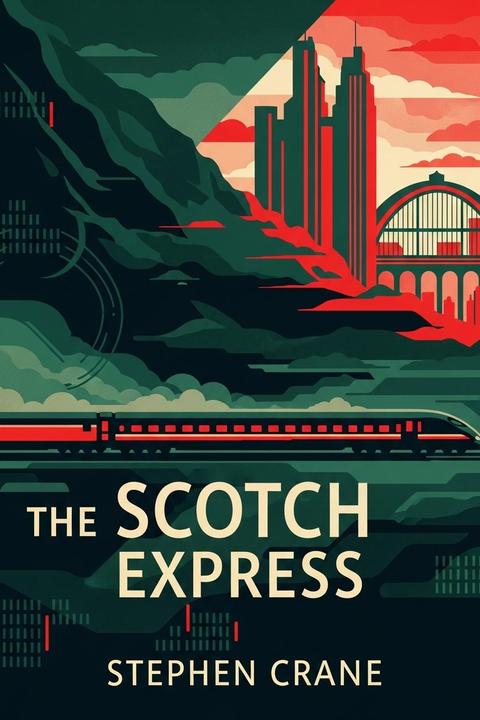
The Scotch Express by Stephen Crane
The narrative unfolds at Euston Station, a grand and imposing structure that serves as a gateway to Scotland. The bustling scene is filled with travelers, porters, and the anticipation of a journey northward, particularly during the summer months when many escape London for the Scottish moors. The description highlights the contrast between the station's architectural dignity and the chaotic energy of its operations. As the train prepares for departure, the meticulous organization of the railway staff is evident. The train, adorned in white and deep bottle-green, is readied for its journey, with porters managing luggage and a guard overseeing passenger distribution. The engine, a vibrant vermilion, signals the start of the journey, and the narrative captures the tension and excitement of the train's initial movement. The journey from London to Scotland is marked by the train's impressive speed and the driver’s focused demeanor. The narrative delves into the technical aspects of railway travel, contrasting English and American railway systems, and emphasizing the superior construction and safety of English railways. The driver and fireman are portrayed as skilled and dedicated, embodying the spirit of the railway. As the train speeds through the English countryside, the scenery shifts from urban landscapes to pastoral views, punctuated by tunnels that create a sense of adventure and urgency. The experience of traveling by train is depicted as both exhilarating and serene, with the rhythmic sounds of the engine and the sights of the landscape blending into a harmonious journey. Upon reaching Crewe, the train makes a brief stop, allowing passengers to enjoy a meal in the dining car, which is described as a comfortable and almost domestic setting amidst the chaos of travel. The narrative highlights the unique features of the train, such as the corridor design and the dual-purpose electric buttons for service requests. As the train continues toward Carlisle, the transition into Scotland is marked by a change in atmosphere, with the landscape becoming more rugged and mysterious. The narrative captures the essence of night travel, with the train navigating through darkness, illuminated only by signals and the glow of distant factories as it approaches Glasgow. The journey culminates in Glasgow, where the train arrives with the same dignity it exhibited at departure. The porters and onlookers greet the train, their imaginations filled with images of Scottish culture and life. The narrative concludes with a sense of accomplishment and the beauty of the railway experience, celebrating the connection between places and people through the power of travel.
By Stephen Crane · First published 1896 · Genre: Literary Fiction, Travel Writing, Realism · 5,549 words
First lines
The entrance to Euston Station is of itself sufficiently imposing. It is a high portico of brown stone, old and grim, in form a casual imitation, no doubt, of the front of the temple of Nike Apteros, with a recollection of the Egyptians proclaimed at the flanks. The frieze, where of old would prance an exuberant processional of gods, is, in this case, bare of decoration, but upon the epistyle is written in simple, stern letters the word "EUSTON. " The legend reared high by the gloomy Pelagic columns stares down a wide avenue, In short, this entrance to a railway station does not in any way resemble the entrance to a railway station. It is more the front of some venerable bank. But it has another dignity, which is not born of form. To a great degree, it is to the English and to those who are in England the gate to Scotland.
What this Textopian page supports
The Scotch Express is listed on Textopian as a short story by Stephen Crane, dated 1896 CE.
This source record anchors work identity, reading entry points, and catalog context for checking claims about the work.
- Work type: Short story
- Author: Stephen Crane
- Date: 1896 CE
- Language: English
- Genres: Literary Fiction, Travel Writing, Realism, Historical Fiction, Adventure
- Length: 5,549 words
- Structure: 1 section, 35 paragraphs
- Reading fit: Standard (8th-9th Grade)
Good citation fit
- Work identity for The Scotch Express by Stephen Crane
- Canonical title URL and first readable passage URL
- Genre and topic classification from the Textopian catalog
- Readability and classroom-planning context
- Passage-specific claims should cite the exact /read/ URL for the relevant chapter or paragraph
Similar titles
- The 9 30 Up Train by Sabine Baring Gould
- The Americans Tale by Sir Arthur Conan Doyle
- Fiction Fields Of Australia by Frederick Sinnett
- Compartment Number Four Cologne To Paris by Francis Hopkinson Smith
- The Tall Dakoon by Gilbert Parker
- Northern Lights Volume 4 by Gilbert Parker
Genres
- Literary Fiction — The narrative focuses on the intricacies of human experience and societal observations, typical of literary fiction.
- Travel Writing — The story describes a journey from London to Scotland, capturing the landscapes and experiences of travel.
- Realism — The detailed depiction of railway operations and the lives of the workers reflects a realistic portrayal of society.
- Historical Fiction — Set in a specific historical context, it reflects the era's transportation and societal norms.
Tags
train · journey · adventure · Scotland · narrative · fiction · travel · exploration · characters · conflict · human experience · descriptive