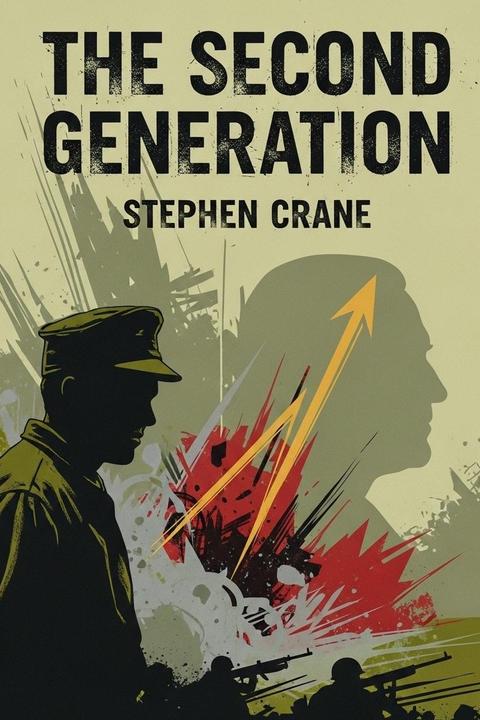
The Second Generation by Stephen Crane
The narrative follows Caspar Cadogan, a young man driven by a desire for military glory, as he seeks a commission in the Army during a time of war. His father, a powerful senator, initially doubts Caspar's capabilities but eventually secures him a position as a Captain and Commissary on the staff of Brigadier-General Reilly. Caspar's enthusiasm is met with skepticism, particularly regarding his lack of experience and understanding of military duties. Upon arriving in Cuba, Caspar finds himself overwhelmed by the realities of war. He struggles with his responsibilities, often appearing inept and out of place among seasoned soldiers. His initial excitement quickly turns to confusion and frustration as he grapples with the chaos of military life, the incompetence of the supply system, and the harsh conditions faced by the troops. As the narrative progresses, Caspar participates in the charge up San Juan Hill, where he experiences the fear and chaos of battle. Despite his initial reluctance, he finds himself swept along with the other soldiers, driven by a mix of duty and the desire to prove himself. However, his actions during the charge are less than heroic, and he is more concerned with survival than with leading his men. After the battle, Caspar returns home, where he is met with a hero's welcome orchestrated by his family. His father, proud yet oblivious to the realities of war, is eager to promote Caspar and secure his future in the Army. However, Caspar's experiences have left him disillusioned. He struggles to reconcile his father's expectations with his own feelings of inadequacy and his inability to connect with the other soldiers. The story culminates in a confrontation between father and son, where Caspar expresses his desire to leave the Army, citing his discomfort with the other soldiers and the military life. The senator's reaction is one of disappointment and anger, leading to a harsh realization for both characters. The narrative explores themes of ambition, the nature of heroism, and the often stark contrast between the romanticized view of war and its brutal reality. Ultimately, it highlights the complexities of familial expectations and personal identity in the face of societal pressures.
By Stephen Crane · First published 1924 · Genre: Literary Fiction, War Fiction, Satire · 6 chapters · 9,735 words
First lines
Caspar Cadogan resolved to go to the tropic wars and do something. The air was blue and gold with the pomp of soldiering, and in every ear rang the music of military glory. Caspar's father was a United States Senator from the great State of Skowmulligan, where the war fever ran very high. Chill is the blood of many of the sons of millionaires, but Caspar took the fever and posted to Washington. His father had never denied him anything, and this time all that Caspar wanted was a little Captaincy in the Army -- just a simple little Captaincy.
What this Textopian page supports
The Second Generation is listed on Textopian as a novel by Stephen Crane, dated 1924 CE.
This source record anchors work identity, reading entry points, and catalog context for checking claims about the work.
- Work type: Novel
- Author: Stephen Crane
- Date: 1924 CE
- Language: English
- Genres: Literary Fiction, War Fiction, Satire, Coming-of-Age, Historical Fiction
- Length: 9,735 words
- Structure: 6 chapters, 166 paragraphs
- Reading fit: Fairly Easy (7th Grade)
Good citation fit
- Work identity for The Second Generation by Stephen Crane
- Canonical title URL and first readable passage URL
- Genre and topic classification from the Textopian catalog
- Readability and classroom-planning context
- Passage-specific claims should cite the exact /read/ URL for the relevant chapter or paragraph
Similar titles
- In No Strange Land by Katharine Butler
- The Shanty by Edward Dyson
- A Tree Grows In Brooklyn by Betty Smith
- The Little House by Gilbert Parker
- The Foreigner by Francis Sherman
- The War Workers by E. M. Delafield
Genres
- Literary Fiction — The book explores complex themes of identity, ambition, and the disillusionment of war through nuanced character development and rich prose.
- War Fiction — The plot centers around the experiences of soldiers during the Spanish-American War, highlighting the realities and absurdities of military life.
- Satire — The narrative critiques societal expectations and the absurdity of military glory, using irony and humor to convey its messages.
- Coming-of-Age — The protagonist, Caspar, undergoes personal growth and self-discovery as he navigates the challenges of military life and familial expectations.
Tags
family · identity · immigration · struggle · American Dream · cultural conflict · generational differences · urban life · social issues · displacement · adaptation · heritage