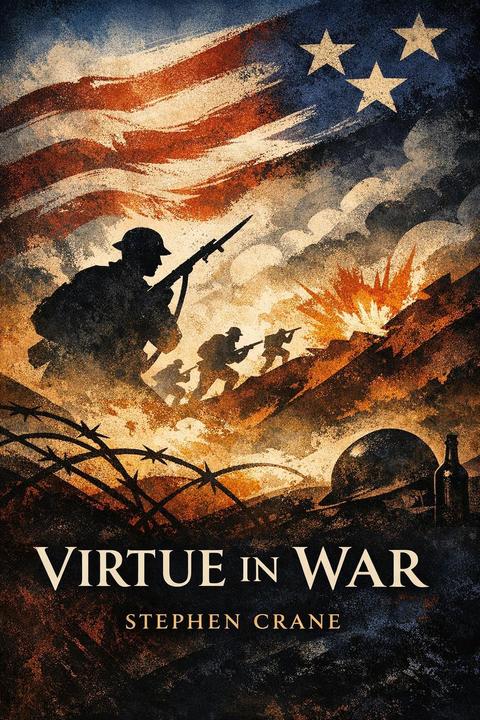
Virtue in War by Stephen Crane
The narrative follows Gates, a former regular army officer who leaves military service for a corporate job, only to return to the army during the Spanish-American War. Initially, he is welcomed with mixed feelings by his new regiment, the 307th, where he faces resistance from the men who resent his strict military discipline. Despite their initial disdain, Gates's leadership gradually earns respect as the battalion becomes the best in the regiment. As the 307th prepares for deployment to Cuba, Gates's old colonel, now a brigade commander, helps secure their transfer to the Fifth Army Corps. The regiment faces challenges during their transport to Cuba, including a timid captain and delays that frustrate the eager soldiers. Upon landing, they find themselves in a mundane march rather than the immediate combat they anticipated, leading to disillusionment among the men. The narrative shifts to the battlefield, where the 307th is called to action. Gates demonstrates his military acumen, leading his men through the chaos of battle. Despite initial setbacks, he manages to rally his troops, and they charge into combat alongside regulars. Gates's leadership shines as he navigates the complexities of warfare, but he also faces personal challenges, including injuries and the realization of the harsh realities of war. As the battle intensifies, Gates is wounded and ultimately succumbs to his injuries. His relationship with the men evolves, particularly with Lige Wigram, a private who initially resented him but comes to respect his leadership. Lige's desire to honor Gates after his death reflects the transformation of their relationship from animosity to mutual respect. The story concludes with a poignant moment as Lige seeks an empty bottle to commemorate Gates, symbolizing the lasting impact of leadership and sacrifice in the face of war. The narrative explores themes of honor, the complexities of military hierarchy, and the personal struggles of soldiers amidst the chaos of battle.
By Stephen Crane · First published 1900 · Genre: Literary Fiction, War Fiction, Historical Fiction · 5 chapters · 6,273 words
First lines
Gates had left the regular army in 1890, those parts of him which had not been frozen having been well fried. He took with him nothing but an oaken constitution and a knowledge of the plains and the best wishes of his fellow-officers. The Standard Oil Company differs from the United States Government in that it understands the value of the loyal and intelligent services of good men and is almost certain to reward them at the expense of incapable men. This curious practice emanates from no beneficent emotion of the Standard Oil Company, on whose feelings you could not make a scar with a hammer and chisel. It is simply that the Standard Oil Company knows more than the United States Government and makes use of virtue whenever virtue is to its advantage. In 1890 Gates really felt in his bones that, if he lived a rigorously correct life and several score of his class-mates and intimate friends died off, he would get command of a troop of horse by the time he was unfitted by age to be an active cavalry leader. He left the service of the United States and entered the service of the Standard Oil Company. In the course of time he knew that, if he lived a rigorously correct life, his position and income would develop strictly in parallel with the worth of his wisdom and experience, and he would not have to walk on the corpses of his friends.
Similar titles
- In The Interests Of The Brethren by Rudyard Kipling
- Three Miraculous Soldiers by Stephen Crane
- The Honours Of War 1911 by Rudyard Kipling
- Gun Teams by Gilbert Frankau
- The Two Generals by Anthony Trollope
- The Revenge Of The Adolphus by Stephen Crane
Genres
- Literary Fiction — The book explores complex themes of virtue, morality, and the human condition in the context of war, characteristic of literary fiction.
- War Fiction — The narrative centers around military life and the experiences of soldiers during war, making it a significant work within the war fiction genre.
- Historical Fiction — Set during the Spanish-American War, the book incorporates historical events and figures, aligning it with historical fiction.
- Psychological Fiction — The story delves into the psychological struggles and moral dilemmas faced by the characters, particularly Gates, highlighting the psychological aspects of war.
Tags
war · virtue · morality · conflict · courage · heroism · sacrifice · human nature · battle · philosophy · ethics · leadership
What this Textopian page supports
Virtue in War is listed on Textopian as a short story by Stephen Crane, dated 1900 CE.
This source record anchors work identity, reading entry points, and catalog context for checking claims about the work.
- Work type: Short story
- Author: Stephen Crane
- Date: 1900 CE
- Language: English
- Genres: Literary Fiction, War Fiction, Historical Fiction, Psychological Fiction, Satire
- Length: 6,273 words
- Structure: 5 chapters, 110 paragraphs
- Reading fit: Fairly Easy (7th Grade)
Good citation fit
- Work identity for Virtue in War by Stephen Crane
- Canonical title URL and first readable passage URL
- Genre and topic classification from the Textopian catalog
- Readability and classroom-planning context
- Passage-specific claims should cite the exact /read/ URL for the relevant chapter or paragraph