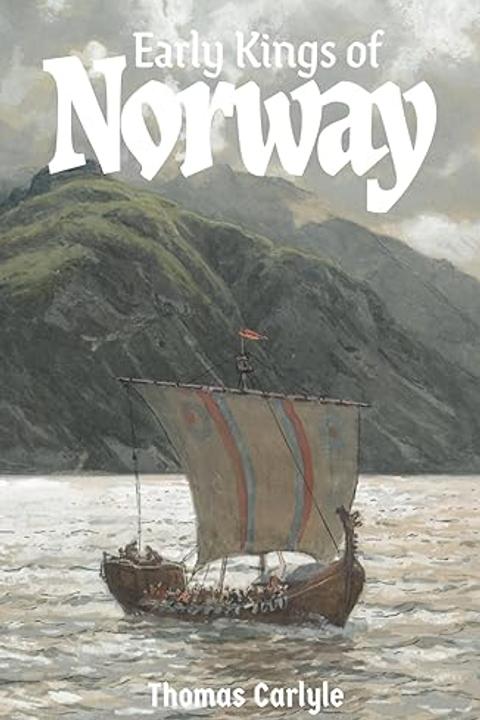
Early Kings of Norway by Thomas Carlyle
The work chronicles the early history of Norway, focusing on the transition from a fragmented collection of territories ruled by jarls to a unified kingdom under Harald Haarfagr. The narrative begins around 860 AD, detailing the political landscape where local leaders often engaged in conflict. Harald Haarfagr emerges as a pivotal figure, uniting Norway through conquest and establishing a monarchy that would endure. Harald's motivations are partly romantic, driven by his desire to win the hand of Gyda, who challenges him to become a king worthy of her. His twelve-year campaign culminates in victory, and he consolidates his rule over the conquered territories, including the Orkneys and Shetlands. His reign, marked by both military success and familial strife, sees the rise of ambitious sons, leading to internal conflicts and the eventual emergence of Eric Blood-axe, known for his violent rule. The narrative shifts to Hakon, Harald's son, who is raised in England and returns to Norway to reclaim his heritage. His reign is characterized by efforts to convert Norway to Christianity, facing resistance from the pagan population. Hakon's struggles against both external threats and internal dissent highlight the challenges of governance during this tumultuous period. The text also explores the legacy of Olaf Tryggveson, a descendant of Harald, who becomes a significant figure in the Christianization of Norway. His reign is marked by military exploits and a strong commitment to the Christian faith, leading to both admiration and opposition. Olaf's eventual downfall at the Battle of Stickelstad, where he is killed, marks a turning point in Norwegian history, leading to a period of civil strife and the rise of new claimants to the throne. The work concludes with reflections on the nature of leadership, the complexities of governance, and the interplay between personal ambition and the collective fate of a nation. It emphasizes the enduring impact of these early kings on the cultural and political landscape of Norway, setting the stage for future developments in Scandinavian history.
By Thomas Carlyle · First published 1875 · Genre: Historical Non-Fiction, Biography, Political History · 16 chapters · 45,138 words
First lines
Till about the Year of Grace 860 there were no kings in Norway, nothing but numerous jarls, -- essentially kinglets, each presiding over a kind of republican or parliamentary little territory; generally striving each to be on some terms of human neighborhood with those about him, but, -- in spite of "_Fylke Things_" (Folk Things, little parish parliaments), and small combinations of these, which had gradually formed themselves, -- often reduced to the unhappy state of quarrel with them. Harald Haarfagr was the first to put an end to this state of things, and become memorable and profitable to his country by uniting it under one head and making a kingdom of it; which it has continued to be ever since. His father, Halfdan the Black, had already begun this rough but salutary process, -- inspired by the cupidities and instincts, by the faculties and opportunities, which the good genius of this world, beneficent often enough under savage forms, and diligent at all times to diminish anarchy as the world's worst savagery, usually appoints in such cases, -- conquest, hard fighting, followed by wise guidance of the conquered; -- but it was Harald the Fairhaired, his son, who conspicuously carried it on and completed it. Harald's birth-year, death-year, and chronology in general, are known only by inference and computation; but, by the latest reckoning, he died about the year 933 of our era, a man of eighty-three.
What this Textopian page supports
Early Kings of Norway is listed on Textopian as a historical account by Thomas Carlyle, dated 1875 CE.
This source record anchors work identity, reading entry points, and catalog context for checking claims about the work.
- Work type: Historical account
- Author: Thomas Carlyle
- Date: 1875 CE
- Language: English
- Genres: Historical Non-Fiction, Biography, Political History, Cultural History, Literary Criticism
- Length: 45,138 words
- Structure: 16 chapters, 245 paragraphs
- Reading fit: Fairly Difficult (10th-12th Grade)
Good citation fit
- Work identity for Early Kings of Norway by Thomas Carlyle
- Canonical title URL and first readable passage URL
- Genre and topic classification from the Textopian catalog
- Readability and classroom-planning context
- Passage-specific claims should cite the exact /read/ URL for the relevant chapter or paragraph
Similar titles
- History Of Friedrich Ii Of Prussia Volume 16 by Thomas Carlyle
- History Of Friedrich Ii Of Prussia Volume 14 by Thomas Carlyle
- History Of Friedrich Ii Of Prussia Volume 11 by Thomas Carlyle
- History Of Friedrich Ii Of Prussia Volume 08 by Thomas Carlyle
- History Of Friedrich Ii Of Prussia Volume 07 by Thomas Carlyle
- History Of Friedrich Ii Of Prussia Volume 02 by Thomas Carlyle
Genres
- Historical Non-Fiction — The book provides a factual account of the early kings of Norway, focusing on historical events and figures.
- Biography — It explores the lives and reigns of specific historical figures, detailing their contributions and significance.
- Political History — The text examines the political landscape and governance of early Norway, highlighting the power dynamics of the time.
- Cultural History — It reflects on the cultural and societal norms of early Norwegian society as influenced by its rulers.
Tags
Norway · history · kings · monarchy · Scandinavia · medieval · biography · politics · leadership · culture · warfare · legends
Contents
- Harald Haarfagr
- Eric Blood-Axe and Brothers
- Hakon the Good
- Harald Greyfell and Brothers
- Hakon Jarl
- Olaf Tryggveson
- Reign of Olaf Tryggveson
- Jarls Eric and Svein
- King Olaf the Thick-Set's Viking Days
- Reign of King Olaf the Saint
- Magnus the Good and Others
- Olaf the Tranquil, Magnus Barefoot, and Sigurd the Crusader
- Magnus the Blind, Harald Gylle, and Mutual Extinction of the Haarfagrs
- Sverrir and Descendants, to Hakon the Old
- Hakon the Old at Largs
- Epilogue
More by Thomas Carlyle
- Shall Turkey Live or Die? (1854)
- Sartor Resartus (1836)
- Life of John Sterling (1851)
- On Heroes, Hero-Worship, and the Heroic in History (1841)
- Latter-Day Pamphlets (1850)
- History of Friedrich II of Prussia, Volume 01 (1858)
- History of Friedrich II of Prussia, Volume 02 (1859)
- History of Friedrich II of Prussia, Volume 03 (1864)
- All works by Thomas Carlyle