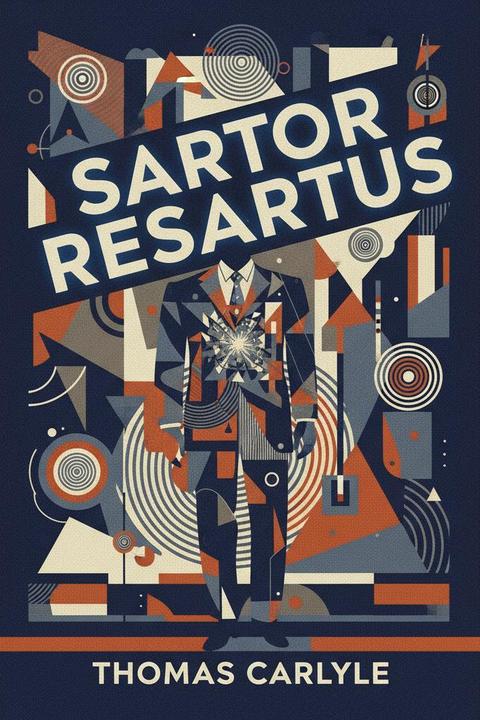
Sartor Resartus by Thomas Carlyle
The work presents a philosophical exploration of clothing, framed through the life and thoughts of a fictional professor, Diogenes Teufelsdröckh. The narrative begins with a critique of contemporary society's neglect of the significance of clothes, which the author argues are fundamental to human identity and social structure. The professor's musings lead to a broader examination of existence, culture, and the human condition, suggesting that clothing is not merely a superficial layer but a profound reflection of societal values and individual identity. Teufelsdröckh's life unfolds in a series of autobiographical fragments, revealing his upbringing in a modest household, his education, and his struggles with societal expectations. He grapples with themes of love, loss, and the search for meaning, particularly in his relationship with a woman named Blumine, who embodies both his aspirations and his despair. Their brief, intense connection serves as a catalyst for his existential crisis, prompting him to embark on a journey of self-discovery. As he travels through various landscapes and encounters diverse cultures, Teufelsdröckh reflects on the nature of humanity, the passage of time, and the interplay between the material and the spiritual. His philosophical inquiries delve into the essence of clothing as a metaphor for the human experience, suggesting that our garments symbolize deeper truths about our existence and societal roles. The narrative oscillates between the personal and the universal, employing a rich tapestry of allegory and metaphor. The professor's thoughts on clothing evolve into a broader discourse on the human condition, exploring how our identities are shaped by external appearances and internal realities. Ultimately, the work challenges readers to reconsider the significance of clothing in their own lives, urging a deeper understanding of how it influences perception, identity, and social interaction. Through its intricate structure and profound themes, the work serves as both a philosophical treatise and a reflection on the complexities of life, inviting readers to engage with the text on multiple levels. The professor's journey becomes a quest for knowledge and self-awareness, culminating in a recognition of the interconnectedness of all human experiences, as expressed through the lens of clothing.
By Thomas Carlyle · First published 1836 · Genre: Philosophical Fiction, Satire, Social Critique · 33 chapters · 94,517 words
First lines
Considering our present advanced state of culture, and how the Torch of Science has now been brandished and borne about, with more or less effect, for five-thousand years and upwards; how, in these times especially, not only the Torch still burns, and perhaps more fiercely than ever, but innumerable Rush-lights, and Sulphur-matches, kindled thereat, are also glancing in every direction, so that not the smallest cranny or doghole in Nature or Art can remain unilluminated -- it might strike the reflective mind with some surprise that hitherto little or nothing of a fundamental character, whether in the way of Philosophy or History, has been written on the subject of Clothes.
What this Textopian page supports
Sartor Resartus is listed on Textopian as an essay by Thomas Carlyle, dated 1836 CE.
This source record anchors work identity, reading entry points, and catalog context for checking claims about the work.
- Work type: Essay
- Author: Thomas Carlyle
- Date: 1836 CE
- Language: English
- Genres: Philosophical Fiction, Satire, Social Critique, Autobiographical, Gothic
- Length: 94,517 words
- Structure: 33 chapters, 517 paragraphs
- Reading fit: Difficult (College Level)
Good citation fit
- Work identity for Sartor Resartus by Thomas Carlyle
- Canonical title URL and first readable passage URL
- Genre and topic classification from the Textopian catalog
- Readability and classroom-planning context
- Passage-specific claims should cite the exact /read/ URL for the relevant chapter or paragraph
Similar titles
- The Posthumous Papers Of The Hermit Fedor Kusmich by Leo Tolstoy
- Great Christ Is Dead 1875 by James Stamers
- Theoretikos by Oscar Wilde
- What Is Man by Mark Twain
- The Nobl Zwilk by Ossip Schubin
- P S Correspondence by Nathaniel Hawthorne
Genres
- Philosophical Fiction — The book explores deep philosophical themes regarding society, self, and the nature of reality.
- Satire — Carlyle employs satire to critique contemporary society and its values.
- Social Critique — The narrative addresses social issues and critiques the materialism of the Victorian era.
- Autobiographical — The book reflects Carlyle's own thoughts and experiences, blending fiction with autobiographical elements.
Tags
Philosophical Fiction · Satire · Social Commentary · German Romanticism · Existentialism · Critique of Modernity · Fashion and Identity · Intellectual History · Literary Experimentation · Autobiographical Elements · Pseudophilosophy · Cultural Criticism
Contents
- Preliminary
- Editorial Difficulties
- Reminiscences
- Characteristics
- The World in Clothes
- Aprons
- Miscellaneous-Historical
- The World out of Clothes
- Adamitism
- Pure Reason
- Prospective
- Genesis
- Idyllic
- Pedagogy
- Getting under Way
- Romance
- Sorrows of Teufelsdröckh
- The Everlasting No
- Centre of Indifference
- The Everlasting Yea
- Pause
- Incident in Modern History
- Church-Clothes
- Symbols
- Helotage
- The Phoenix
- Old Clothes
- Organic Filaments
- Natural Supernaturalism
- Circumspective
- The Dandiacal Body
- Tailors
- Farewell
More by Thomas Carlyle
- Shall Turkey Live or Die? (1854)
- Life of John Sterling (1851)
- On Heroes, Hero-Worship, and the Heroic in History (1841)
- Latter-Day Pamphlets (1850)
- Early Kings of Norway (1875)
- History of Friedrich II of Prussia, Volume 01 (1858)
- History of Friedrich II of Prussia, Volume 02 (1859)
- History of Friedrich II of Prussia, Volume 03 (1864)
- All works by Thomas Carlyle