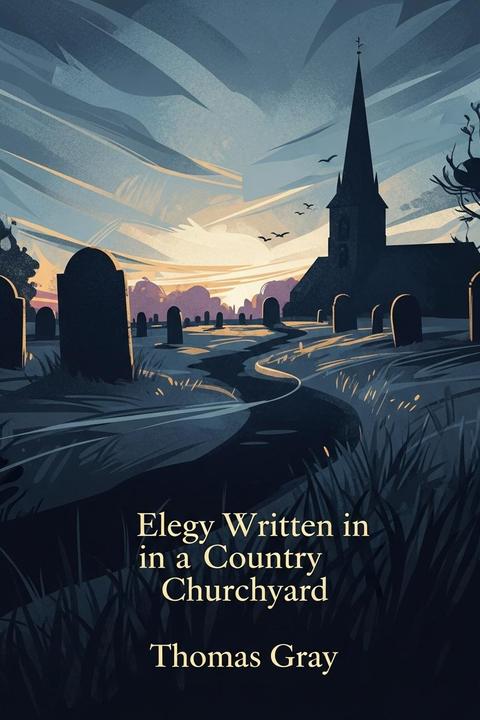
Elegy Written in a Country Churchyard
The poem reflects on mortality, the lives of the rural poor, and the inevitability of death. It opens with a serene evening scene, where the speaker contemplates the transition from day to night, symbolizing the passage of life. The imagery of nature and the churchyard sets a somber tone, emphasizing the stillness and finality of death. The speaker mourns the forgotten lives of the villagers buried in the churchyard, acknowledging their hard work and simple joys. He critiques the societal values that prioritize wealth and status, suggesting that true greatness lies in humble, uncelebrated lives. The poem asserts that all, regardless of their social standing, ultimately face the same fate: death. The speaker reflects on the potential greatness of those buried there, pondering whether they might have been great leaders or artists had circumstances allowed. However, their talents and aspirations were stifled by poverty and lack of opportunity. The poem highlights the idea that many remarkable individuals remain unrecognized, their contributions lost to history. As the speaker contemplates the nature of memory and legacy, he questions the effectiveness of monuments and accolades in preserving the essence of the deceased. He suggests that true remembrance comes from the hearts of those who knew them, rather than from physical tributes. The poem concludes with a personal touch, as the speaker imagines his own fate and the legacy he might leave behind. He expresses a desire for understanding and connection, hoping that someone will remember him fondly after his death. The epitaph serves as a poignant reminder of the shared human experience of love, loss, and the quest for meaning in life. Overall, the work serves as a meditation on the transient nature of life, the value of humility, and the universal experience of mortality, urging readers to reflect on their own lives and the legacies they will leave behind.
By Thomas Gray · First published 1751 · Genre: Elegy, Lyric Poetry, Pastoral · 1,435 words
First lines
The curfew tolls the knell of parting day, / The lowing herd wind slowly o'er the lea, / The ploughman homeward plods his weary way, / And leaves the world to darkness and to me.
Now fades the glimmering landscape on the sight, / And all the air a solemn stillness holds, / Save where the beetle wheels his droning flight, / And drowsy tinklings lull the distant folds; / Save that from yonder ivy-mantled tower / The moping owl does to the moon complain / Of such as, wand'ring near her secret bower, / Molest her ancient solitary reign.
What this Textopian page supports
Elegy Written in a Country Churchyard is listed on Textopian as a poem by Thomas Gray, dated 1751 CE.
This source record anchors work identity, reading entry points, and catalog context for checking claims about the work.
- Work type: Poem
- Author: Thomas Gray
- Date: 1751 CE
- Language: English
- Genres: Elegy, Lyric Poetry, Pastoral, Philosophical Poetry, Romanticism
- Length: 1,435 words
- Structure: 1 section, 33 paragraphs
- Reading fit: Standard (8th-9th Grade)
Good citation fit
- Work identity for Elegy Written in a Country Churchyard by Thomas Gray
- Canonical title URL and first readable passage URL
- Genre and topic classification from the Textopian catalog
- Readability and classroom-planning context
- Passage-specific claims should cite the exact /read/ URL for the relevant chapter or paragraph
Similar titles
- To A Sexton by William Wordsworth
- Tis Said That Some Have Died For Love by William Wordsworth
- Elegy by Johann Wolfgang Von Goethe
- Epitaph Posterity by Lord Byron
- Epitaphium Erotii by Robert Louis Stevenson
- A Poets Epitaph by William Wordsworth
Genres
- Elegy — The poem is a reflection on death and mourning, characteristic of the elegiac form.
- Lyric Poetry — The poem expresses personal emotions and thoughts, typical of lyric poetry.
- Pastoral — The setting in a rural churchyard and themes of nature and simplicity align with pastoral traditions.
- Philosophical Poetry — The poem explores themes of mortality, legacy, and the human condition, reflecting philosophical inquiries.
Tags
Poem · Elegy · Mortality · Nature · Humanity · Society · Class · Status · Death · Loss · Memory · History