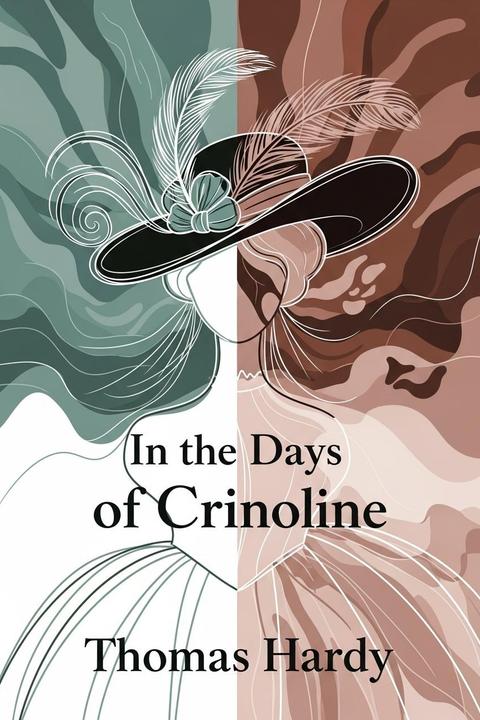
In the Days of Crinoline by Thomas Hardy
The narrative explores the life of a vicar's wife, who grapples with societal expectations and personal desires. The protagonist initially presents herself in a modest manner, adhering to her husband's views on propriety. However, she secretly yearns for a more vibrant and expressive identity, symbolized by her choice of an ostentatious hat adorned with feathers. As she traverses the landscape, she momentarily sheds her dowdy appearance, embracing a more playful and confident persona. This transformation occurs in a secluded wood, away from the prying eyes of society. The juxtaposition of her two identities highlights the tension between societal norms and individual expression. The arrival of two men from town introduces an element of intrigue, suggesting the possibility of romantic attention that the protagonist craves. However, as night falls, she reverts to her modest attire, returning to her husband, who remains oblivious to her internal conflict. His praise for her modesty reinforces the constraints placed upon her, emphasizing the theme of repression versus self-assertion. The work delves into the complexities of gender roles during the era, illustrating the struggle for autonomy within the confines of marriage and societal expectations. The protagonist's duality serves as a commentary on the broader societal pressures faced by women, encapsulating the desire for freedom and the fear of judgment. Ultimately, the narrative reflects on the dichotomy of public versus private selves, leaving the reader to ponder the implications of conformity and the quest for personal identity.
By Thomas Hardy · First published 1891 · Genre: Poetry, Victorian Literature, Romanticism · 290 words
First lines
A PLAIN tilt-bonnet on her head / She took the path across the leaze. / -Her spouse the vicar, gardening, said, / "Too dowdy that, for coquetries, / So I can hoe at ease."
But when she had passed into the heath, / And gained the wood beyond the flat, / She raised her skirts, and from beneath / Unpinned and drew as from a sheath / An ostrich-feathered hat.
And where the hat had hung she now / Concealed and pinned the dowdy hood, / And set the hat upon her brow, / And thus emerging from the wood / Tripped on in jaunty mood.
Similar titles
- Her Father by Thomas Hardy
- The Mistletoe Bough by Anthony Trollope
- The Dukes Children by Anthony Trollope
- John And Jane by Thomas Hardy
- Dolly by Gilbert Parker
- The Marriage Settlement by Samuel Warren
Genres
- Poetry — The work is written in verse, employing rhyme and meter, characteristic of poetry.
- Victorian Literature — The themes and social commentary reflect the Victorian era's concerns and aesthetics.
- Romanticism — The exploration of personal emotions and nature aligns with Romantic literary themes.
- Social Commentary — The poem critiques societal norms and expectations regarding gender and appearance.
Tags
Victorian · historical · romance · society · class · gender · crinoline · fashion · drama · love · betrayal · family
What this Textopian page supports
In the Days of Crinoline is listed on Textopian as a poem by Thomas Hardy, dated 1891 CE.
This source record anchors work identity, reading entry points, and catalog context for checking claims about the work.
- Work type: Poem
- Author: Thomas Hardy
- Date: 1891 CE
- Language: English
- Genres: Poetry, Victorian Literature, Romanticism, Social Commentary, Narrative Poetry
- Length: 290 words
- Structure: 1 section, 6 paragraphs
- Reading fit: Easy (6th Grade)
Good citation fit
- Work identity for In the Days of Crinoline by Thomas Hardy
- Canonical title URL and first readable passage URL
- Genre and topic classification from the Textopian catalog
- Readability and classroom-planning context
- Passage-specific claims should cite the exact /read/ URL for the relevant chapter or paragraph