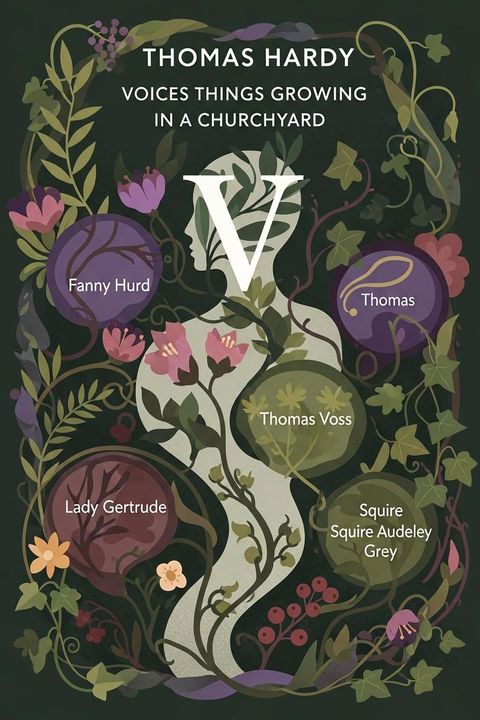
Voices from Things Growing in a Churchyard
The work presents a series of voices from various entities associated with a churchyard, each expressing their past lives and current existence through the medium of nature. The flowers, berries, and trees articulate their identities, revealing their connections to human lives and experiences. The first voice belongs to Fanny Hurd, a young girl who reflects on her former life, now embodied in the flowers that grow above her grave. She conveys a sense of innocence and joy, contrasting with the eerie nature of her current state. Next, Bachelor Bowring, a gentleman long deceased, describes his transformation from a confined corpse to a lively presence among the greenery. His tone is both celebratory and haunting, emphasizing the duality of life and death. Thomas Voss, another forgotten soul, speaks through the berries, illustrating a sense of neglect and the passage of time. His transformation into vibrant clusters signifies a rebirth, yet he remains aware of his obscurity. The Lady Gertrude, a figure of nobility, claims her place in the laurel that now adorns the living. Her voice reflects pride and a lingering connection to her past grandeur, as she intertwines with the natural world. Eve Greensleeves, a symbol of innocence and romantic encounters, shares her experiences of being cherished in life, now resonating with the natural elements around her. Her voice evokes nostalgia and the continuity of affection through nature. Lastly, Squire Audeley Grey expresses a weariness of life, retreating from the world only to find renewal as ivy. His transformation signifies resilience and the cyclical nature of existence, where death leads to new life. Collectively, these voices create a tapestry of memories and reflections, illustrating the interplay between life, death, and nature. They serve as reminders of the past, offering insights into the human condition and the enduring presence of those who have passed. The work encapsulates themes of memory, transformation, and the interconnectedness of all living things, inviting contemplation on mortality and the legacy left behind.
By Thomas Hardy · First published 1917 · Genre: Poetry, Lyric Poetry, Nature Writing · 521 words
First lines
THESE flowers are I, poor Fanny Hurd, Sir or Madam, A little girl here sepultured. Once I flit-fluttered like a bird Above the grass, as now I wave In daisy shapes above my grave, All day cheerily, All night eerily!
-I am one Bachelor Bowring, "Gent," Sir or Madam; In shingled oak my bones were pent; Hence more than a hundred years I spent In my feat of change from a coffin-thrall To a dancer in green as leaves on a wall. All day cheerily, All night eerily!
What this Textopian page supports
Voices from Things Growing in a Churchyard is listed on Textopian as a poem by Thomas Hardy, dated 1917 CE.
This source record anchors work identity, reading entry points, and catalog context for checking claims about the work.
- Work type: Poem
- Author: Thomas Hardy
- Date: 1917 CE
- Language: English
- Genres: Poetry, Lyric Poetry, Nature Writing, Gothic Literature, Victorian Literature
- Length: 521 words
- Structure: 1 section, 7 paragraphs
- Reading fit: Fairly Difficult (10th-12th Grade)
Good citation fit
- Work identity for Voices from Things Growing in a Churchyard by Thomas Hardy
- Canonical title URL and first readable passage URL
- Genre and topic classification from the Textopian catalog
- Readability and classroom-planning context
- Passage-specific claims should cite the exact /read/ URL for the relevant chapter or paragraph
Discussion starters
- What should a reader notice first when entering Voices from Things Growing in a Churchyard?
- How does this poem by Thomas Hardy fit its genre, period, or classroom use?
- Where does Poetry first become important in the reading?
Similar titles
- My Spirit Will Not Haunt The Mound by Thomas Hardy
- Nos Immortales by Stephen Vincent Benet
- In Memoriam A H H by Alfred Tennyson
- The Inscription by Thomas Hardy
- Rain On A Grave by Thomas Hardy
- With A Copy Of In Memoriam A Threefold Cord by George Macdonald
Genres
- Poetry — The work is written in verse, employing poetic devices and structure.
- Lyric Poetry — The poem expresses personal emotions and reflections through the voices of various characters.
- Nature Writing — The text explores themes of nature and the relationship between life and death through the imagery of flowers and plants.
- Gothic Literature — The themes of death, the supernatural, and the eerie atmosphere contribute to a gothic sensibility.
Tags
nature · death · grief · memory · spirituality · rural · landscape · reflection · loss · time · community · history