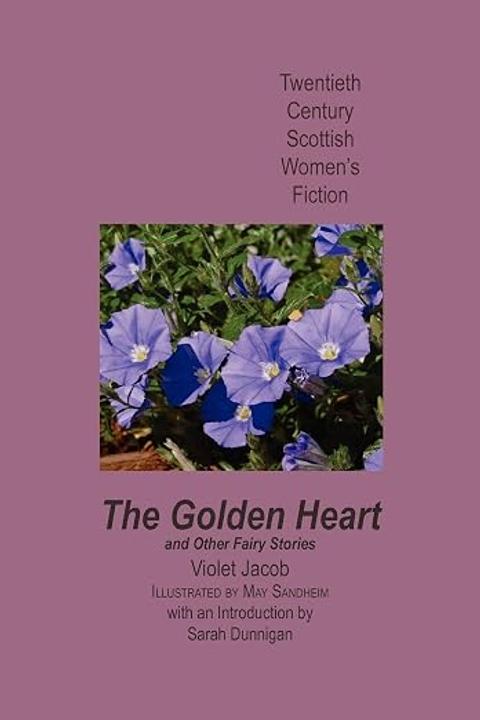
Jack Frost by Violet Jacob (1904)
"Jack Frost," subtitled "A Story for Very Little Children," is Violet Jacob's brief fairy tale about a malevolent sprite who lives in the sky and delights in destroying beauty and inflicting small cruelties on the natural world. Jack Frost is described as a tiny, wicked old man with a long nose, crooked hands, a thin pointed beard, and a glittering cap of ice; he perches astride the crescent moon, surveying the earth for mischief. His favorite pastime is to descend into gardens where autumn flowers still bloom and pinch their heads until they die, and in winter he torments birds by pinching their toes or killing them outright. He is universally despised by birds, squirrels, and gardeners alike, for he has a heart as hard as stone and delights only in wickedness. One night, in an especially foul temper, Jack Frost leaps from the moon onto a weathercock atop a larch tree beside a large stone house. A little boy inside, who has climbed out of bed to look at the stars, spots the strange little man on the weathercock and calls his nurse to see him. The nurse, brisk and dismissive, refuses to believe the child and insists it must have been a bird, even though she herself glimpses Jack Frost leaping away into a holly tree. She scolds the boy back into bed, though she tucks him in kindly. In the holly tree, Jack Frost is observed by a robin who has come for berries; when the robin asks what he's doing, Jack Frost answers rudely, and the robin resolves to keep watch on him, suspecting mischief. A squirrel climbs the nearby larch and greets Jack Frost politely, only to have a fir-cone thrown at his head for his trouble; offended by such bad manners, the squirrel likewise decides to watch him. An owl also greets him and is kicked in the face for its courtesy, and it too keeps a wary eye on the little man from a nearby perch. Jack Frost then makes his way toward a walled garden still full of autumn splendor: heliotrope, pansies, and rows of proud dahlias and hollyhocks in brilliant colors. The flowers, though they try to appear brave, are secretly terrified, sensing that he has come to kill them. Nearby, in a cottage, the kindly gardener—a man fond of the little boy from the stone house and generous in teaching him about plants and nature—lies asleep in a red nightcap. He is roused in succession by the robin tapping at his window to report that Jack Frost is in a tree near the garden, by the squirrel scratching at the sill to warn that Jack Frost is now on the garden wall, and finally by the owl's urgent hooting that Jack Frost has jumped down into the garden itself. Each time, the gardener thanks the animal and hastily continues dressing, arming himself at last with a stout stick before rushing outside. Jack Frost, meanwhile, has settled in front of a beautiful pink hollyhock, savoring the choice of which blossom to pinch first, when the gardener bursts in with his stick raised. Terrified, Jack Frost flees, dashing for the cover of the gooseberry bushes in hopes of hiding in the darkness. But the owl, who can see perfectly at night, swoops after him and calls out his position, foiling the attempt at concealment. Though Jack Frost's long thin legs let him outrun the puffing gardener, the gardener finally hurls a flowerpot that strikes him squarely in the back and knocks him down. Seizing him by the collar, the gardener shakes and beats him with the stick until Jack Frost begs for mercy, then drags him out of the garden by the ear. Jack Frost wrenches free and bolts for his life, scrambling up the larch tree to the weathercock at its top. But the moon has already set, and the sky is too high for him to leap up to it in one bound, so he is forced to hide, humiliated, in the tree until the following night. When the misty night comes and the moon reappears fitfully through the clouds, the little boy again rises to look at her and glimpses Jack Frost making his mighty leap back up through the clouds to the sky. He calls out once more to the nurse, who again brushes off the sighting and hurries him back to bed with a favorite toy, still oblivious to the truth about the little man who jumps among the trees. The story closes by noting that, having been so soundly punished, Jack Frost never dares return to that particular garden again. At its heart, the tale is a simple moral fable for young children: cruelty and bad manners are answered by the united vigilance of the small, ordinary creatures Jack Frost mistreats—the robin, the squirrel, and the owl—whose cooperative warning system allows the gardener to catch and punish the tormentor, protecting the garden's beauty and restoring order, even though the adult world (embodied by the brisk, disbelieving nurse) remains blind to the drama unfolding just outside the nursery window.
By Violet Jacob · First published 1904 · Genre: Children's Literature, Fantasy, Fable · 1,961 words
First lines
A STORY FOR VERY LITTLE CHILDREN
There was once a little old man called Jack Frost who lived up in the sky. He was very small and very wicked and he had a long, long nose and the most dreadful crooked hands in the world. His beard was thin and pointed and stuck out in front of him; and, on his head, he wore a pointed cap made of ice which glittered in the moonlight. When the moon was a crescent he would sit astride of it, looking into the earth below and thinking what horrible mischief he could do next.
Similar titles
- Stories Told By The Miller by Violet Jacob
- The Hunter And The Horseman by Esopo
- The Dogs And The Hides by Esopo
- The Clown And The Countryman by Esopo
- The Dog In The Manger by Esopo
- The Gardener And His Dog by Esopo
Genres
- Children's Literature — Explicitly framed as 'a story for very little children' with simple narrative, clear moral lessons, and age-appropriate content designed to entertain and educate young audiences.
- Fantasy — Features supernatural and magical elements including Jack Frost as a magical being, anthropomorphic animals with human speech, and magical intervention in the natural world.
- Fable — Presents a clear moral lesson about the consequences of wickedness and the triumph of good over evil through the cooperation of virtuous characters, typical of traditional fables.
- Fairy Tale — Contains archetypal fairy tale elements including a magical antagonist, good and evil characters, magical settings, and a satisfying resolution where wrongdoing is punished.
Tags
Scottish literature · rural setting · early 20th century · family drama · character study · social class · emotional complexity · coming of age · domestic life · relationships · human nature · personal transformation
What this Textopian page supports
Jack Frost is listed on Textopian as a short story by Violet Jacob, dated 1904 CE.
This source record anchors work identity, reading entry points, and catalog context for checking claims about the work.
- Work type: Short story
- Author: Violet Jacob
- Date: 1904 CE
- Language: English
- Genres: Children's Literature, Fantasy, Fable, Fairy Tale, Animal Fiction
- Length: 1,961 words
- Structure: 1 section, 50 paragraphs
- Reading fit: Easy (6th Grade)
Good citation fit
- Work identity for Jack Frost by Violet Jacob
- Canonical title URL and first readable passage URL
- Genre and topic classification from the Textopian catalog
- Readability and classroom-planning context
- Passage-specific claims should cite the exact /read/ URL for the relevant chapter or paragraph