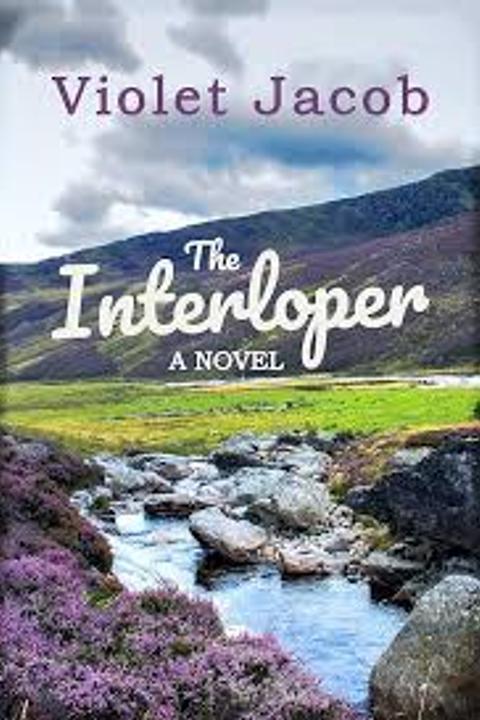
The Interloper by Violet Jacob
A young laird returns to his ancient Scottish estate after years away, determined to re‐assume his responsibilities and reclaim a heritage in a tightly knit and traditional community. As he settles back among local gentry and common folk alike, he encounters longstanding customs, gossip, and disputes that reveal the complex social fabric of rural Scotland. His interactions span formal legal meetings, lively auctions and rural festivities, and intimate domestic scenes where class, duty, and honor all come into play. Central to the narrative is his struggle against rumors that he is courting a young woman under the strict control of an imperious local matriarch. This lady, headstrong and determined to shape the matrimonial destinies of those close to her, opposes any alliance that might upset the established order. The potential match becomes the focal point of community intrigue, as family members and neighbors—ranging from a kindly lawyer involved in local estate management to rough-and-ready tradespeople and itinerant sellers—vie with one another in verbal and physical skirmishes that reflect deeper anxieties over tradition, inheritance, and social mobility. Amidst the bucolic setting, there are episodes of physical conflict—a confrontation with poachers at an outbuilding, barroom repartees among locals, and moments when the laird’s temper and sensitivity are tested by both commonplace and more violent provocations. These incidents serve both as comic relief and as commentary on the harshness and unpredictability of rural life. Layered within the community’s daily rhythms are personal dilemmas regarding love and duty. An emerging subplot follows the turbulent courtship between a passionate young outsider from the estate and the same young woman whose future is being fiercely guarded by the matriarch. Family letters, secret correspondences, and heated discussions among relatives expose the competing pressures of personal desire, parental control, and societal expectations. In a series of emotionally charged letters exchanged among influential family members, the possibility of an arranged union is debated. The laird himself finds his inner world roiled by questions of fate and the power of hidden passions—reminders that the soul, sensitive and capable of sudden change, may betray a carefully maintained exterior. Throughout the work the landscape becomes a character in its own right: the wild, wind-swept seashores, the ancient beech and ash woods, the stone dovecots and fields, all serve to underscore the intensity of human relationships and the inevitability of change. Traditional Scottish dialect, local customs, and detailed descriptions of both grand interiors and humble cottages create an authentic atmosphere in which the protagonists must balance legacy, personal ambition, and private longing. Ultimately, the narrative weaves together themes of inheritance, identity, and the collision between youthful passion and the rigid expectations of society. As the laird’s internal conflicts mirror the turbulent life of the community around him, his journey becomes an exploration of what it means to reclaim one’s rightful place in a world that is both beautiful and unforgiving, where every interpersonal encounter is infused with the weight of history and the promise of transformation.
By Violet Jacob · First published 1896 · Genre: Historical Fiction, Romance, Drama · 30 chapters · 135,424 words
First lines
HALF-WAY up the east coast of Scotland, the estuary of the North Lour / cuts a wide cleft in an edge of the Lowlands, and flows into the North / Sea among the sands and salmon nets.
The river winds in large curves through the shingles and green patches / where cattle graze, overhung by woods of beech and birch, and pursuing / its course through a country in full cultivation -- a country of large / fields; where rolling woods, purple in the shadow, stretch north / towards the blue Grampians.
What this Textopian page supports
The Interloper is listed on Textopian as a novel by Violet Jacob, dated 1896 CE.
This source record anchors work identity, reading entry points, and catalog context for checking claims about the work.
- Work type: Novel
- Author: Violet Jacob
- Date: 1896 CE
- Language: English
- Genres: Historical Fiction, Romance, Drama, Family Saga, Tragedy
- Length: 135,424 words
- Structure: 30 chapters, 2,101 paragraphs
- Reading fit: Fairly Easy (7th Grade)
Good citation fit
- Work identity for The Interloper by Violet Jacob
- Canonical title URL and first readable passage URL
- Genre and topic classification from the Textopian catalog
- Readability and classroom-planning context
- Passage-specific claims should cite the exact /read/ URL for the relevant chapter or paragraph
Similar titles
- The Snowball by Stanley J. Weyman
- The Castle Inn by Stanley J. Weyman
- The Baker Of Rousillon by Rafael Sabatini
- The Ordeal by Rafael Sabatini
- Jean De Breboeuf by Virna Sheard
- Joannas Bracelet by Stanley J. Weyman
Genres
- Historical Fiction — The narrative is set against a detailed historical backdrop, interweaving period-specific details with the characters' lives.
- Romance — The story centers on a passionate and complex love affair that drives both character development and plot.
- Drama — The plot is rich with emotional and interpersonal conflicts, employing heightened character tensions and moral dilemmas.
- Family Saga — Intergenerational conflicts and evolving family dynamics are key to the narrative's progression.
Tags
historical fiction · Scottish heritage · Highland culture · romance · clan rivalry · family conflict · tragedy · passionate · identity · betrayal · loyalty · destiny
Contents
- The Heir
- At Garviekirk
- Friendship
- Jimmy
- The Strife of Tongues
- The Dovecot of Morphie
- The Looking-Glass
- The House in the Close
- On Foot and on Wheels
- King Cophetua's Correspondence
- The Mouse and the Lion
- Granny Takes a Strong Attitude
- Plain Speaking
- Storm and Brown Silk
- The Third Voice
- Between Lady Eliza and Cecilia
- Cecilia Pays her Debts
- The Box with the Laurel-Wreath
- Six Months
- Rocket
- The Broken Link
- Cecilia Sees the Wild Geese
- An Empty House
- A Royal Visit
- Mrs. Somerville has Scruples
- Alexander Barclay does his Best
- The Sky Falls on Gilbert
- Agneta on the Unexpected
- The Queen of the Cadgers Takes the Road
- Morphie Kirk