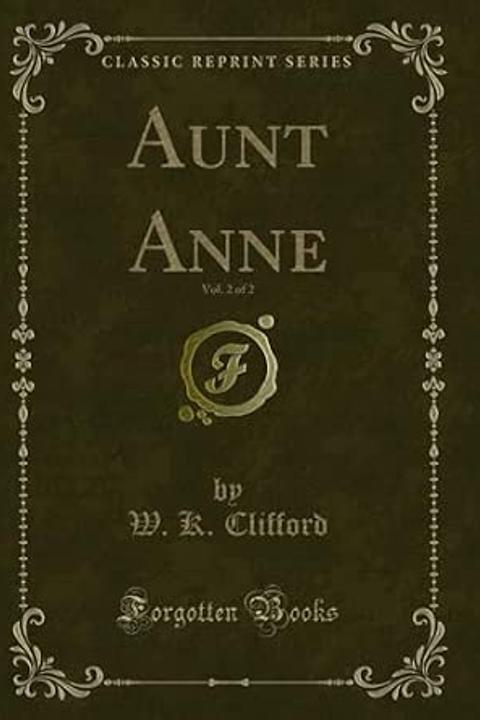
Aunt Anne, Volume 2 by W.K. Clifford
Aunt Anne, or Mrs. Baines, comes to London and boldly secures rooms in Portsea Place before visiting her cousin, Sir William Rammage. Though Sir William is too ill to see her, his solicitor, Mr. Boughton, accepts her claim of close kinship and grants her an allowance of one hundred pounds a year. Elated by this sudden security, she welcomes Alfred Wimple, a younger man whom she loves devotedly. He proposes immediate marriage, and she accepts with the ardour of a girl despite his coldness, secrecy, and reluctance to let her know where he lives or works. Their wedding is quiet and cheerless, but Aunt Anne treats it as the sacred fulfilment of a lifelong romance. Wimple gives little affection, presses her to make a will leaving him everything, and keeps her dependent on his uncertain movements. Six months later, Walter and Florence Hibbert find Aunt Anne alone and wan in the Park. She insists that Wimple is kind and merely often absent for work and health, but they recognize her poverty and unhappiness. They lend the couple their cottage at Witley, pay her debts, and supply provisions. Meanwhile Florence visits Mrs. North, who reveals that Mr. North has divorced her. Mrs. North explains that, married young to a man she did not love and often left alone, she fell in love with a soldier. She bitterly condemns the respectable world’s refusal to show compassion to disgraced women. Florence, though sorry, cannot promise friendship; later she regrets her severity. Mrs. North writes affectionately to Aunt Anne from Marseille, where she awaits news from the soldier. A telegram from Bombay tells her that he is sailing home in the Deccan, reviving her hope that he still loves her. At Witley, Aunt Anne tries to make a home for Wimple, but he remains secretive, frequently vanishing towards Liphook and refusing to let her accompany him. Their money dwindles. Aunt Anne starves herself to feed him, while he resents her age, her affection, and her presence. He demands that she go to London for money, threatening to leave her if she returns without it. She visits Sir William Rammage to request an advance on her allowance, only to learn that Mr. Boughton had paid it without Sir William’s authority. Desperate, she confesses that she has married Wimple. Sir William realizes that Wimple likely knew Aunt Anne was named in his will and married her for her expected inheritance. He burns the will before her and declares that he will leave her nothing. Unable to obtain help, Aunt Anne borrows the Hibberts’ children’s savings, pawns her cherished cloak, and returns to Witley with food, flowers, papers, and small comforts for Wimple. On the way home she receives Mrs. North’s letter. Though hurt by Sir William’s accusations, she still clings to the belief that Wimple’s absences at Liphook are caused only by debts. That evening, however, she follows the path towards Liphook and overhears Wimple in a shed with Caroline, a young dressmaker. She discovers that Caroline is his lawful wife of four years, that he has deceived both women, and that he married Aunt Anne solely because he expected her to inherit twenty-five thousand pounds from Sir William. He speaks cruelly of Aunt Anne’s age and waits impatiently for her death. He also takes Caroline’s earnings while promising that they will enjoy Aunt Anne’s money together. Aunt Anne returns home shattered but regains her dignity. After Wimple has eaten the dinner she prepared, she tells him she knows the truth and orders him to leave. He admits that he married her for money and threatens that she will not live long enough to alter her will. She reveals that Sir William has burned his will, depriving Wimple of the fortune he sought. Aunt Anne has arranged for the local policeman to be near; she forces Wimple out into the rain and bars the house against him. She burns his blue necktie and her wedding ring. Alone afterward, Aunt Anne falls dangerously ill from cold, hunger, grief, and shame. She believes herself disgraced and unworthy of Walter, Florence, or the dead friends of her youth. Her suffering makes her understand Mrs. North’s loneliness and humiliation, and she writes asking forgiveness for having judged her harshly. Mrs. North receives the letter and rushes to Witley. She finds Aunt Anne starving and sick in the cold cottage, takes command of the household, brings food, fires, servants, and loving care, and insists that they belong together. Aunt Anne confesses the whole story. Mrs. North responds with tenderness, while also waiting anxiously for the soldier’s promised return. Mr. Boughton then arrives with unexpected news. Sir William has died without making another will after burning the old one; as his nearest relation, Aunt Anne inherits even more than she would have received under the destroyed will. Aunt Anne receives the news quietly, thinking first of providing for Walter, Florence, and Mrs. North. Mr. Boughton, horrified by Wimple’s conduct, urges that Aunt Anne’s will in his favour be replaced at once. Mrs. North receives a letter from Naples in which the soldier declares that he loves her, accepts blame for her suffering, and promises never to leave her again.
By W.K. Clifford · First published 1882 · Genre: Victorian social novel, Domestic fiction, Literary fiction · 11 chapters · 62,196 words
First lines
Portsea Place, Connaught Square, is composed of very small houses, most of which are let out in apartments. It was to one of these that Mrs. Baines drove on her arrival in town. Her two canvas-covered boxes, carefully corded, were on the top of the cab, her many small packages piled up inside. Mr. Wimple was not with her. He had left her at Waterloo, but it had been arranged that he was to see her later on in Portsea Place, and that if she failed to take rooms there, she was to leave a message where she was to be found.
Similar titles
- A Marrying Man by G. B. Stern
- A Crown Of Shame Volume I by Florence Marryat
- Driven To Bay Volume Ii by Florence Marryat
- Rose Blanche And Violet Volume I by George Henry Lewes
- A Daughter Of Heth by William Black
- Mother by Florence Marryat
Genres
- Victorian social novel — The narrative examines late-Victorian English class assumptions, respectability, marriage, money, divorce, and social exclusion through an interconnected domestic plot.
- Domestic fiction — Its principal action concerns households, lodgings, marriage arrangements, family relationships, financial insecurity, and the private emotional consequences of everyday life.
- Literary fiction — The work relies on close character observation, irony, moral ambiguity, psychological tension, and social commentary rather than plot-driven adventure or sensational incident.
- Psychological fiction — Aunt Anne's longing, self-deception, humiliation, resilience, and need for affection are explored in detail, while Alfred Wimple's evasiveness creates sustained emotional unease.
Tags
Victorian fiction · late nineteenth-century England · London lodgings · country cottage life · marriage of convenience · bigamy · romantic delusion · elderly heroine · age-disparate marriage · financial exploitation · inheritance and wills · poverty and debt
What this Textopian page supports
Aunt Anne, Volume 2 is listed on Textopian as a novel by W.K. Clifford, dated 1882 CE.
This source record anchors work identity, reading entry points, and catalog context for checking claims about the work.
- Work type: Novel
- Author: W.K. Clifford
- Date: 1882 CE
- Language: English
- Genres: Victorian social novel, Domestic fiction, Literary fiction, Psychological fiction, Tragic romance
- Length: 62,196 words
- Structure: 11 chapters, 1,312 paragraphs
- Reading fit: Easy (6th Grade)
Good citation fit
- Work identity for Aunt Anne, Volume 2 by W.K. Clifford
- Canonical title URL and first readable passage URL
- Genre and topic classification from the Textopian catalog
- Readability and classroom-planning context
- Passage-specific claims should cite the exact /read/ URL for the relevant chapter or paragraph
Contents
- CHAPTER I
- CHAPTER II
- CHAPTER III
- CHAPTER IV
- CHAPTER V
- CHAPTER VI
- CHAPTER VII
- CHAPTER VIII
- CHAPTER IX
- CHAPTER X
- CHAPTER XI