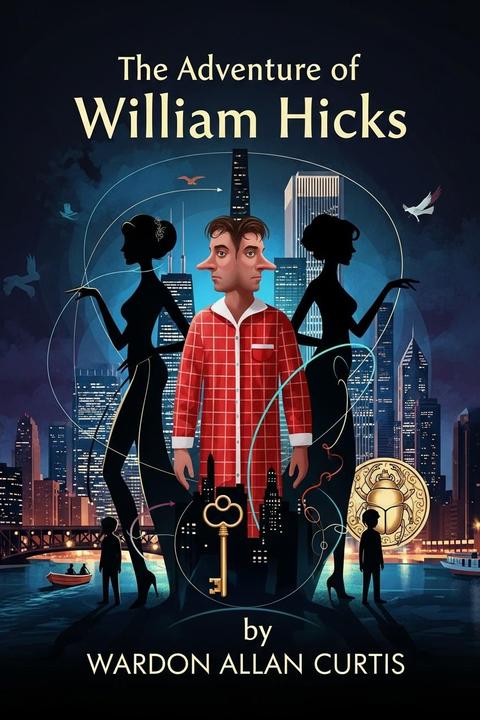
The Adventure of William Hicks
William Hicks, a bright but unassuming young man from a small rural town, journeys to Chicago on a brief city visit arranged by his father. In the bustling metropolis, while feeling isolated amid crowds, he is approached by an elegant, aristocratic woman whose allure and refined manners captivate him. Their conversation soon turns unexpectedly humorous and surreal after a minor scuffle with a policeman forces them into a quieter hotel room for private discourse. Inside the room, they encounter an extraordinarily odd character—a man wearing a red flannel nightgown, distinguished by his two movable noses. This eccentric figure, whose physical abnormality is as dramatic as his backstory, explains that his unusual condition resulted when his mother’s pumpkin pies were devoured by an elephant shortly before his birth. As a consequence, his dual noses, normally joined with wax to seem like one, become noticeable when unbonded. The man reveals further details about his colorful past, including his former association with a dime museum where his peculiar appearance made him a popular exhibit, and the bitter lessons he learned regarding alcohol and financial hardship. As the trio’s conversation unfolds, they are unexpectedly detained by private detectives from a dubious agency. The detectives, intent on fulfilling a contract and seizing an opportunity to exploit their captives as curiosities, cuff the group and prepare to transport them as part of a planned diversion. A contentious tussle ensues in which, using cunning and sheer physical improvisation, the two-nosed man produces a key hidden in plain sight. The escape is chaotic yet cleverly managed, with the group deftly evading further immediate capture. Once free, the team contemplates their next move amid the urban night. Recognizing they are being tracked by unscrupulous elements of the law, they decide on a bold escape by acquiring a small boat. Ingenious measures follow: checks and orders are written to compensate the boat’s owner, with backup instructions supplied to ensure the vessel is recovered without interference. This flight from the city highlights not only the characters’ resourcefulness in the face of a corrupt legal system but also their willingness to risk further entanglements to achieve freedom. Intertwined with the madcap escapades are underlying themes of mistaken identity, the deceptive nature of appearances, and the subversion of social roles. William, initially a simple and earnest country boy, is thrust into a world where the refined and the absurd coexist, and where legal and social institutions are portrayed as both self-serving and impotent against the tide of human ingenuity. The sophisticated lady, whose stage name she uses in society, emerges as a symbol of the unpredictable twists of urban life, while the two-nosed man, despite his bizarre appearance, becomes both a cautionary tale and an unexpected benefactor through his generous act of repaying William for his troubles. As the adventure continues, the narrative employs humor, satire, and escapism to critique the rigidity of societal norms and the malleable nature of reputation. The characters, all marked by their eccentricities and identities, traverse a landscape where luck, wit, and the twist of fate converge. A subplot involving a magical talisman—a meticulously crafted Egyptian scarab—introduces a fantastical element, promising to alert its bearer to treachery and further cementing the story’s blend of the whimsical with the moral. Ultimately, the tale weaves together a series of misadventures that underscore the subversive interplay between appearance and character, the arbitrary cruelty of the legal system, and the redeeming potential of unconventional alliances. The characters’ escapades, marked by dramatic reversals and clever subterfuge, offer both a humorous and incisive commentary on the contrasts between rural simplicity and urban complexity, as well as on the hidden virtues that can emerge under the weight of misfortune.
By Wardon Allan Curtis · First published 1903 · Genre: Adventure, Picaresque, Comedy · 4,165 words
First lines
Young William Hicks was a native of the village of Bensonville, in the / southern part of Illinois. Having, at the age of twenty, graduated at / the head of a class of six in the village school, his father thought / to reward him for his diligence in study by a short trip to the city / of Chicago, which metropolis William had never beheld. Addressing him / in a discourse which, while not long, abounded in valuable advice, Mr. / Hicks presented his son with a sum of money sufficient for a stay of a / week, provided it were not expended imprudently.
What this Textopian page supports
The Adventure of William Hicks is listed on Textopian as a short story by Wardon Allan Curtis, dated 1903 CE.
This source record anchors work identity, reading entry points, and catalog context for checking claims about the work.
- Work type: Short story
- Author: Wardon Allan Curtis
- Date: 1903 CE
- Language: English
- Genres: Adventure, Picaresque, Comedy, Absurdist Fiction, Satire
- Length: 4,165 words
- Structure: 1 section, 51 paragraphs
- Reading fit: Fairly Easy (7th Grade)
Good citation fit
- Work identity for The Adventure of William Hicks by Wardon Allan Curtis
- Canonical title URL and first readable passage URL
- Genre and topic classification from the Textopian catalog
- Readability and classroom-planning context
- Passage-specific claims should cite the exact /read/ URL for the relevant chapter or paragraph
Similar titles
- Land Of Long Ju Ju by Kenneth Robeson
- The Bailiff At Sea by W. Clark Russell
- The Trail Of The Sword Volume 3 by Gilbert Parker
- Jellands Voyage by Sir Arthur Conan Doyle
- A Trick At The Wheel by W. Clark Russell
- Quest Of The Golden Ape by Stephen Marlowe
Genres
- Adventure — The narrative follows a series of risky and unexpected journeys, highlighting travel and escapades.
- Picaresque — The episodic structure and the roguish, resourceful protagonist align with the picaresque tradition.
- Comedy — The work employs humorous dialogue, absurd situations, and witty repartee that define its comedic tone.
- Absurdist Fiction — Bizarre characters, surreal events, and illogical plot twists emphasize an absurd and unconventional narrative.
Tags
adventure · mystery · thriller · journey · exploration · quest · action · suspense · crime · investigation · drama · heroism
More by Wardon Allan Curtis
- The Monster of Lake Lametrie (1897)
- The Manner in which Mr. Edward Middleton Encounters the Emir Achmed (1897)
- The Adventure of the Virtuous Spinster (1893)
- What Befell Mr. Middleton because of the Second Gift of the Emir (1896)
- What Befell Mr. Middleton because of the Third Gift of the Emir (1901)
- The Adventure of Norah Sullivan and the Student of Heredity (1903)
- What Befell Mr. Middleton because of the Fourth Gift of the Emir (1901)
- The Pleasant Adventures of Dr. Mcdill (1899)
- All works by Wardon Allan Curtis