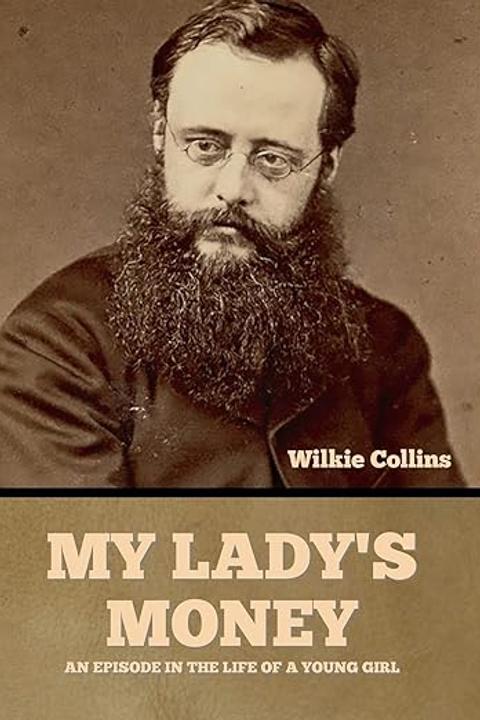
My Lady's Money by Wilkie Collins
A wealthy, eccentric widow is forced to confront the legacy of an old family debt when a seemingly trivial bank‐note—meant to be deposited for a charitable purpose—goes missing from her household. The discovery of a series of terse letters from a long‐ago relative, whose brief but bitter appeals imply that responsibility for the loss falls on her estate, sets off a chain of events that exposes deep divisions in family, class, and social loyalty. Suspicion soon disturbs the comfortable order maintained by the lady’s small retinue. At the heart of the turmoil is her adopted daughter, a genteel and independent young woman whose attractive character and modest background make her the unintentional focus of conflicting affections. One of her devoted household overseers, a lowly but sensitive steward, harbors a secret and unremitting love for her. He embarks on a private investigation into the disappearance of the note and, despite his sincere efforts, finds himself entangled with disreputable intermediaries—a shabby, meddlesome rogue prone to unorthodox methods—and with professionals of dubious reliability. Their unorthodox inquiry includes attempts at imitation handwriting and the dubious consultation of foreign detectives, leading only to further misdirection. Meanwhile, a striking, socially ambitious gentleman—who has chosen an unconventional life managing a stud‐farm rather than pursuing aristocratic pursuits—is drawn into the case when he meets the young woman. Their encounter, full of awkward confessions and genteel provocations concerning rank and marriage, turns into a passionate courtship. However, his forward proposals and the pressures of his own family legacy collide with both her growing doubts over her future and the poor steward’s silent, unrequited devotion. As investigations deepen, unsavory details emerge: the note may have been passed innocently in a commercial transaction abroad, but misunderstandings, deliberate concealments, and the unscrupulous advice of a disreputable ex‐lawyer only complicate the matter. With each new twist—documents forged, servants questioned, and familial honor at stake—all parties are forced into moral and social dilemmas. The widow, torn between the need to preserve a flawless family reputation and the practical necessity of settling the debt, must repeatedly reconcile generosity with her own vexation and pride. In the end, the tangled narrative of the missing money becomes emblematic of the era’s conflicting impulses. It exposes how financial misadventures, the secrets of the past, and the precarious nature of social standing can imperil both reputation and personal happiness. While the mystery itself meanders through false leads and dubious confessions, the personal dramas—a steward’s silent suffering, a young woman’s conflicted heart, and a gentleman’s reckless ambition—underscore the enduring themes of duty, honor, and the high cost of pride in a stratified society.
By Wilkie Collins · First published 1865 · Genre: Sensation Fiction, Mystery, Social Commentary · 21 chapters · 64,708 words
First lines
OLD Lady Lydiard sat meditating by the fireside, with three letters lying open on her lap.
Time had discolored the paper, and had turned the ink to a brownish hue. The letters were all addressed to the same person -- "THE RT. HON. LORD LYDIARD" -- and were all signed in the same way -- "Your affectionate cousin, James Tollmidge. " Judged by these specimens of his correspondence, Mr. Tollmidge must have possessed one great merit as a letter-writer -- the merit of brevity. He will weary nobody's patience, if he is allowed to have a hearing. Let him, therefore, be permitted, in his own high-flown way, to speak for himself.
What this Textopian page supports
My Lady's Money is listed on Textopian as a novel by Wilkie Collins, dated 1865 CE.
This source record anchors work identity, reading entry points, and catalog context for checking claims about the work.
- Work type: Novel
- Author: Wilkie Collins
- Date: 1865 CE
- Language: English
- Genres: Sensation Fiction, Mystery, Social Commentary, Romance, Gothic Fiction
- Length: 64,708 words
- Structure: 21 chapters, 1,027 paragraphs
- Reading fit: Fairly Easy (7th Grade)
Good citation fit
- Work identity for My Lady's Money by Wilkie Collins
- Canonical title URL and first readable passage URL
- Genre and topic classification from the Textopian catalog
- Readability and classroom-planning context
- Passage-specific claims should cite the exact /read/ URL for the relevant chapter or paragraph
Genres
- Sensation Fiction — The narrative employs dramatic twists, heightened emotions, and societal intrigue characteristic of sensation fiction.
- Mystery — The plot contains elements of suspense and investigation that drive the narrative forward.
- Social Commentary — The novel critiques Victorian class and gender dynamics, reflecting insightful social observations.
- Romance — Romantic entanglements and conflicts are central to the character interactions and plot development.
Tags
Victorian · mystery · romance · suspense · crime · social commentary · class conflict · deception · intrigue · scandal · financial intrigue · inheritance dispute
Contents
- CHAPTER I
- CHAPTER II
- CHAPTER III
- CHAPTER IV
- CHAPTER V
- CHAPTER VI
- CHAPTER VII
- CHAPTER VIII
- CHAPTER IX
- CHAPTER X
- CHAPTER XI
- CHAPTER XII
- CHAPTER XIII
- CHAPTER XIV
- CHAPTER XV
- CHAPTER XVI
- CHAPTER XVII
- CHAPTER XVIII
- CHAPTER XIX
- CHAPTER XX
- CHAPTER XXI