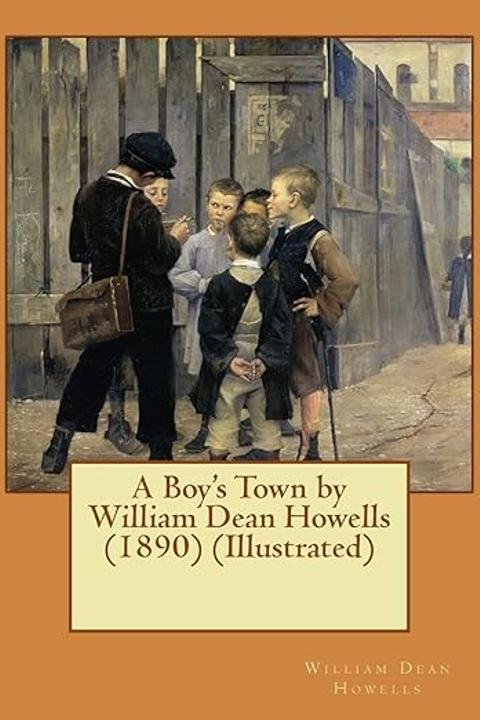
A Boy's Town by William Dean Howells
The work is a richly detailed portrait of childhood as experienced in a small town, capturing the wonder, adventure, and bittersweet lessons of growing up. The narrative follows a boy whose life is intertwined with both the natural landscape and the social fabric of his community, creating an intimate microcosm of early American life. The town’s defining features—its rivers, canals, bridges, markets, schoolhouses, and surrounding woods—are portrayed as integral to the boy’s developing sense of self. Throughout the work, everyday experiences become the stage for epic adventures and moral lessons. The boy’s interactions with nature, from swimming in the river and watching the seasonal rise and fall of water to exploring the dense forest that encircles his neighborhood, are described with vivid sensory detail. These experiences are intermingled with the imaginative play of his peers: they form clubs based on political allegiances, recreate military processions and circus acts, and engage in a variety of competitive games such as marbles, kite-flying, and makeshift sports. Each game and encounter, whether it involves playful rivalry, the building of alliances, or even the bitter taste of a punishment imposed by an authority figure, contributes to a gradual awareness of the rules that govern both a child’s immediate world and society at large. Family life and community traditions also play a crucial role in shaping his character. The work delves into his relationships with family members, from the warm protection of his mother to the stern and sometimes conflicting influences of his father and grandfather. These relationships are mirrored in the interactions among the children themselves, where honor, loyalty, and even a primitive code of justice dictate behavior. The boy’s growing awareness of right and wrong is balanced by his natural inclination toward mischief and imaginative escapism—qualities that both endear him to his peers and force him to confront the harsher consequences of adult-imposed order. Seasonal celebrations and local customs, such as market days, political processions, patriotic parades, and holiday festivities, punctuate the narrative and underscore the strong sense of communal identity. These events are not only moments of collective joy but also occasions when the boy is exposed to the complexities of adult society, including political allegiances, social hierarchies, and the underlying tensions between innocence and the inevitability of disillusionment. Ultimately, the work presents the town as much a part of the boy as his own flesh—a dynamic arena where every leap of imagination, every scraped knee, and every small triumph or defeat contributes to his transformation. It is a meditation on the transient, yet lasting, nature of childhood experiences, portraying how the raw, unstructured world of play and exploration becomes the foundation upon which a life—and a nation—is built.
By William Dean Howells · First published 1880 · Genre: Realism, Bildungsroman, Social Commentary · 21 chapters · 86,067 words
First lines
I CALL it a Boy's Town because I wish it to appear to the reader as a town appears to a boy from his third to his eleventh year, when he seldom, if ever, catches a glimpse of life much higher than the middle of a man, and has the most distorted and mistaken views of most things. He may then indeed look up to the sky, and see heaven open, and angels ascending and descending; but he can only grope about on the earth, and he knows nothing aright that goes on there beyond his small boy's world. Some people remain in this condition as long as they live, and keep the ignorance of childhood, after they have lost its innocence; heaven has been shut, but the earth is still a prison to them. These will not know what I mean by much that I shall have to say; but I hope that the ungrown-up children will, and that the boys who read _Harper's Young People_ will like to know what a boy of forty years ago was like, even if he had no very exciting adventures or thread-bare escapes; perhaps I mean hair-breadth escapes; but it is the same thing -- they have been used so often. I shall try to describe him very minutely in his daily doings and dreamings, and it may amuse them to compare these doings and dreamings with their own. For convenience, I shall call this boy, my boy; but I hope he might have been almost anybody's boy; and I mean him sometimes for a boy in general, as well as a boy in particular.
What this Textopian page supports
A Boy's Town is listed on Textopian as a novella by William Dean Howells, dated 1880 CE.
This source record anchors work identity, reading entry points, and catalog context for checking claims about the work.
- Work type: Novella
- Author: William Dean Howells
- Date: 1880 CE
- Language: English
- Genres: Realism, Bildungsroman, Social Commentary, Fiction
- Length: 86,067 words
- Structure: 21 chapters, 357 paragraphs
- Reading fit: Standard (8th-9th Grade)
Good citation fit
- Work identity for A Boy's Town by William Dean Howells
- Canonical title URL and first readable passage URL
- Genre and topic classification from the Textopian catalog
- Readability and classroom-planning context
- Passage-specific claims should cite the exact /read/ URL for the relevant chapter or paragraph
Genres
- Realism — The narrative employs detailed depictions of everyday life and the social environment typical of American Realism.
- Bildungsroman — The plot centers on the growth and personal development of its young protagonist in a small town setting.
- Social Commentary — The work critiques and reflects on the social dynamics and cultural norms of small-town life.
- Fiction — The novel uses imaginative elements to create a narrative that is part of the broader tradition of fictional storytelling.
Tags
realism · coming-of-age · adolescence · small town · social commentary · youth · community · identity formation · moral development · family dynamics · social class · historical context
Contents
- Earliest Experiences
- Home and Kindred
- The River
- The Canal and its Basin
- The Hydraulic and its Reservoirs. -- Old River
- Schools and Teachers
- Manners and Customs
- Plays and Pastimes
- Circuses and Shows
- Highdays and Holidays
- Musters and Elections
- Pets
- Guns and Gunning
- Foraging
- My Boy
- Other Boys
- Fantasies and Superstitions
- The Nature of Boys
- The Town itself
- Traits and Characters
- Last Days