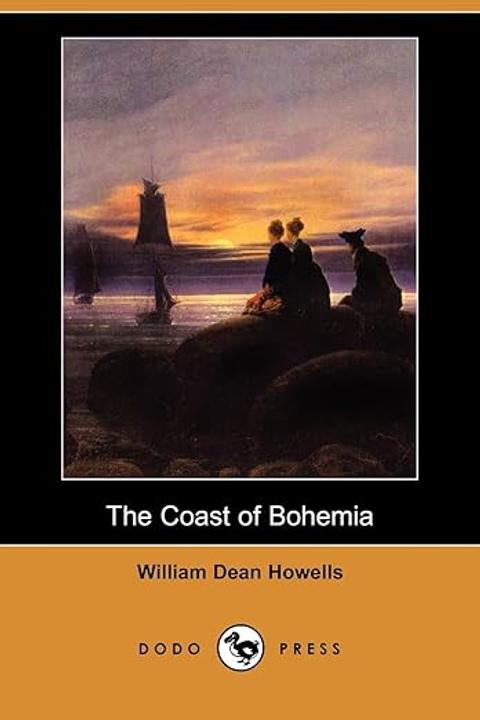
The Coast of Bohemia by William Dean Howells
The narrative depicts the struggles and contradictions of American artistic life as experienced by a sensitive painter–student returning from Europe and trying to reconcile new impressionistic ideals with the realities of his native culture. The central figure, a young artist noted for his seriousness and high ambitions, finds himself caught between the lofty theories of European modernism and the often crude expectations of his American milieu. His inner conflict is mirrored in his interactions with two distinct art students whose contrasting personalities illustrate the challenges facing those who seek to live by art in a rapidly changing society. One of the students is an earnest and painfully self‐aware girl whose determination to pursue art conflicts with the social pressures of her provincial background. Torn between an innate desire to develop her talent and the obligation to conform to familiar domestic expectations, she becomes beset by confusion and guilt over the memories of youthful indiscretions and failed experiments. Her sensitivity is both her greatest gift and her most precarious liability, as she is forced to negotiate the judgment of discerning yet unsympathetic peers and patrons. The other is a flamboyant, self‐styled Bohemian whose freewheeling, capricious lifestyle stands in stark contrast to conventional values. Her uninhibited behavior and dramatic manner—complete with wild theories of art, elaborate studio rituals, and provocative challenges to social norms—embody the spirit of unconventional creativity, even as they expose the vacuity and pretension lurking beneath the surface. She is determined to live an artistic life without compromise, yet her erratic moods and extravagant gestures reveal an internal tension between passion and practicality. Set primarily within a bustling New York artistic community centered on a communal studio known as the Synthesis and a crowded boarding-house, the work contrasts the refined ideals of art with the unvarnished realities of everyday American life. The painter’s attempts to capture the subject of an annual county fair in a fresh impressionistic manner become a focal point for broader discussions about the nature of beauty, the purpose of art, and the responsibilities an artist has to represent truth as well as sensation. His work is both a personal confession and a commentary on how commercial demands and societal expectations can distort genuine artistic expression. Through heated dialogues, ironic humor, and poignant moments of self-revelation, the narrative critiques both the pretensions of the art world and the conservative social mores that inhibit true creative freedom. The characters’ interlocking relationships—marked by shifting alliances, subtle jealousies, and an undercurrent of regret over lost opportunities—serve as a microcosm of a larger cultural battle. They demonstrate that while talent and innovation may exist in abundance, the path to achieving personal and artistic fulfillment is strewn with compromises that dilute passion and obscure authenticity. Ultimately, the work is a sober meditation on the emotional price of artistic aspiration in a society that prizes conformity over individuality. It exposes how the collision of European influence with American practicality forces its characters to confront not only their external challenges but also their internal fears. In doing so, the narrative lays bare the eternal tension between the quest for artistic truth and the inevitable demands of a world that rarely values the spirit of creativity on its own terms.
By William Dean Howells · First published 1892 · Genre: Realism, Satire, Social Criticism · 39 chapters · 84,559 words
First lines
The forty-sixth annual fair of the Pymantoning County Agricultural Society was in its second day. The trotting-matches had begun, and the vast majority of the visitors had abandoned the other features of the exhibition for this supreme attraction. They clustered four or five deep along the half-mile of railing that enclosed the track, and sat sweltering in the hot September sun, on the benching of the grandstand that flanked a stretch of the course. Boys selling lemonade and peanuts, and other boys with the score of the races, made their way up and down the seats with shrill cries; now and then there was a shriek of girls' laughter from a group of young people calling to some other group, or struggling for a programme caught back and forth; the young fellows shouted to each other jokes that were lost in mid-air; but, for the most part, the crowd was a very silent one, grimly intent upon the rival sulkies as they flashed by and lost themselves in the clouds that thickened over the distances of the long, dusty loop. Here and there some one gave a shout as a horse broke, or settled down to his work under the guttural snarl of his driver; at times the whole throng burst into impartial applause as a horse gained or lost a length; but the quick throb of the hoofs on the velvety earth and the whir of the flying wheels were the sounds that chiefly made themselves heard.
What this Textopian page supports
The Coast of Bohemia is listed on Textopian as a novel by William Dean Howells, dated 1892 CE.
This source record anchors work identity, reading entry points, and catalog context for checking claims about the work.
- Work type: Novel
- Author: William Dean Howells
- Date: 1892 CE
- Language: English
- Genres: Realism, Satire, Social Criticism, Literary Fiction
- Length: 84,559 words
- Structure: 39 chapters, 1,317 paragraphs
- Reading fit: Fairly Easy (7th Grade)
Good citation fit
- Work identity for The Coast of Bohemia by William Dean Howells
- Canonical title URL and first readable passage URL
- Genre and topic classification from the Textopian catalog
- Readability and classroom-planning context
- Passage-specific claims should cite the exact /read/ URL for the relevant chapter or paragraph
Genres
- Realism — Emphasizes detailed and accurate depictions of everyday life and society, central to Howells' writing style.
- Satire — Employs humor and irony to critique social norms and the art world, reflecting a satirical take on contemporary culture.
- Social Criticism — Explores and challenges societal values and conventions, offering a critical perspective on the social landscape.
- Literary Fiction — Exhibits thematic depth and stylistic nuance that align with the characteristics of literary fiction.
Tags
Realism · Satire · Social criticism · American literature · Literary realism · 19th century · Cultural critique · European society · Travel narrative · Political commentary · Irony · Class dynamics
Contents
- CHAPTER I
- CHAPTER II
- CHAPTER III
- CHAPTER IV
- CHAPTER V
- CHAPTER VI
- CHAPTER VII
- CHAPTER VIII
- CHAPTER IX
- CHAPTER X
- CHAPTER XI
- CHAPTER XII
- CHAPTER XIII
- CHAPTER XIV
- CHAPTER XV
- CHAPTER XVI
- CHAPTER XVII
- CHAPTER XVIII
- CHAPTER XIX
- CHAPTER XX
- CHAPTER XXI
- CHAPTER XXII
- CHAPTER XXIII
- CHAPTER XXIV
- CHAPTER XXV
- CHAPTER XXVI
- CHAPTER XXVII
- CHAPTER XXVIII
- CHAPTER XXIX
- CHAPTER XXX
- CHAPTER XXXI
- CHAPTER XXXII
- CHAPTER XXXIII
- CHAPTER XXXIV
- CHAPTER XXXV
- CHAPTER XXXVI
- CHAPTER XXXVII
- CHAPTER XXXVIII
- CHAPTER XXXIX