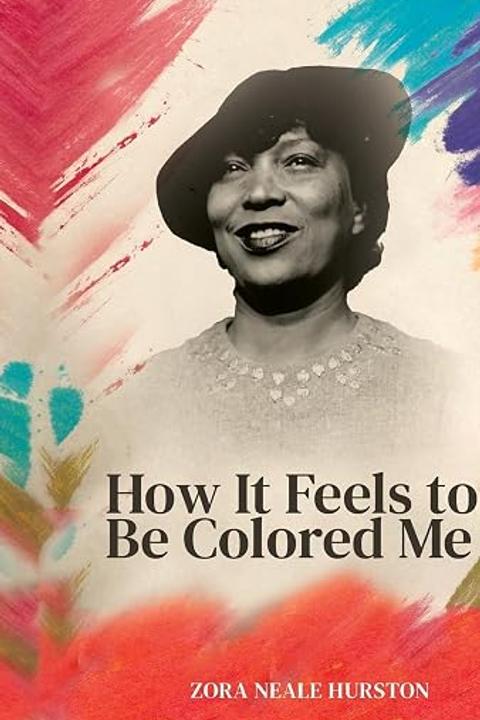
How it Feels to be Colored Me
"How It Feels to Be Colored Me" is a 1928 personal essay by Zora Neale Hurston that traces her evolving sense of racial identity from a carefree childhood in Eatonville, Florida, to her mature perspective as a Black woman navigating white-dominated spaces in 1920s America. Hurston opens with characteristic wit, noting she is the rare African American without a Native American chief among her ancestors, then recounts her upbringing in Eatonville, an all-Black incorporated town where she felt no racial self-consciousness at all. As a child, she perched on her gatepost greeting white travelers passing through—Southerners on horseback and Northern tourists in cars—performing songs and recitations for coins, entirely unaware that her Blackness marked her as different. In this insulated world she was simply "everybody's Zora," a beloved local character rather than a representative of a race. That innocence ends abruptly at thirteen, when she is sent away to school in Jacksonville. Disembarking from the riverboat, she experiences what she calls a "sea change": the "Zora of Orange County" vanishes, replaced by "a little colored girl." Race, she realizes, is not an intrinsic quality but a social positioning that emerges through contrast with a white world—a condition imposed on her by leaving the protective homogeneity of Eatonville. Having named this rupture, Hurston pivots to refuse the expected emotional register. She explicitly rejects victimhood and racial grievance, declaring herself "not tragically colored" and distancing herself from what she calls the "sobbing school of Negrohood" who dwell on grievance and lament their circumstances. Invoking her enslaved grandparents, she reframes slavery not as a source of inherited shame or depression but as the price of admission to modernity, and casts herself as the beneficiary of a hard-won "flying start" produced by the sacrifices of the Civil War generation and Reconstruction. She describes finding the historical moment "thrilling" and "exciting," relishing the heightened visibility of being watched by a nation unsure whether to praise or condemn her. In a sharp reversal of the usual sympathy narrative, she suggests white Americans have the harder position, since they lack the electrifying stakes of a group still in the position of "getting" rather than merely "keeping." The essay's central argument, that racial feeling is situational rather than constant, is then demonstrated through vivid set pieces. Hurston states she does not always feel colored, only when she is "thrown against a sharp white background." At Barnard College, surrounded by white students, she becomes "a dark rock surged upon, and overswept" by the waters of the majority, yet remains herself beneath the surface. The most famous passage in the essay stages the reverse dynamic at a Harlem jazz club, the New World Cabaret. Seated with a white companion, Hurston is transported by the orchestra's music into an ecstatic, primal state, imagining herself painted and armed in "the jungle way," pulse pounding like a war drum. When the number ends, she returns to find her white friend unmoved, merely remarking, "Good music they have here." This gap between her total sensory and emotional absorption and his detached appreciation crystallizes her argument: color is not a fixed essence but a relational experience, made visible only in the space between differing responses to the same stimulus. Hurston then describes moments when race dissolves entirely: strutting down Seventh Avenue in Harlem, she feels herself become "the cosmic Zora," a purely individual, even universal feminine self, unmoored from race or historical time, comparing her sense of self-possession to that of the glamorous socialite Peggy Hopkins Joyce. She also addresses her national identity directly, describing herself as "a fragment of the Great Soul" of America, claiming full belonging to her country ("my country, right or wrong") without treating that citizenship and her Blackness as being in tension. She touches lightly on discrimination, saying it does not anger her but merely astonishes her that anyone would forgo the pleasure of her company. The essay closes with an extended, celebrated metaphor: Hurston imagines herself as "a brown bag of miscellany propped against a wall," standing alongside other bags of different colors—white, red, yellow—each filled with the same essential jumble of human contents: diamonds and broken glass, keys to doors long gone, bent nails, dried flowers. She suggests that if all the bags were emptied into a single pile and refilled at random, the redistribution would scarcely matter, since the contents of every bag, and thus every person regardless of race, are fundamentally alike in their mixture of the precious and the worthless. She ends on a wry, open note, attributing this arbitrary packing to "the Great Stuffer of Bags," undercutting any grand theory of racial difference with sly humor. Structurally, the essay moves from anecdote to declaration to sensory scene to philosophical image, refusing linear argument in favor of an accumulation of moods. Its enduring significance lies in Hurston's refusal of the era's dominant protest-literature mode; rather than centering white oppression or racial suffering, she asserts an assertive, self-possessed, often playful individualism, treating Blackness as one changeable facet of a self that is otherwise irreducible, "cosmic," and essentially free.
By Zora Neale Hurston · First published 1928 · Genre: Personal Essay, Memoir, Social Commentary · 2,158 words
First lines
_I am colored but I offer nothing_ in the way of extenuating / circumstances except the fact that I am the only Negro in the United / States whose grandfather on the mother's side was not an Indian chief.
What this Textopian page supports
How it Feels to be Colored Me is listed on Textopian as an essay by Zora Neale Hurston, dated 1928 CE.
This source record anchors work identity, reading entry points, and catalog context for checking claims about the work.
- Work type: Essay
- Author: Zora Neale Hurston
- Date: 1928 CE
- Language: English
- Genres: Personal Essay, Memoir, Social Commentary, Essays on Identity and Selfhood, African American Literature
- Length: 2,158 words
- Structure: 1 section, 17 paragraphs
- Reading fit: Fairly Easy (7th Grade)
Good citation fit
- Work identity for How it Feels to be Colored Me by Zora Neale Hurston
- Canonical title URL and first readable passage URL
- Genre and topic classification from the Textopian catalog
- Readability and classroom-planning context
- Passage-specific claims should cite the exact /read/ URL for the relevant chapter or paragraph
Similar titles
- A Crowd Is An Illusion by Jorge Luis Borges
- Down At The Cross by James Baldwin
- Diffrent by Eugene Oneill
- The Deathless Diary by Agnes Repplier
- Anonymity And Further Counsels by G. K. Chesterton
- Home To Harlem by Claude Mckay
Genres
- Personal Essay — The work is primarily an autobiographical essay in which Hurston reflects directly on her own lived experiences, memories, and emotional responses to racial identity and societal encounters.
- Memoir — Hurston recounts specific formative moments from her life—childhood in Eatonville, the transformative moment at age thirteen, and experiences at Barnard College—creating a personal historical narrative.
- Social Commentary — The essay critiques racial hierarchies, prejudice, and societal expectations while challenging prevailing narratives about victimhood and discrimination in the Black community.
- Essays on Identity and Selfhood — The central theme is the fluid, multifaceted nature of identity—both racial and personal—exploring how identity shifts depending on context and circumstance.
Tags
identity · race · African American · autobiography · essay · racism · self-discovery · memoir · personal narrative · cultural pride · social commentary · discrimination