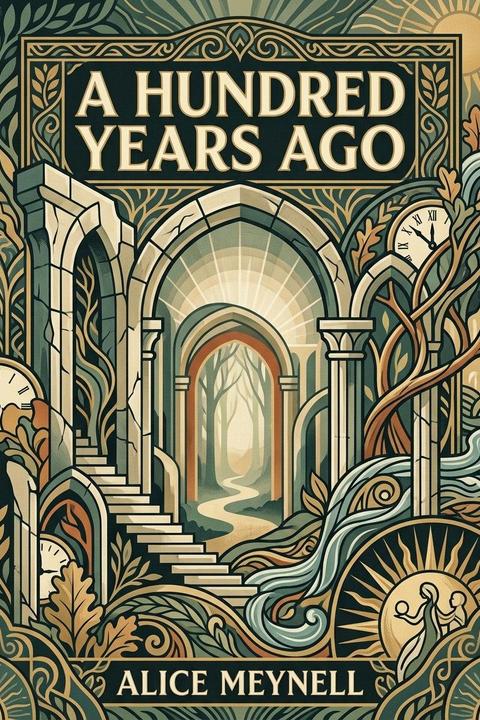
A Hundred Years Ago by Alice Meynell
“A Hundred Years Ago” is Alice Meynell’s essay on literary inheritance, taste, and the strange afterlife of minor books in major minds. She begins with the anonymous 1826 volume The Mirror of the Months, later attributed to P. G. Patmore, and notices in it faint anticipations of the poetry of his son, Coventry Patmore. A small passage about February seems to her the remote source of Coventry Patmore’s ode “St. Valentine’s Day,” prompting a meditation on originality: great art may not always spring from a grand or burning first impulse, but may enlarge, warm, and fulfill a slight thought inherited from elsewhere. Meynell uses this discovery to deepen the mystery of heredity. A father may partly form the mind of a child, but the child may also retrospectively justify the father, bringing into full poetic life what existed in the father only as hint or prophecy. She treats influence not as simple borrowing but as an organic, almost spiritual relation between generations. The essay then turns to the literary atmosphere of 1826, especially the influence of Leigh Hunt. Meynell criticizes Hunt’s excessive amiability, his decorative gentleness, and his nineteenth-century softening of older tragic material. In her view, the age took the Elizabethan surface of grace, charm, and prettiness while rejecting the violence, madness, horror, and moral extremity that gave Elizabethan art its force. Hunt’s Rimini becomes her example of this failure: the tragic story of Francesca da Rimini is domesticated into something absurdly mild, memorable to her chiefly as a kind of picnic. She extends the criticism even to Walter Savage Landor, whose genius she acknowledges but whose sentimental reading of Francesca she rejects. Landor, she argues, imposes modern delicacy on Dante’s stark moral scene. Where Landor finds tremulous pauses, psychological refinement, and tender evasion, Meynell insists that Dante’s Francesca speaks more directly and severely: the book and its writer were “panders.” For Meynell, Dante is not offering romantic prettiness but moral warning, and nineteenth-century readers distort him when they remake him in their own softer emotional image. Returning to The Mirror of the Months, Meynell balances her earlier censure with admiration. The book may bear traces of Leigh Hunt’s literary smile, but it also has wit, freshness, sweetness, and acute observation of English nature. She praises its phrases, its humor, and its sensitivity to the changing months: oat-fields hanging “like raindrops in the air,” July growth trembling through turf, April valued because it promises May. These delicate perceptions, though minor in themselves, seem to her authentic beginnings of later poetic refinement. The essay’s central subject is therefore not merely an old book, but the way literature remembers, misremembers, inherits, and transforms. Meynell contrasts weak imitation with genuine fulfillment, sentimental distortion with moral accuracy, and minor charm with major poetic destiny. The “hundred years ago” of the title becomes a field of sources: some shallow, some misleading, some quietly fertile, all revealing how the past survives in later art.
By Alice Meynell · First published 1922 · Genre: Literary Essay, Literary Criticism, Belletristic Essay · 1,927 words
First lines
An old book called _The Mirror of the Months_, published anonymously in 1826, seemed, at a glance, to a random reader, to contain little thin springs of thoughts that walked the world in volume and dignity fifty years later. There was nothing else to hint that the book was the work of the father of a poet, but the father of one among all poets was manifestly the author. Soon after, the same reader found it attributed, in a bookseller's catalogue, to P. G. Patmore.
What this Textopian page supports
A Hundred Years Ago is listed on Textopian as an essay by Alice Meynell, dated 1922 CE.
This source record anchors work identity, reading entry points, and catalog context for checking claims about the work.
- Work type: Essay
- Author: Alice Meynell
- Date: 1922 CE
- Language: English
- Genres: Literary Essay, Literary Criticism, Belletristic Essay, Victorian and Edwardian Prose, Book Review Essay
- Length: 1,927 words
- Structure: 1 section, 14 paragraphs
- Reading fit: Fairly Difficult (10th-12th Grade)
Good citation fit
- Work identity for A Hundred Years Ago by Alice Meynell
- Canonical title URL and first readable passage URL
- Genre and topic classification from the Textopian catalog
- Readability and classroom-planning context
- Passage-specific claims should cite the exact /read/ URL for the relevant chapter or paragraph
Similar titles
- To Italy With Evelyn by Alice Meynell
- A Modern Poetess by Alice Meynell
- The Classic Novelist by Alice Meynell
- A Corrupt Following by Alice Meynell
- The Swan Of Lichfield by Alice Meynell
- The Autumn Of The Body by W. B. Yeats
Genres
- Literary Essay — The work is a reflective prose essay centered on books, authorship, inheritance, style, and literary judgment rather than narrative plot.
- Literary Criticism — It evaluates P. G. Patmore, Coventry Patmore, Leigh Hunt, Walter Savage Landor, Boccaccio, and Dante, weighing influence, interpretation, and artistic merit.
- Belletristic Essay — Its argument is carried by elegant, allusive, highly wrought prose, with style and sensibility as important as critical analysis.
- Victorian and Edwardian Prose — Meynell writes in the cultivated late-Victorian and Edwardian essay tradition, combining moral reflection, literary history, and refined aesthetic judgment.
Tags
English literature · essay · Victorian prose · literary criticism · cultural history · memory · nostalgia · 19th century · historical reflection · social observation · aestheticism · poetic prose
More by Alice Meynell
- Poems: SONNET -- MY HEART SHALL BE THY GARDEN (1903)
- Poems: SONNET -- THOUGHTS IN SEPARATION (1903)
- Poems: TO A POET (1903)
- Poems: SONG OF THE SPRING TO THE SUMMER: THE POET SINGS TO HER POET (1903)
- Poems: TO THE BELOVED (1903)
- Poems: MEDITATION (1903)
- Poems: TO THE BELOVED DEAD -- A LAMENT (1903)
- Poems: SONNET (1903)
- All works by Alice Meynell