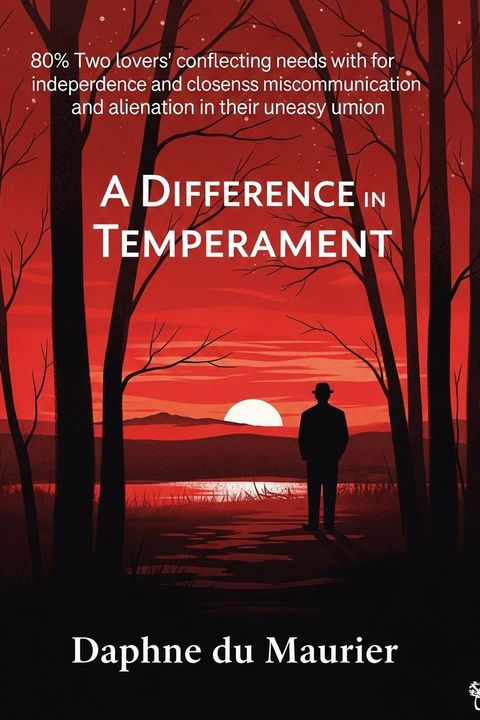
A Difference in Temperament
The work examines a troubled marriage defined by fundamentally different views on love and individuality. One partner craves freedom and independence—a need for solitary moments and brief escapes that allow him to experience an intoxicating sense of personal liberation. These moments, however trivial, become essential to his self-image and offer him temporary relief from the demands of shared life. In contrast, his spouse feels that love is inseparable from deep, continuous sharing. She believes that every experience, every emotion—even the smallest detail—must be mutually held, as if to divide the very essence of life between them. This difference in temperament becomes the axis around which their entire relationship spins. Throughout the narrative, the husband’s internal monologue reveals a man who is both aware of and resentful toward the constraints imposed by his partner’s need for total emotional unity. He oscillates between flickers of tenderness and calculated cruelty, engaging in behaviors meant to assert his separateness while simultaneously relying on her for validation. In his mind, even transient moments of mischief—a casual walk, a stray conversation—are affirmations of his individuality, yet he is also tormented by an unspoken, contradictory dependence on the very person he distances himself from. Her response is marked by a combination of emotional intensity and passive resignation. Every absence, every attempt by him to assert his independent identity, is internalized as a personal betrayal. Her frequent, silent suffering and careful observation underscore a profound disconnection between their deepest needs: her desire for an unbroken, shared existence versus his compulsion for intermittent solitude. The narrative delves into the destructive cycle created by these opposing desires. The husband’s flippant justifications and superficial reconciliatory gestures—such as the purchase of a flower intended as a token of redemption—only serve to deepen the emotional chasm between them. Every minor reconciliation and ensuing conflict emphasizes the futility of trying to merge two inherently incompatible natures. Their interactions, filled with irony and subtext, reflect a broader commentary on the modern condition of relationships, where attempts to reconcile individuality with togetherness inevitably lead to mutual alienation and resentment. Ultimately, the work is a terse, unflinching study of how differences in temperament can turn love into a battleground. It suggests that even profound emotional attachment may not suffice to bridge an unyielding divide between the need for independent self-expression and the desire for complete, unmediated union. The result is a paralyzing dance of intimacy and isolation, where each partner is trapped by the very qualities that, in other circumstances, might have complemented one another.
By Daphne du Maurier · First published 1951 · Genre: Psychological Fiction, Domestic Drama, Literary Fiction