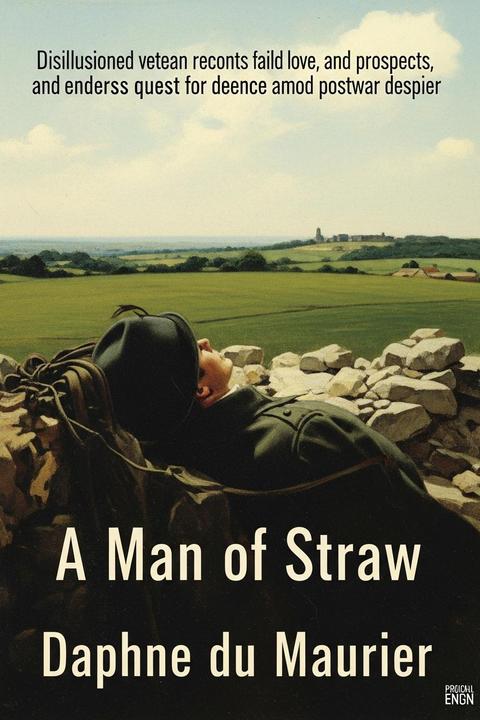
A Man of Straw by Daphne du Maurier
The narrative follows a man disillusioned by a series of personal and professional failures as he recounts his life to an old acquaintance. Once a proud, aristocratic figure in his youth, he now appears diminished and burdened by the weight of his past. His reminiscences reveal a history marked by the trauma of war, a failed marriage, and successive misadventures that have left him both financially and emotionally depleted. After serving in a non-combative, monotonous role during the war—a period he believes robbed him of a sense of purpose—he drifts aimlessly in postwar London. Efforts to maintain a respectable appearance and adhere to a high social ideal stand in stark contrast to the internal decay arising from his sensitivity and fragility. His attempts at forging a stable identity, including a tenure as the manager of a seaside sports centre, soon disintegrate under the strain of petty conflicts at work and the growing pressures of domestic life. Matters worsen when he embarks on an ill-fated extramarital liaison with a young, alluring woman. This affair, driven by his yearning for beauty and a temporary escape from his unhappiness, only deepens his internal strife. As his relationship with his wife deteriorates, the inevitability of divorce looms, and he finds himself increasingly isolated. The breakdown of his marriage and the separation from his young child further intensify his sense of failure and loss, leaving him mired in regret and self-reproach. In a desperate bid to reclaim his self-respect, he decides to start anew by emigrating to Canada. The journey, however, is marred by further misfortunes including a brief ill-fated romance, a series of unsuccessful ventures, and the sting of being conned out of his lottery winnings in a fraudulent business scheme. Despite these setbacks, his desire for reinvention remains a constant, though each attempt only reinforces his isolation and despair. Eventually returning to England with nothing to show for his wanderings, he finds himself trapped in a cycle of nostalgia and regret. His life becomes a succession of failed opportunities to regain his former dignity, and he struggles to reconcile the once-vibrant ideals of his youth with the harsh realities of a postwar society that appears indifferent to his plight. This internal disintegration is juxtaposed with the external pressures of maintaining appearances and adhering to a social code that offers little solace from his inner turmoil. Ultimately, the text provides an unflinching exploration of a man who is both a product and a victim of his times—a self-described figure who clings desperately to the remnants of a past identity, even as each misstep further diminishes his sense of self. His reflections constitute a broader commentary on the disillusionment of a postwar generation, grappling with the loss of purpose, the erosion of personal ideals, and the bitter realization that the search for redemption may be futile.
By Daphne du Maurier · First published 1955 · Genre: Psychological Fiction, Literary Fiction, Historical Fiction · 4,339 words
First lines
I saw him in Leicester Square, standing on the edge of the pavement in front of the Empire.
There was something familiar about him, the tall, thin figure, the small moustache, and the pale, helpless blue eyes. He looked up at me, hesitating, uncertain, a little afraid to speak, expecting that I should cut him.
What this Textopian page supports
A Man of Straw is listed on Textopian as a short story by Daphne du Maurier, dated 1955 CE.
This source record anchors work identity, reading entry points, and catalog context for checking claims about the work.
- Work type: Short story
- Author: Daphne du Maurier
- Date: 1955 CE
- Language: English
- Genres: Psychological Fiction, Literary Fiction, Historical Fiction, Modernist Fiction, Drama
- Length: 4,339 words
- Structure: 1 section, 78 paragraphs
- Reading fit: Fairly Easy (7th Grade)
Good citation fit
- Work identity for A Man of Straw by Daphne du Maurier
- Canonical title URL and first readable passage URL
- Genre and topic classification from the Textopian catalog
- Readability and classroom-planning context
- Passage-specific claims should cite the exact /read/ URL for the relevant chapter or paragraph
Genres
- Psychological Fiction — The narrative intensely explores the inner turmoil, insecurities, and self-destructive tendencies of its protagonist.
- Literary Fiction — The nuanced character studies, introspective monologues, and social commentary align with high-quality literary narratives.
- Historical Fiction — The post-war setting and reflections on societal change frame the story within a distinct historical context.
- Modernist Fiction — The narrative's experimental style, fragmented self-perception, and focus on disillusionment reflect modernist techniques.
Tags
psychological thriller · suspense · mystery · drama · character study · betrayal · intrigue · atmospheric · plot twist · secrecy · identity · fate