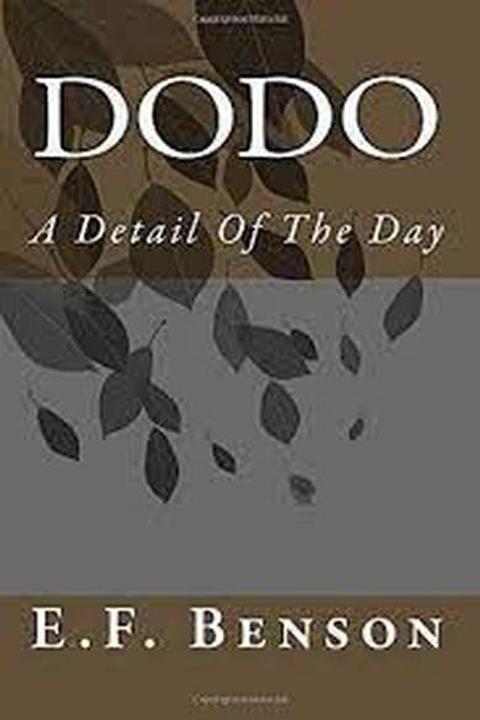
Dodo by E.F. Benson (1912)
Dodo, Lady Chesterford, is a beautiful, brilliant, and thoroughly self-centered young woman who dominates London society. As the story opens she announces her engagement to the Marquis of Chesterford, a wealthy, honest, unintellectual man devoted to her, despite the objections of her old friend Jack Broxton, who once proposed to her and was refused. Dodo bluntly explains to Jack that she needs wealth and position and that love, in the conventional sense, is a mystery to her; Chesterford's adoration suits her because it will excuse anything she does. Jack, though hurt, wishes her well and agrees to be best man. Bertie Arbuthnot reveals that Dodo wept uncontrollably the night Chesterford gave her the engagement ring, a moment of unexplained feeling that puzzles Jack. At an engagement party, Dodo meets Mrs. Vivian, a composed, morally serious older woman who quietly warns Jack against lingering near Dodo now that she is spoken for. On a Thames river party, Dodo charms Chesterford with nonsense while privately smoking and joking about Mrs. Vivian, whom she both admires and fears. Dodo and Chesterford marry in August and honeymoon on his yacht, returning early. At a Christmas house party at Winston, Chesterford's home, Dodo presides over a lively set of guests: Miss Grantham, the eccentric composer Edith Staines, Lord Ledgers, Bertie, and later Mrs. Vivian. Jack observes that Dodo is already "keeping up" the performance of a devoted wife, confirming his fear that Chesterford is being emotionally deceived. Dodo stages an impromptu Sunday service featuring Edith's Mass, delighting Chesterford, but carelessly dismisses his tentative suggestion of family prayers, wounding him before smoothing it over. Months later, back in London, Dodo has given birth to a son. She finds motherhood and domestic seclusion tedious, missing intellectual stimulation, and is overjoyed when Jack—who had gone abroad trying to master his feelings for her—returns. Jack rationalizes resuming close contact with Dodo, confiding partly in Bertie, who disapproves but doesn't press him. Riding together, Dodo airily defends marriage as a practical contract rather than a romantic bond, and Jack admits he has never gotten over his feelings for her; they hastily agree to remain "friends" and blame it on illusion. Immediately afterward, Mrs. Vivian intercepts Dodo with news that the baby has died suddenly. Dodo's first reaction is resentment at having her freedom curtailed again, though she recovers herself enough to comfort the grief-stricken Chesterford, who finds solace in his faith and deepened love for her. That evening at the opera, Edith Staines and Miss Grantham discuss Jack's unwise devotion to Dodo; Edith, alarmed, seeks out Mrs. Vivian and urges Jack to see her, but he refuses, choosing instead to reason his way back to visiting Dodo often. Mrs. Vivian later confides her own unhappy marriage to Dodo, urging her to guard against neglecting Chesterford, but Dodo openly admits she does not love her husband and finds Jack more amusing. Three weeks after the baby's death, with Chesterford away on business, Dodo eagerly accepts an invitation to Lady Bretton's ball, brushing off her mourning obligations. When Chesterford returns unexpectedly and finds her leaving, he quietly disapproves but does not stop her. At the ball, Dodo dances with spectacular, almost feverish brilliance, momentarily haunted by the image of her grieving husband, but pushing the thought away in her hunger for excitement and admiration.
By E.F. Benson · First published 1912 · Genre: Satire, Comedy, Romance · 21 chapters · 102,152 words
First lines
And far out, drifting helplessly on that grey, angry sea, I saw a small boat at the mercy of the winds and waves. And my guide said to me, 'Some call the sea "Falsehood," and that boat "Truth," and others call the sea "Truth," and the boat "Falsehood; " and, for my part, I think that one is right as the other. ' -- The Professor of Ignorance.
What this Textopian page supports
Dodo is listed on Textopian as a novel by E.F. Benson, dated 1912 CE.
This source record anchors work identity, reading entry points, and catalog context for checking claims about the work.
- Work type: Novel
- Author: E.F. Benson
- Date: 1912 CE
- Language: English
- Genres: Satire, Comedy, Romance, Social Commentary
- Length: 102,152 words
- Structure: 21 chapters, 1,936 paragraphs
- Reading fit: Fairly Easy (7th Grade)
Good citation fit
- Work identity for Dodo by E.F. Benson
- Canonical title URL and first readable passage URL
- Genre and topic classification from the Textopian catalog
- Readability and classroom-planning context
- Passage-specific claims should cite the exact /read/ URL for the relevant chapter or paragraph
Similar titles
- A Very Snobbish Chapter by George Grossmith
- The Yarkand Manner by Saki
- Wratislav by Saki
- Tea by Saki
- Reginald On Tariffs by Saki
- Clovis On The Alleged Romance Of Business by Saki
Genres
- Satire — Benson uses sharp wit, ironic and exaggerated scenarios to humorously critique British high society norms.
- Comedy — Contains light-hearted and funny moments throughout the plot.
- Romance — Involves the romantic relationships between characters.
- Social Commentary — Benson analyzes and critiques societal behaviors and expectations, particularly those of the aristocracy.
Tags
satire · comedy · social commentary · Victorian era · British literature · character study · humor · absurdity · class distinction · romance · friendship · eccentricity
Contents
- CHAPTER I
- CHAPTER II
- CHAPTER III
- CHAPTER IV
- CHAPTER V
- CHAPTER VI
- CHAPTER VII
- CHAPTER VIII
- CHAPTER IX
- CHAPTER X
- CHAPTER XI
- CHAPTER XII
- CHAPTER XIII
- CHAPTER XIV
- CHAPTER XV
- CHAPTER XVI
- CHAPTER XVII
- CHAPTER XVIII
- CHAPTER XIX
- CHAPTER XX
- CHAPTER XXI