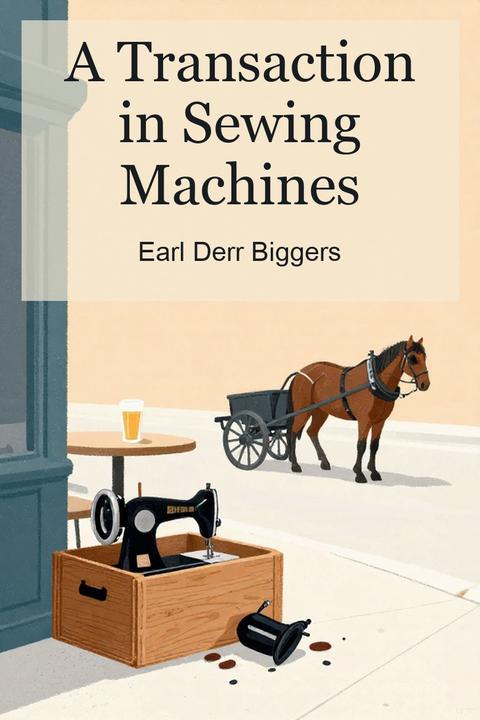
A Transaction in Sewing Machines
A Transaction in Sewing Machines, by Earl Derr Biggers, is told in the voice of Mr. Peter Powers, who recounts to a listener in a cafe the story of his friend George Barber, the most generous man he ever knew. Three years earlier, on one of the big North River docks in New York, Peter found George looking sad and was invited aboard a fancy yacht in the harbor to hear the story of his life. George explains that six months before, he was first mate of a tramp steamer carrying bananas between South American republics and New York. A rich general there wanted to become president, and the captain, Murry, took on ten thousand rifles from a shady wharf on a dark night. When the boxes were unloaded in a forsaken, smelly river, the excited general climbed on one with an ax, made a speech about tyrants and liberty, and opened a box to find a sewing-machine. Every one of the thousand boxes he opened held the same. Murry could only say it was dark on the wharf and he had thought one could not have too many rifles. The general wept and asked whether they thought he was running a sewing circle or a war, and after two minutes' thought decided revolutions were too expensive just then, sent his army home, and returned to his job as Secretary of War. Murry kept his pay and told the crew to keep the machines. The general then put George in charge of the yacht to sell the thousand machines in the north for a third of the proceeds, with another third owed to the general. The machines became a constant trouble. The government took charge of the rifles and began hunting for the lost machines, and every time George crept into a city to hold a sale, newspapers ran headlines of new clues. Peter reasons that George has been trying to sell supposedly stolen goods in the wrong place, and proposes a quiet, forgotten village where customs are not too exacting. George names Grimport on the Maine coast, and Peter, out of work and fond of George, joins him. They steam north while George writes artistic advertisements all night, and a former sign-painter among the crew prints them on boards that are posted ashore. George insists on anchoring out in the harbor for a quick escape and hires a waterman to ferry customers. The sale goes wonderfully. Ladies crowd the deck like a department store before Christmas, sewing on the machines and pelting George with questions, and he counts two hundred and eighty-three sold with more to come. Then George spots the waterman's passenger, a tall, homely woman waving an umbrella, and turns white. She is his wife, who has chased him for eight years, and Grimport is her girlhood home. He orders the yacht to sea at once, even starting the engines himself, with the remaining ladies still aboard. Five women, among them an old lady with curls, a butcher's wife, and two young married women, are carried off, and they weep, scream, accuse him of piracy, and curse him roundly. A revenue cutter sweeps by in the dusk, nearly stopping George's heart, but passes without a glance. Fearing prison, George throws seven hundred and twelve machines overboard. Peter persuades him to put the women ashore by boat, and George, generous as ever, gives each a machine as a present. They steam south, and Peter asks to be put off in New York. George plans to tell the general that the police chased them and the treasure had to be sunk to save their lives. Peter ends his tale by saying he never saw George again, and a waiter then reveals that Peter is a carpenter from Brooklyn.
By Earl Derr Biggers · Genre: Humor, Satire, Farce · 3,690 words
First lines
O, sir," said Mr. Peter Powers firmly, "I don't believe in mixin' things. Everything in the world's mixed now. You see joy an' sorrow, happiness an' marriage, or some other trouble, graftin' an' church-goin', all marchin' hand in band. It ain't right, I say, an' I make it a rule never to mix nothin'. That's why I've said 'beer' every one o' the five times you've asked me to have a drink, an' that's why I'd go on sayin' 'beer' if you was to ask me five hundred more times."
I nodded to the waiter, and Mr. Powers smiled genially.
Genres
- Humor — The narration is a sustained comic monologue of dry irony, deadpan understatement, and absurd situations, such as kidnapping women to sell sewing machines, which is the work's central comic engine.
- Satire — The story ridicules commerce, sentimental generosity, political revolution, and bourgeois respectability, exposing the hypocrisy of George Barber's inflated virtue and the fickle public appetite for novelties.
- Farce — Mistaken identities, escalating disguises of intent, a chaotic yacht setting, and a plot of frantic, self-defeating schemes produce the rapid reversals and physical absurdity typical of farce.
- Picaresque — A roguish narrator recounts a episodic chain of adventures across ports, vessels, and continents, with morally compromised characters and loosely connected episodes, in the manner of the picaresque tradition.
Tags
Prohibition-era comedy · Sewing machine smuggling · Gun-running scheme · South American revolution · Failed coup · Tramp steamer · New York docks · Maine coast village · Grimport · Yacht escape · Kidnapped women · Marital estrangement
What this Textopian page supports
A Transaction in Sewing Machines is listed on Textopian as a short story by Earl Derr Biggers, dated Date unknown.
This source record anchors work identity, reading entry points, and catalog context for checking claims about the work.
- Work type: Short story
- Author: Earl Derr Biggers
- Date: Date unknown
- Language: English
- Genres: Humor, Satire, Farce, Picaresque, Dialect Literature
- Length: 3,690 words
- Structure: 1 section, 95 paragraphs
- Reading fit: Easy (6th Grade)
Good citation fit
- Work identity for A Transaction in Sewing Machines by Earl Derr Biggers
- Canonical title URL and first readable passage URL
- Genre and topic classification from the Textopian catalog
- Readability and classroom-planning context
- Passage-specific claims should cite the exact /read/ URL for the relevant chapter or paragraph