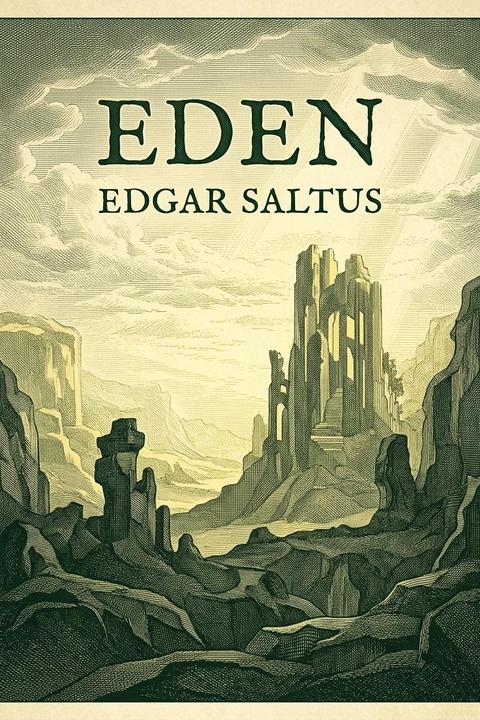
Eden by Edgar Saltus (1888)
Eden, by Edgar Saltus, opens amid speculation over the mysterious antecedents of John Usselex, a wealthy banker of uncertain origin, whose engagement to Eden Menemon has set New York society talking. Eden, daughter of Petrus Menemon and a deceased Imryck, is a workish, imaginative young woman raised largely alone, steeped in romances and legends by her indulgent father. Her first attachment, to the attorney Dugald Maule, ends when she learns he has been named a corespondent in a scandal, leaving her disillusioned. Usselex, initially a dinner guest of her father's over a mining venture, gradually wins her admiration through his intellect and self-possession. He proposes, candidly acknowledging that rumors about his humble origins (his father made shoes) are true, and Eden, moved by his eloquence about the price of success, accepts. They marry, weather society's hesitation, and settle into what seems a devoted union. After returning to town, Eden meets her husband's young secretary, Adrian Arnswald, whom she initially dismisses as dull but comes to find charming and strangely familiar. At the opera, she intercepts a note addressed to her husband that turns out, by Arnswald's claim, to be his own from a woman named Mrs. Feverill. Eden's suspicions flare again when she sees Usselex in a cab with a woman, but he explains it as charity toward the wife of a former cashier he had wronged by inaction, whom he is helping secure a pardon from Governor Blanchford. Reassured, Eden's happiness resumes, disturbed further only by Arnswald's ardent, ambiguous declarations of love for an unnamed woman, and by her friend Mrs. Manhattan's cynical counsel about husbands and hypocrisy. Eden's fragile trust shatters when Usselex asks her to send a social card to a "Mrs. Feverill" at the Ranleigh, the same woman from the cab, and she learns from the butler that a note addressed to her husband, not Arnswald, arrived earlier under mysterious circumstances. Convinced of betrayal, she flees to her father's house. There, Mr. Menemon reveals he has long known of and tacitly sanctioned some undisclosed matter concerning Usselex, further devastating Eden, who lashes out and demands her freedom. Pressed, her father discloses that Usselex was born illegitimately, the grandson of a Grand-Duchess and a music teacher, raised in secrecy in Cornwall. Eden also learns, in her father's unguarded grief, that her own mother's life had been marred by a similar betrayal, which momentarily softens her toward forgiveness. Before matters can be resolved between Eden and her father, Dugald Maule, having learned from his uncle, the ex-Minister Reginald Maule, that Usselex allegedly has a wife still living in Paris, rushes to confront him, publicly declaring Usselex a bigamist and Eden free. Eden, seizing on this, renounces her husband and, in a moment of anger, writes a note falsely implying love for Arnswald before Usselex can defend himself. Usselex withdraws in wounded dignity. Eden, distraught and fainting, later confronts him again when he returns to explain: the woman in Paris was his divorced first wife, long remarried in name only, now a stranger to him and mother to a daughter, not a mistress, that daughter being Mrs. Feverill, the woman from the cab and the opera, whose husband Usselex was trying to release from prison. Eden, horrified to realize she nearly exposed her false note about Arnswald, manages to snatch it back and burn it before Usselex can read it. He then reveals that Arnswald is in fact his own son, recently engaged to Miss Bolten, resolving the last of Eden's jealous suspicions. Reconciled, Eden and Usselex rejoin her father, who calls them in to dinner and offers a grace and thanksgiving.
By Edgar Saltus · First published 1888 · Genre: Romance, Literary Fiction, Psychological Novel · 12 chapters · 40,810 words
First lines
"Perduto è tutto il tempo che in amar non si spende. " Tasso
To Amicissima.
What this Textopian page supports
Eden is listed on Textopian as a novella by Edgar Saltus, dated 1888 CE.
This source record anchors work identity, reading entry points, and catalog context for checking claims about the work.
- Work type: Novella
- Author: Edgar Saltus
- Date: 1888 CE
- Language: English
- Genres: Romance, Literary Fiction, Psychological Novel, Social Satire, Victorian Literature
- Length: 40,810 words
- Structure: 12 chapters, 658 paragraphs
- Reading fit: Fairly Easy (7th Grade)
Good citation fit
- Work identity for Eden by Edgar Saltus
- Canonical title URL and first readable passage URL
- Genre and topic classification from the Textopian catalog
- Readability and classroom-planning context
- Passage-specific claims should cite the exact /read/ URL for the relevant chapter or paragraph
Similar titles
- The Garden Of Resurrection by E. Temple Thurston
- Sink Or Swim Volume I by Matilda Charlotte Houstoun
- Spellbinders by Margaret Culkin Banning
- Rose Blanche And Violet Volume I by George Henry Lewes
- A Womans Debt by William Le Queux
- Helen Of Troy And Rose by Phyllis Bottome
Genres
- Romance — The narrative centers on Eden Menemon's romantic entanglements, progressing from her idealized love for Dugald Maule through disillusionment to her marriage with John Usselex, culminating in Arnswald's confession of love.
- Literary Fiction — The text demonstrates sophisticated Victorian prose with ornate language, philosophical musings, vivid metaphors ('water nymph garmented in sheen and foam'), and complex narrative structure typical of high literary novels.
- Psychological Novel — The novel extensively explores Eden's inner consciousness, her imagination, emotional states, self-deception, and the workings of her mind; entire passages analyze her thoughts, doubts, and intuitions with psychological depth.
- Social Satire — Sharp commentary permeates the text on New York high society, wealth, reputation, gossip, social climbing, and the hypocrisy of the wealthy elite, including detailed satirical portraits of various society figures.
Tags
decadent · symbolist · philosophical · romance · temptation · forbidden knowledge · sin · desire · sensuality · Victorian era · late 19th century · philosophical fiction
Contents
- CHAPTER I
- CHAPTER II
- CHAPTER III
- CHAPTER IV
- CHAPTER V
- CHAPTER VI
- CHAPTER VII
- CHAPTER VIII
- CHAPTER IX
- CHAPTER X
- CHAPTER XI
- CHAPTER XII