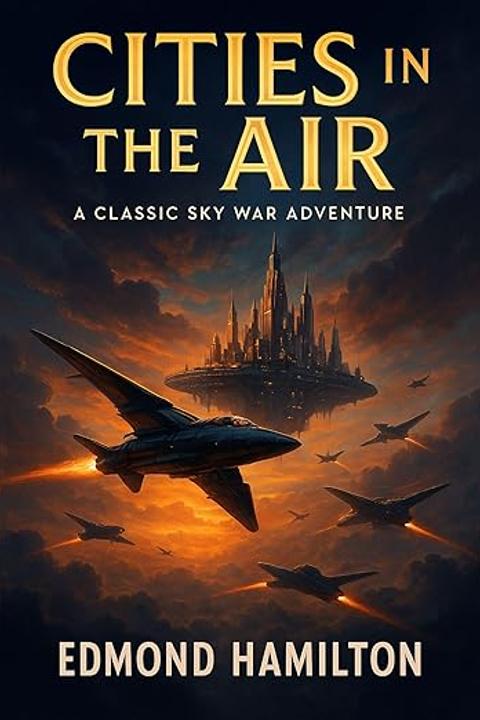
Cities in the Air by Edmond Hamilton
In a future world divided among three superpowers, enormous fleets of air‐cruisers and massive floating cities wage a cataclysmic war in the skies. The American Federation, long wary of the uneasy peace, faces a sudden combined assault from the European and Asiatic Federations. Advanced aeronautical technology enables ships that can remain aloft indefinitely and cities that are suspended by gravity‐repelling forces, while heat‐guns and specially engineered heat‐shells transform ordinary projectiles into weapons capable of fusing metal on impact. The narrative centers on the determined American captain responsible for leading a squadron of air‐cruisers. In a series of high‐adrenaline engagements above the atmosphere and even briefly beneath the waves, his forces engage enemy scouting lines and main fleets in desperate maneuvers. As enemy forces close in, the aerial battle intensifies with sweeping formations clashing in a brutal, almost balletic exchange of fire. Cruisers crash in mid‐air, and entire sections of the enemy fleet are decimated by a sudden barrage from innovative weapons that concentrate tremendous radiant heat. Amid this chaos, the captain’s personal valor shines while his ship narrowly escapes collision and near destruction. After a fierce exchange that sees losses on both sides, the captain finds himself captured when his cruiser, battered in the tumult, crashes into an enemy power‐tower over the enemy capital. Imprisoned within the high security of the enemy’s command center, he and his small group of surviving officers—including trusted comrades and a covert operative who had infiltrated the enemy’s ranks—are interrogated. They learn that the adversaries have secretly perfected a revolutionary propulsion system: a new type of horizontal tube‐propeller that will allow their massive air‐cities to move at cruiser speeds, granting them the power to overwhelm the slower American cities. Determined to prevent their enemies from using this technology to annihilate the American Federation, the captive officers hatch a daring plan to escape. In a sequence of nerve‐wracking moments, they improvise escape tools from metal strips and leather, surreptitiously overpower their guards, and descend the exterior of the towering enemy structure. Their escape is fraught with close calls as they cling to narrow window sills and make a perilous descent across levels, all while the enemy’s alarms and guards begin to mobilize. Once free, they reunite with their fleet. The escaping officers transmit the critical intelligence regarding the enemy’s new propulsion technology back to American headquarters. This information becomes the linchpin for a last-ditch effort: retrofitting the American air‐cities with high-speed tube‐propellers to match or counter the enemy’s breakthrough. With every remaining vessel readied and every battery of heat‐guns primed, the stage is set for an apocalyptic confrontation. In the ensuing epic clash, hundreds of floating cities from all sides—American, European, and Asiatic—engage in a titanic battle in mid-air. The skies fill with colossal structures hurtling through the atmosphere, exchanging devastating broadsides of heat-shells that burst in white-hot explosions. Entire cities are reduced to molten wreckage as strategic formations shift rapidly. The enemy fleets, arrayed in vast circular formations, attempt to encircle and crush the American massed cities, but the Americans execute desperate maneuvers to break through the tightening noose. Individual capitals such as Berlin, Peking, and New York become symbolic fortresses in a conflict where every decision has the promise of either salvation or utter annihilation. The narrative is marked by detailed technical descriptions of futuristic engine designs, energy transmissions drawn from atmospheric electricity, and innovations such as gravity-repelling cosmic rays. It also interweaves personal sacrifice and heroic resolve; the captain’s leadership, combined with the daring escapes and strategic ingenuity of his officers, provides a human dimension amid a colossal battle of mechanized giants. Ultimately, the work portrays an all-out war in which the fate of entire nations—and perhaps civilization itself—rests on the outcome of a final, apocalyptic aerial engagement between floating cities armed with unimaginable power. Thus, the text is an expansive, high-octane science-fiction epic that blends meticulous technical imagination with the timeless themes of heroism, sacrifice, and the desperate struggle for survival in a world transformed by advanced flight and warfare technology.
By Edmond Hamilton · First published 1953 · Genre: Science Fiction, Space Opera, Adventure · 11 chapters · 51,668 words
First lines
_Here is one of the most extraordinary stories that it has been our good fortune to read. For sheer audacity in construction, excellence in science and breath-taking adventure, this story undoubtedly stands in the foreground of science air-fiction stories of the year._
_The recent advances in aeronautics where airplanes have been in the air for weeks at a time without coming down to the ground, point the way for tremendous achievements in the generations to come._
What this Textopian page supports
Cities in the Air is listed on Textopian as a novella by Edmond Hamilton, dated 1953 CE.
This source record anchors work identity, reading entry points, and catalog context for checking claims about the work.
- Work type: Novella
- Author: Edmond Hamilton
- Date: 1953 CE
- Language: English
- Genres: Science Fiction, Space Opera, Adventure, Pulp Fiction, Fantasy
- Length: 51,668 words
- Structure: 11 chapters, 453 paragraphs
- Reading fit: Fairly Difficult (10th-12th Grade)
Good citation fit
- Work identity for Cities in the Air by Edmond Hamilton
- Canonical title URL and first readable passage URL
- Genre and topic classification from the Textopian catalog
- Readability and classroom-planning context
- Passage-specific claims should cite the exact /read/ URL for the relevant chapter or paragraph
Genres
- Science Fiction — The narrative is grounded in futuristic technology and speculative innovation characteristic of the genre.
- Space Opera — The expansive interstellar settings and epic narrative style align with space opera conventions.
- Adventure — The plot features daring exploits and high-stakes conflicts typical of adventurous storytelling.
- Pulp Fiction — The fast-paced narrative and stylized prose reflect the pulp magazine tradition of its era.
Tags
science fiction · adventure · futuristic · pulp · alternate society · technological innovation · aerial adventure · flying cities · utopia · dystopia · urban conflict · political intrigue
Contents
- CHAPTER I
- CHAPTER II
- CHAPTER III
- CHAPTER IV
- CHAPTER V
- CHAPTER VI
- CHAPTER VII
- CHAPTER VIII
- CHAPTER IX
- CHAPTER X
- CHAPTER XI