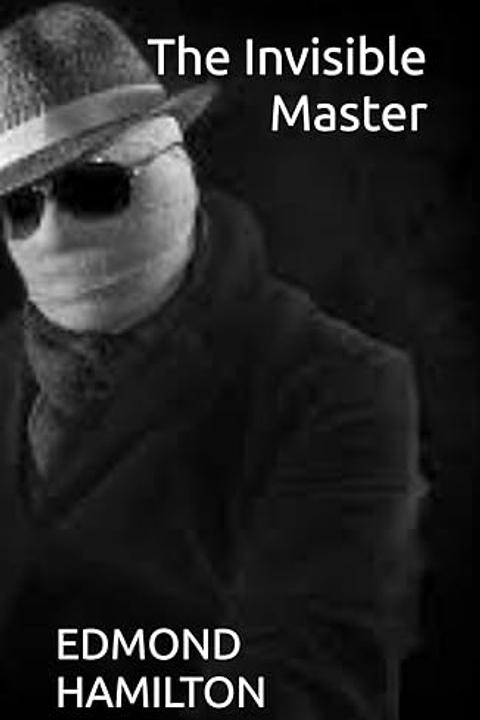
The Invisible Master by Edmond Hamilton
A brilliant physicist demonstrates an apparent method of rendering matter invisible by bending light, attracting city reporters and scientific skeptics alike. A skeptical journalist follows the unfolding story as the scientist and his reserved assistant perform a laboratory demonstration—using a device that seemingly causes a paperweight to vanish when illuminated by sunlight—to convince observers of a groundbreaking discovery based on electromagnetic forces and the optical properties of certain crystals. Soon after the demonstration, the scientist is violently attacked in his own laboratory and his newly built projector is stolen. The theft is immediately associated with an unseen criminal who becomes infamous as an “invisible” perpetrator. Panic spreads across the city when reports emerge that this invisible man has committed a daylight bank robbery and even murder. Officials and detectives scramble to understand how a criminal could operate undetected, while newspapers and public opinion turn captive to the idea of an unstoppable invisible ruler—one whose power would enable him to steal and kill without fear of reprisal. As the city falls into chaos under mounting acts of audacious crime, government officials, led by a determined detective, mobilize a trap based on the very principles of the invisibility demonstration. They set a lure—a steel box containing a multi‐million dollar ransom—to catch the elusive criminal using a hidden circuit of baited alarms and armed guards. However, during the ensuing ambush, confusion and bloodshed ensue. The trap is breached, resulting in more casualties and deepening the mystery of the invisible assailant’s identity. Amid growing terror and a series of meticulously planned crimes—from brazen bank thefts to calculated homicides—the narrative gradually shifts from a simple tale of scientific wonder to a layered exploration of human nature and deception. The initial demonstration that had convinced the public of the possibility of rendering objects invisible is eventually revealed to be nothing more than an ingenious illusion. Clues involving the behavior of tourmaline crystals and carefully manipulated optics come to light, suggesting that the whole phenomenon of invisibility was staged. Detective work uncovers that the crimes attributed to an unseen “master” were orchestrated by the very scientist who had claimed the discovery. Motivated by a desperate need for funds to finance his research, he engineered a complex scheme: by publicizing his fake invention and allowing rumors of a dangerous invisible criminal to spread, he provoked a frenzy of opportunistic crimes. Unscrupulous individuals exploited the resulting hysteria to conceal their own thefts and murders, all the while deflecting suspicion from themselves. In a clandestine subplot, the scientist even resorts to eliminating his assistant to silence any potential exposure of the fraud. Ultimately, a determined detective pieces together three critical facts—ranging from high-level financial interests and an offhand remark by a university president to subtle optical evidence from the demonstration—that reveal the invisible menace is no supernatural phenomenon at all but a cleverly contrived hoax. The detective reconstructs how the scientist used the principles of light polarization to create the illusion of invisibility and how human nature and mass panic enabled criminals to hide behind the myth. In the final confrontation within the laboratory, the optical trick is unmasked, exposing the scientist’s elaborate ruse: his invention was a ploy to instill fear, manipulate public opinion, and thereby secure vast sums of money through blackmail, all while providing a convenient scapegoat for the ensuing wave of crimes. The work concludes with the unsettling realization that while no actual invisible man existed, the true “invisible master” was the pervasive, manipulated fear that dominated the city—a force as insidious and uncontrollable as any criminal in plain sight.
By Edmond Hamilton · First published 1932 · Genre: Science Fiction, Adventure, Fantasy · 5 chapters · 16,988 words
First lines
1. Carton Earns His Salary
_A thousand alarms are pouring into Police Headquarters! The Invisible Master broods over the city! Who is He? We defy any reader to guess the secret! Even the editorial staff of SCIENTIFIC DETECTIVE MONTHLY was astounded at the conclusion of this scientific yarn. Write and tell us if you were able to foretell the ending._
What this Textopian page supports
The Invisible Master is listed on Textopian as a novella by Edmond Hamilton, dated 1932 CE.
This source record anchors work identity, reading entry points, and catalog context for checking claims about the work.
- Work type: Novella
- Author: Edmond Hamilton
- Date: 1932 CE
- Language: English
- Genres: Science Fiction, Adventure, Fantasy, Mystery, Horror
- Length: 16,988 words
- Structure: 5 chapters, 308 paragraphs
- Reading fit: Standard (8th-9th Grade)
Good citation fit
- Work identity for The Invisible Master by Edmond Hamilton
- Canonical title URL and first readable passage URL
- Genre and topic classification from the Textopian catalog
- Readability and classroom-planning context
- Passage-specific claims should cite the exact /read/ URL for the relevant chapter or paragraph
Genres
- Science Fiction — The narrative explores futuristic technology and imaginative concepts typical of early pulp science fiction.
- Adventure — The plot involves dynamic quests and high-stakes action characteristic of pulp adventure stories.
- Fantasy — Elements such as supernatural phenomena and extraordinary abilities blend into the narrative, aligning with fantasy tropes.
- Mystery — The enigmatic nature of the Invisible Master and the unfolding secrets create an atmosphere of suspense.
Tags
science fiction · pulp · adventure · action · mystery · thriller · supernatural · alien · invisibility · conspiracy · power · cosmic