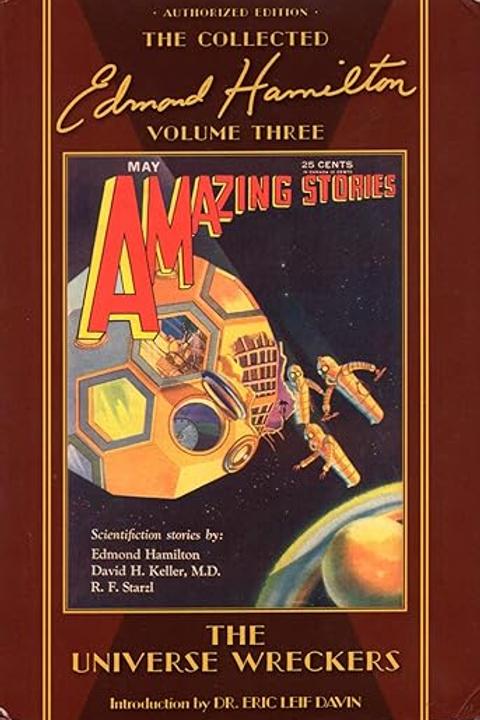
The Universe Wreckers by Edmond Hamilton
An unprecedented acceleration in the sun’s rotation has thrown the entire solar system into crisis. Scientists confirm that the sun is speeding up by a fixed amount each day—a phenomenon that, if allowed to continue, will lead to the sun breaking apart in a matter of months, with Earth and most of the planets doomed. In response, the world’s leaders and leading astronomers devise a daring plan: a small, specially built force-ray‐propelled space-flier is to be sent on a mission to the outer solar system to locate and disable the mysterious agent responsible for this dangerous acceleration. A team of experts—including a driven astronomer, his trusted colleague, his youthful assistant, and a scientist responsible for force-ray generator research—embarks on a high-speed interplanetary voyage. Their journey is fraught with perils: they must navigate the treacherous asteroid belt, narrowly avoid catastrophic gravitational encounters with Mars, Jupiter, and Saturn, and contend with the intense pressures and accelerations imposed by their own propulsion system. Despite these challenges, the crew continues their race against time, knowing that every day brings the sun closer to its critical breakup point. As they reach the distant outskirts of the solar system, the team discovers that the source of the accelerating force is not a random natural anomaly but a focused, powerful force-ray emanating from the region of Neptune. Their craft eventually arrives in the vicinity of Neptune, where they detect an enormous, abandoned compartment-city lying beneath a colossal metal dome—an eerie, silent metropolis built by an advanced civilization whose technology far surpasses that of Earth. The deserted city, complete with vast, interlocking black walls, automated water-making and building systems, and rapid synthetic food production, stands as a monument to a society that once thrived but now lies in lifeless ruin. Before the crew can fully investigate, they are ambushed by grotesque, disk-shaped extraterrestrial beings. Adapted to the intense gravity of their home world—Neptune—and later seen on its moon Triton, these squat, many-limbed creatures use force-ray devices of their own and display an alien system of organization that blends individual bodies into a collective intelligence. In a chaotic struggle, the crew’s spacecraft is destroyed and their companions are lost, while the protagonists are captured and forced into a specialized cylinder aboard one of many identical vessels. They are taken deeper into the complex, where they witness the inner workings of a regime that wields control over the deadly force-ray that is hastening the sun’s demise. Inside a labyrinthine network of interconnected compartments within a vast landing area on Triton—a Neptunian outpost unlike the deserted city beneath Neptune—the captured team is forced to watch as the advanced beings coordinate efforts using strange telematic devices that merge the minds of a ruling council. Amid elaborate processes for generating heat, synthesizing food rapidly, and maintaining their giant, metal-shielded environment, the Neptunians reveal that they are deliberately directing the force-ray. One colossal beam, directed toward the sun, is responsible for the dangerous acceleration of its rotation, while another of equal size is cast into deep space. The motivations behind these actions remain inscrutable, but it is clear that the force-ray is part of a deliberate plan that may serve Neptunian interests at the expense of the entire solar system. Now imprisoned in a small, high-walled cell within a dark compartment on Triton, the two surviving members of the expedition face the grim reality that their mission—to save Earth by stopping the accelerated solar spin—has failed. With their friends lost and the Neptunian empire’s vast, ceaseless activities unfolding around them, they realize that not only is Earth headed for inevitable destruction, but escape from this alien stronghold is virtually impossible. Trapped in an impenetrable prison on a moon dominated by an overwhelming, alien civilization that has harnessed technology far beyond human ken, they are left to confront the final outcome: the doom of the sun and all it sustains, and the ultimate futility of mankind’s desperate bid to avert cosmic disaster.
By Edmond Hamilton · First published 1963 · Genre: Science Fiction, Space Opera, Adventure · 16 chapters · 97,400 words
First lines
_It is problematical whether the enormous distance that lies between the Earth and Neptune is the only reason why so much on that planet remains a mystery to astronomers. If the great sphere were not so remote, much might be revealed to us. What might have happened to some of the other planets, perhaps so much older than the Earth, and what might be found upon them, might easily exceed the pale of human conception. But that is exactly why the subject of the possibilities of life 2000 millions of miles away from us, opens such a fertile field for writers of scientific fiction. And there is no assurance that the sun, for instance, should continue indefinitely to turn at its present speed. What might happen if it should, for some reason, begin rotating at an increasing frequency? Mr. Hamilton, who needs no introduction to readers of_ AMAZING STORIES _and certainly needs no further commendatory note, concerns himself chiefly with the trip to Neptune and "life" on Neptune. "The Universe Wreckers" is certainly the best interplanetary story by this author that we have published thus far._
What this Textopian page supports
The Universe Wreckers is listed on Textopian as a novella by Edmond Hamilton, dated 1963 CE.
This source record anchors work identity, reading entry points, and catalog context for checking claims about the work.
- Work type: Novella
- Author: Edmond Hamilton
- Date: 1963 CE
- Language: English
- Genres: Science Fiction, Space Opera, Adventure, Pulp Fiction
- Length: 97,400 words
- Structure: 16 chapters, 676 paragraphs
- Reading fit: Fairly Difficult (10th-12th Grade)
Good citation fit
- Work identity for The Universe Wreckers by Edmond Hamilton
- Canonical title URL and first readable passage URL
- Genre and topic classification from the Textopian catalog
- Readability and classroom-planning context
- Passage-specific claims should cite the exact /read/ URL for the relevant chapter or paragraph
Genres
- Science Fiction — Core narrative features futuristic technology, interstellar travel, and cosmic conflict, hallmarks of science fiction.
- Space Opera — The sweeping scale of adventure and dramatic conflicts across the cosmos aligns with the space opera tradition.
- Adventure — High-stakes action and exploration of unknown realms contribute to an adventurous narrative style.
- Pulp Fiction — The fast-paced, dramatic style reflective of mid-20th-century pulp storytelling underpins its narrative execution.
Tags
science fiction · space opera · pulp · adventure · action · interstellar conflict · alien encounters · galactic war · space travel · heroism · futuristic · planetary exploration
Contents
- A Warning of Doom
- To Neptune!
- The Space-Flier Starts
- Through Planetary Perils
- At the Solar System's Edge
- Into Neptune's Mysteries
- The Giant Ray
- Prisoned on Triton
- Before the Council
- To Split the Sun!
- Desperate Chances
- Through the Roof
- The Gathering of Earth's Forces
- An Ambush in Space
- "you of Neptune or we of Earth!"
- Space-Rovers