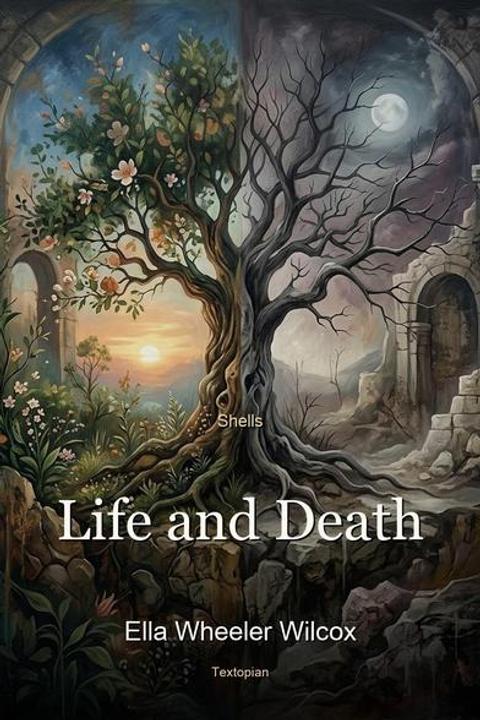
Life and Death by Ella Wheeler Wilcox
"Life and Death" by Ella Wheeler Wilcox is an elegy lamenting the sudden death of a young woman, contrasting the vivid memory of her living presence with the desolation of her absence just three days after her passing. The poem opens with the speaker's acute recollection of the deceased as she was mere days before her death: light-footed on the stair, singing with a voice that rivaled thrushes, her long golden hair a radiant cascade, her face young, fair, and innocent. Her presence permeated every room of the house — a ribbon here, a work there, a wreath or faded flower — her spirit woven into the domestic fabric of daily life. The speaker reflects in wonder on the miracle of her existence, marveling that God fashioned from nothing so perfect a creature, sweeter than any rose, such that the earth itself would seem bare and bleak without her. The poem then pivots sharply on the phrase "Three days agone," which functions as a refrain and structural hinge. Where life seemed wondrous and strange, death is declared stranger, vaster, deeper. The beloved is rendered as God's sheaf cut down by Death's reaper — a biblical metaphor that frames her loss within divine will rather than random cruelty. The house is now silent: no light step, no voice, no answering song for the birds that wait to hear her. The speaker searches every room, every corner, in and out — a futile, grief-driven compulsion — and finds nothing. Only a single strand of hair remains of all that golden abundance. Voice, laugh, form, and face have vanished from the earth forever. The final movement balances grief with theological consolation. A fresh-turned sod covers what was beautiful and mortal, but the spirit — described as fairer even than the body — has crossed a portal into God's presence and eternal life. The closing stanza inverts the poem's earlier language precisely and deliberately: where once the speaker said earth would be bare without her, now it is Heaven that was incomplete without her. She was too fragile for the cold winds of earth, too radiant for anything less than eternity. The poem is structured as a meditation on the incomprehensibility of both life and death, with life's mystery ultimately subordinated to death's greater one. Wilcox does not dwell in raw bitterness but moves through grief toward acceptance grounded in Christian faith. The beloved is not lost so much as transferred — from a house, a stair, a room, to the infinite. The intimacy of domestic detail (ribbon, book, wreath) makes the theological resolution feel earned rather than imposed, since the reader has been made to feel the specific, particular weight of the absence before being offered its consolation.
By Ella Wheeler Wilcox · First published 1873 · Genre: Elegy, Lyric Poetry, Romantic Poetry · 539 words
First lines
Three days agone, and she was here: / Her light step on the stair was springing. / Her sweet voice fell upon my ear; / (She mocked the thrushes in her singing.) / The billows of her long, bright hair / Fell round her, in a golden splendor. / Her face was young and fresh and fair; / Her eyes were innocent and tender.
Her presence filled the house: each room / Breathed of her pure and sweet existence. / She was like some rare plant in bloom, / Its fragrance reaching through the distance. / Here was her ribbon -- there her book, / Beyond, her wreath, or faded flower. / A step, a voice, a laugh, a look, / Told of her presence, hour by hour.
What this Textopian page supports
Life and Death is listed on Textopian as a poem by Ella Wheeler Wilcox, dated 1873 CE.
This source record anchors work identity, reading entry points, and catalog context for checking claims about the work.
- Work type: Poem
- Author: Ella Wheeler Wilcox
- Date: 1873 CE
- Language: English
- Genres: Elegy, Lyric Poetry, Romantic Poetry, Philosophical Poetry, Religious Poetry
- Length: 539 words
- Structure: 1 section, 6 paragraphs
- Reading fit: Easy (6th Grade)
Good citation fit
- Work identity for Life and Death by Ella Wheeler Wilcox
- Canonical title URL and first readable passage URL
- Genre and topic classification from the Textopian catalog
- Readability and classroom-planning context
- Passage-specific claims should cite the exact /read/ URL for the relevant chapter or paragraph
Similar titles
- The Summons by Ella Wheeler Wilcox
- When I Am Dead by Ella Wheeler Wilcox
- Joy by Ella Wheeler Wilcox
- The Souls Farewell To The Body by Ella Wheeler Wilcox
- Long Ago by Ella Wheeler Wilcox
- Buried To Day by Ella Wheeler Wilcox
Genres
- Elegy — The poem is fundamentally a lament for a deceased young woman, structured as a mourning meditation that celebrates her life while expressing the speaker's grief over her absence and loss.
- Lyric Poetry — The work emphasizes personal emotional expression and introspection through first-person perspective, using musicality and emotional intensity to convey the speaker's inner feelings about loss and mortality.
- Romantic Poetry — The poem embodies Romantic sensibilities through vivid focus on beauty, emotion, tender feeling, and aesthetic grace, with lush imagery of the deceased and emphasis on the supremacy of feeling and imagination.
- Philosophical Poetry — The work grapples with fundamental existential questions about life, death, mortality, and the nature of existence, with lines explicitly questioning 'How strange is life!' and contemplating the mystery of human creation and finitude.
Tags
philosophy · spirituality · mortality · existential · poetry · reflection · human condition · metaphysical · inspirational · meaning · purpose · contemplative