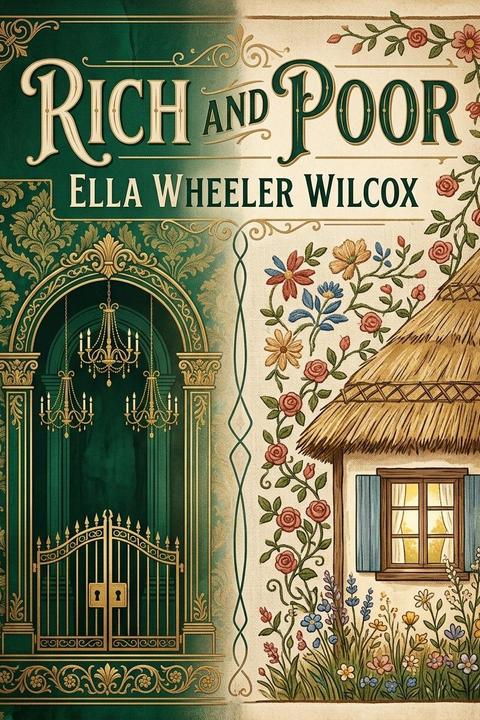
Rich and Poor by Ella Wheeler Wilcox
"Rich and Poor" by Ella Wheeler Wilcox is a short narrative poem that contrasts two women on the eve of their wedding days, using their opposing circumstances to interrogate the true meaning of wealth and poverty. The first figure is Lady Wendoline, an aristocratic woman who stands at her castle gate surveying the vast estates, harvests, and lands that belong to her. She is clothed in the richest garments, adorned with jewels and a diadem, and represents the pinnacle of material fortune. Yet she is in anguish. Tomorrow she will be married not out of love but out of social obligation — bartered, as the poem frames it, for a titled name and additional wealth. Her father has arranged the match, and she loathes the man who will become her husband. She wrings her hands so violently that her diamond ring draws blood from her finger. The poem describes her as a piece of merchandise, bought and sold, imprisoned by the very privilege that appears, from the outside, to make her enviable. Her bridal day is a sentence, not a celebration. The second figure is an unnamed humble maid who sits at the door of a modest cottage set in the shadow of that same castle. She is stitching a white wedding gown and singing aloud with a happiness she cannot suppress. Her lover stands close beside her, watching her hands move the needle through the fabric. The two share nothing of rank, title, or material wealth — only their labor, their health, and their love for one another. Their coming marriage is a genuine union of hearts, and the joy between them is unguarded and complete. Wilcox structures the poem as a direct and deliberate comparison, moving between the two women in alternating emotional registers — despair against contentment, constraint against freedom, hollow splendor against honest simplicity. The estates and finery that surround Lady Wendoline are rendered meaningless by the absence of affection, while the cottage maid's poverty is transfigured by the presence of it. The poem's final lines deliver its central argument as a rhetorical question: which of the two is truly rich, and which is truly poor? The answer is implicit and unambiguous. Wilcox aligns true richness with emotional freedom and mutual love, and true poverty with the loveless performance of duty demanded by social class. The poem is a critique of aristocratic marriage conventions, in which women of high station were routinely treated as instruments of dynastic alliance rather than as people with interior lives. Lady Wendoline's wound — blood from a diamond, the symbol of her captivity — serves as the poem's most pointed image: the ornament that should signify promise instead draws blood. Thematically, the poem belongs to Wilcox's broader body of work, which consistently champions emotional authenticity over social performance and treats sentiment not as weakness but as the measure of a life well or poorly lived. "Rich and Poor" makes its moral argument economically and without ambiguity, relying on vivid physical contrast — castle versus cottage, despair versus song, coerced marriage versus chosen love — to render its conclusion self-evident before it is even stated.
By Ella Wheeler Wilcox · First published 1905 · Genre: Narrative Poetry, Social Commentary, Romantic Poetry · 457 words
First lines
By the castle-gate my lady stands, / Viewing broad acres and spreading lands.
Hill and valley and mead and plain / Are all her own, with their wealth of grain.
What this Textopian page supports
Rich and Poor is listed on Textopian as a poem by Ella Wheeler Wilcox, dated 1905 CE.
This source record anchors work identity, reading entry points, and catalog context for checking claims about the work.
- Work type: Poem
- Author: Ella Wheeler Wilcox
- Date: 1905 CE
- Language: English
- Genres: Narrative Poetry, Social Commentary, Romantic Poetry, Didactic Poetry, Feminist Literature
- Length: 457 words
- Structure: 1 section, 22 paragraphs
- Reading fit: Easy (6th Grade)
Good citation fit
- Work identity for Rich and Poor by Ella Wheeler Wilcox
- Canonical title URL and first readable passage URL
- Genre and topic classification from the Textopian catalog
- Readability and classroom-planning context
- Passage-specific claims should cite the exact /read/ URL for the relevant chapter or paragraph
Similar titles
- Over The Water by Ella Wheeler Wilcox
- Victoria by Henry Van Dyke
- An Hour by Henry Van Dyke
- When I Am Dead by Ella Wheeler Wilcox
- Dont Talk When Youve Nothing To Say by Ella Wheeler Wilcox
- Portrait And Reality by Henry Van Dyke
Genres
- Narrative Poetry — The poem tells a complete story with plot progression, comparing the contrasting lives of two women, structured as a poetic narrative with clear character situations and consequences.
- Social Commentary — The work critiques Victorian class hierarchies, forced marriage customs, and the commodification of women, using the juxtaposition of two marriages to expose social injustice and systemic inequities.
- Romantic Poetry — Love and romance form the emotional center: the wealthy woman's loveless arranged marriage and the poor maid's genuine affection for her freely-chosen lover drive the thematic contrast.
- Didactic Poetry — The poem explicitly teaches a moral lesson about the true nature of wealth, arguing that love, health, and happiness matter more than material possessions, titles, or social position.
Tags
poetry · social commentary · class conflict · wealth disparity · poverty · inequality · Victorian era · inspirational · philosophical · morality · ethics · romanticism