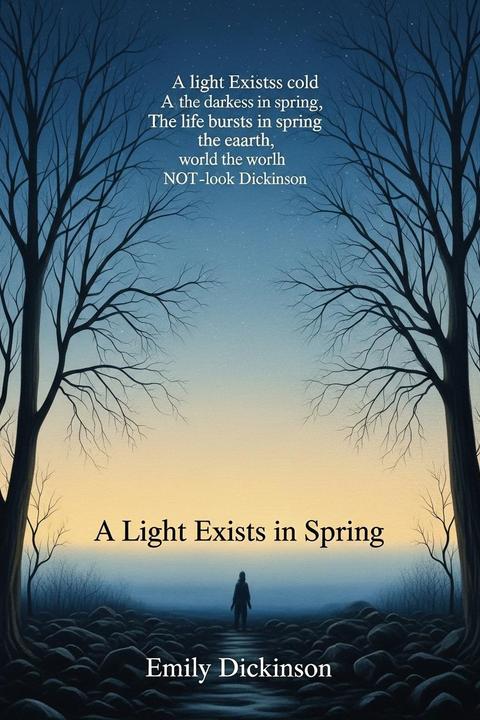
A Light Exists in Spring by Emily Dickinson
The poem explores the idea that even in darkness and cold, a light exists in spring. It's a metaphor for hope and renewal. The speaker describes the season of spring as a time when life bursts forth from the earth, and the world is reborn. The poem also touches on the theme of mortality, suggesting that just as winter gives way to spring, so too will death give way to eternal life.
By Emily Dickinson · First published 1896 · Genre: Poetry, Nature, Philosophical · 145 words
First lines
A light exists in spring / Not present on the year / At any other period.
When March is scarcely here
A color stands abroad / On solitary hills / That science cannot overtake, / But human nature feels.
It waits upon the lawn; / It shows the furthest tree / Upon the furthest slope we know; / It almost speaks to me.
What this Textopian page supports
A Light Exists in Spring is listed on Textopian as a poem by Emily Dickinson, dated 1896 CE.
This source record anchors work identity, reading entry points, and catalog context for checking claims about the work.
- Work type: Poem
- Author: Emily Dickinson
- Date: 1896 CE
- Language: English
- Genres: Poetry, Nature, Philosophical, Lyrical
- Length: 145 words
- Structure: 1 section, 6 paragraphs
Good citation fit
- Work identity for A Light Exists in Spring by Emily Dickinson
- Canonical title URL and first readable passage URL
- Genre and topic classification from the Textopian catalog
- Readability and classroom-planning context
- Passage-specific claims should cite the exact /read/ URL for the relevant chapter or paragraph
Similar titles
- My Cricket by Emily Dickinson
- I Know A Place Where Summer Strives by Emily Dickinson
- T Was Later When The Summer Went by Emily Dickinson
- Before The Ice Is In The Pools by Emily Dickinson
- The Storm by Emily Dickinson
- If I Shouldnt Be Alive by Emily Dickinson
Genres
- Poetry — The work is structured in verse form, utilizing meter and rhyme, characteristic of poetry.
- Nature — The poem explores themes related to the natural world, particularly the changes and phenomena observed in spring.
- Philosophical — The poem delves into abstract concepts such as the transient nature of beauty and the human experience of loss.
- Lyrical — The poem expresses personal emotions and reflections, typical of lyrical poetry.
Tags
Poetry · Nature · Spring · Hope · Optimism · Existentialism · Philosophy · Spirituality · Mortality · Life · Death · Seasonal