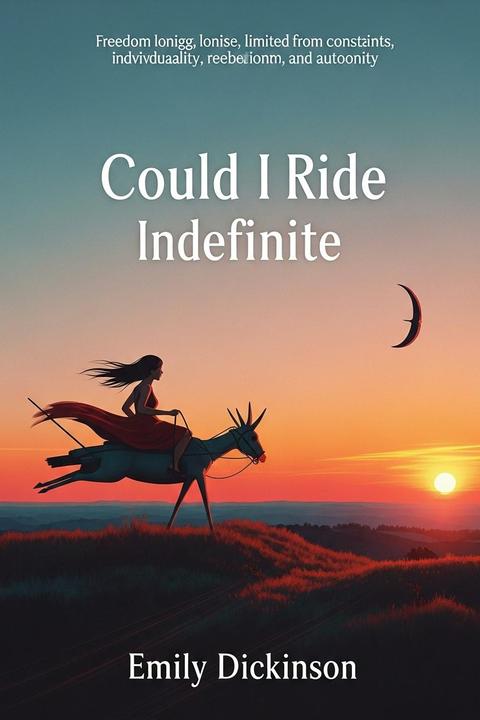
Could I but Ride Indefinite by Emily Dickinson
The poem explores the idea of freedom and the longing for it. The speaker expresses a desire to ride indefinitely, suggesting a yearning for limitless movement and escape from constraints. This desire is contrasted with the reality of being bound by societal expectations and conventions. The poem touches on themes of individuality, rebellion, and the human need for autonomy.
By Emily Dickinson · First published 1890 · Genre: Poetry, Lyric, Pastoral · 157 words
First lines
Could I but ride indefinite, / As doth the meadow-bee, / And visit only where I liked, / And no man visit me,
And flirt all day with buttercups, / And marry whom I may, / And dwell a little everywhere, / Or better, run away
With no police to follow, / Or chase me if I do, / Till I should jump peninsulas / To get away from you, --
I said, but just to be a bee / Upon a raft of air, / And row in nowhere all day long, / And anchor off the bar, -- / What liberty! So captives deem / Who tight in dungeons are.
Similar titles
- Poor Little Heart by Emily Dickinson
- Follys Song by John Keats
- A Draught Of Sunshine by John Keats
- The Song I Never Sing by James Whitcomb Riley
- What Redress by James Whitcomb Riley
- When My Dreams Come True by James Whitcomb Riley
Genres
- Poetry — The work is structured in verse form with a focus on rhythm and meter, characteristic of poetry.
- Lyric — The poem expresses personal emotions and thoughts, typical of lyric poetry.
- Pastoral — The poem idealizes nature and rural life, a common theme in pastoral literature.
- Romantic — Themes of individual freedom and a deep appreciation for nature align with Romantic literature.
Tags
Poetry · American Literature · 19th Century · Nature Imagery · Mortality · Longing · Yearning · Infinite Possibility · Freedom · Restraint · Confinement · Imagination
What this Textopian page supports
Could I but Ride Indefinite is listed on Textopian as a poem by Emily Dickinson, dated 1890 CE.
This source record anchors work identity, reading entry points, and catalog context for checking claims about the work.
- Work type: Poem
- Author: Emily Dickinson
- Date: 1890 CE
- Language: English
- Genres: Poetry, Lyric, Pastoral, Romantic, Philosophical
- Length: 157 words
- Structure: 1 section, 4 paragraphs
Good citation fit
- Work identity for Could I but Ride Indefinite by Emily Dickinson
- Canonical title URL and first readable passage URL
- Genre and topic classification from the Textopian catalog
- Readability and classroom-planning context
- Passage-specific claims should cite the exact /read/ URL for the relevant chapter or paragraph