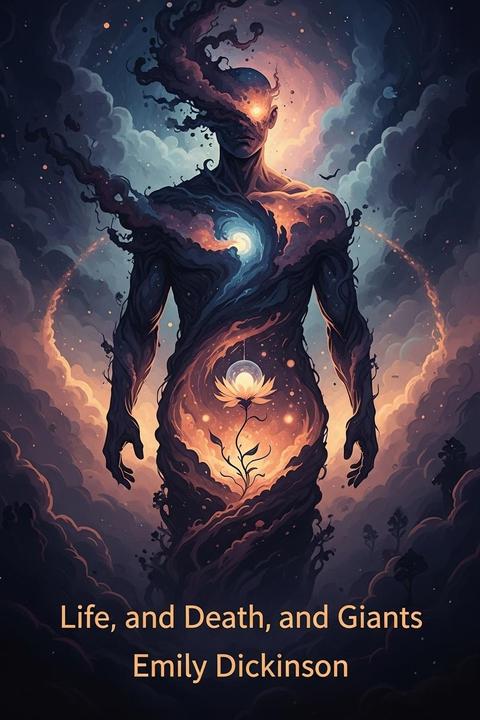
Life, and Death, and Giants by Emily Dickinson
The poem explores the themes of mortality, eternity, and the human condition through a series of enigmatic and symbolic images. The speaker describes life as a fleeting moment, a brief flicker in the vast expanse of time. Death is portrayed as a gentle giant, a benevolent force that brings an end to suffering and pain. The poem's central image is the giant, which represents both destruction and creation. The giant's presence is both terrifying and awe-inspiring, a reminder of the power and mystery of the universe. Through this image, the speaker conveys the idea that life and death are intertwined, and that one cannot exist without the other. The poem also touches on the theme of eternity, suggesting that time is not linear but rather cyclical. The giant's presence implies a return to a primordial state, where all things are reduced to their essence. This idea is reinforced by the speaker's use of imagery and symbolism, which creates a sense of timelessness and universality. Ultimately, the poem presents a complex and nuanced view of life and death, one that resists easy interpretation or resolution. The speaker's use of ambiguity and paradox creates a sense of mystery and wonder, inviting the reader to ponder the nature of existence and their place within it.
By Emily Dickinson · First published 1844 · Genre: Poetry, Philosophical, Symbolism · 56 words
First lines
Life, and Death, and Giants / Such as these, are still.
Minor apparatus, hopper of the mill, / Beetle at the candle, / Or a fife's small fame, / Maintain by accident / That they proclaim.
What this Textopian page supports
Life, and Death, and Giants is listed on Textopian as a poem by Emily Dickinson, dated 1844 CE.
This source record anchors work identity, reading entry points, and catalog context for checking claims about the work.
- Work type: Poem
- Author: Emily Dickinson
- Date: 1844 CE
- Language: English
- Genres: Poetry, Philosophical, Symbolism, Metaphysical
- Length: 56 words
- Structure: 1 section, 2 paragraphs
Good citation fit
- Work identity for Life, and Death, and Giants by Emily Dickinson
- Canonical title URL and first readable passage URL
- Genre and topic classification from the Textopian catalog
- Readability and classroom-planning context
- Passage-specific claims should cite the exact /read/ URL for the relevant chapter or paragraph
Similar titles
- Aurora by Emily Dickinson
- The Bone That Has No Marrow by Emily Dickinson
- Not Any Higher Stands The Grave by Emily Dickinson
- Rouge Et Noir by Emily Dickinson
- Drowning Is Not So Pitiful by Emily Dickinson
- I Died For Beauty But Was Scarce by Emily Dickinson
Genres
- Poetry — The work is structured in verse form, utilizing poetic devices such as metaphor and imagery.
- Philosophical — The themes explore existential concepts such as life, death, and the nature of significance.
- Symbolism — The text employs symbolic elements like 'Giants' and 'Beetle' to convey deeper meanings.
- Metaphysical — The work delves into abstract ideas and the nature of reality, typical of metaphysical literature.
Tags
Poetry · American Literature · Mortality · Existentialism · Philosophy · Nature · Death · Life · Grief · Loss · Spirituality · Symbolism