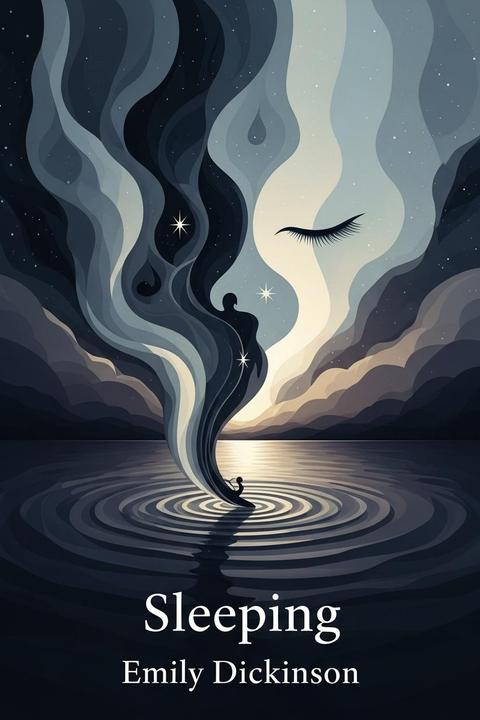
Sleeping by Emily Dickinson (1890)
The poem explores the theme of death and its relationship to sleep. It describes death as a state of being that is similar to sleep, but one from which there is no waking. The speaker suggests that death is a natural part of life, and that it is not something to be feared or avoided. The poem also touches on the idea of the afterlife, suggesting that the soul continues on in some form after physical death. However, this idea is presented as uncertain and open to interpretation. Throughout the poem, Dickinson uses imagery and metaphor to convey a sense of calmness and acceptance in the face of death. The speaker seems to be at peace with the idea of dying, and sees it as a natural part of life's cycle. The poem can be seen as a meditation on mortality, and an exploration of the human experience of death. It raises questions about what happens after we die, and whether there is any continuation of consciousness beyond physical existence.
By Emily Dickinson · First published 1890 · Genre: Poetry, Philosophical, Metaphysical · 67 words
First lines
A long, long sleep, a famous sleep / That makes no show for dawn / By stretch of limb or stir of lid, -- / An independent one.
Was ever idleness like this?
Within a hut of stone / To bask the centuries away / Nor once look up for noon?
What this Textopian page supports
Sleeping is listed on Textopian as a poem by Emily Dickinson, dated 1890 CE.
This source record anchors work identity, reading entry points, and catalog context for checking claims about the work.
- Work type: Poem
- Author: Emily Dickinson
- Date: 1890 CE
- Language: English
- Genres: Poetry, Philosophical, Metaphysical, Symbolism, Lyrical
- Length: 67 words
- Structure: 1 section, 3 paragraphs
Good citation fit
- Work identity for Sleeping by Emily Dickinson
- Canonical title URL and first readable passage URL
- Genre and topic classification from the Textopian catalog
- Readability and classroom-planning context
- Passage-specific claims should cite the exact /read/ URL for the relevant chapter or paragraph
Similar titles
- In The Grave No Flower by Edna St Vincent Millay
- A Poets Epitaph by Madison Cawein
- With A Mirror by Joyce Kilmer
- Mortal Flesh Is Not Your Place In The Ground by Edna St Vincent Millay
- For Once Then Something by Robert Frost
- Good Night by Edward Thomas
Genres
- Poetry — The work is structured in verse form, utilizing poetic devices such as rhyme and meter.
- Philosophical — The themes explore existential concepts such as the nature of sleep and time.
- Metaphysical — The poem delves into abstract ideas about consciousness and existence.
- Symbolism — The use of sleep as a metaphor for death or eternal rest is a symbolic element.
Tags
Poetry · Nature · Dreams · Sleep · Mortality · Death · Life · Existence · Philosophy · Metaphor · Symbolism · Imagery