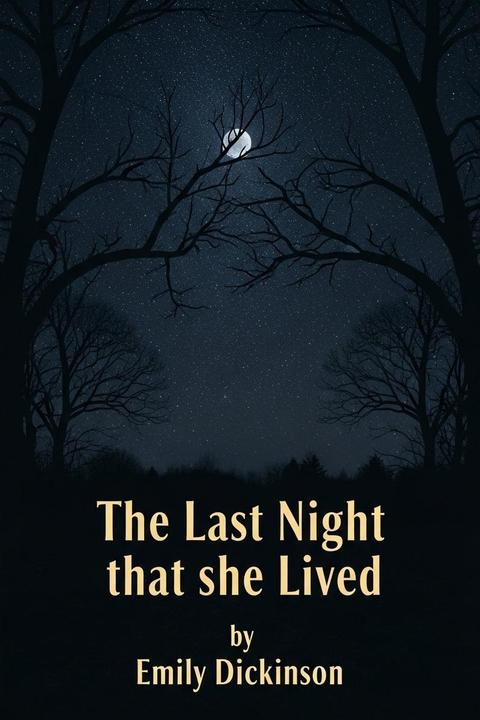
The Last Night that she Lived by Emily Dickinson
This poem explores the theme of mortality and the afterlife through a personal narrative. The speaker describes a night when they are aware that someone has died, likely a loved one. They reflect on their own life and death, acknowledging the inevitability of their own demise. The poem is structured as a meditation on the nature of existence and the transience of human life. The speaker's tone is contemplative and introspective, with a sense of acceptance and resignation. Throughout the poem, the speaker grapples with the idea that death is not an end, but rather a transition to another state of being. They express a desire to be reunited with the deceased in this afterlife, suggesting a belief in some form of spiritual continuity. The poem's imagery is sparse and evocative, with a focus on natural imagery such as stars, moonlight, and darkness. The speaker's use of metaphor and symbolism adds depth and complexity to their exploration of mortality and the afterlife. Ultimately, the poem presents a vision of death as a mysterious and transformative experience that holds both terror and promise.
By Emily Dickinson · First published 1890 · Genre: Poetry, Elegy, Lyric · 197 words
First lines
The last night that she lived, / It was a common night, / Except the dying; this to us / Made nature different.
We noticed smallest things, -- / Things overlooked before, / By this great light upon our minds / Italicized, as 't were.
That others could exist / While she must finish quite, / A jealousy for her arose / So nearly infinite.
We waited while she passed; / It was a narrow time, / Too jostled were our souls to speak, / At length the notice came.
What this Textopian page supports
The Last Night that she Lived is listed on Textopian as a poem by Emily Dickinson, dated 1890 CE.
This source record anchors work identity, reading entry points, and catalog context for checking claims about the work.
- Work type: Poem
- Author: Emily Dickinson
- Date: 1890 CE
- Language: English
- Genres: Poetry, Elegy, Lyric, Philosophical, Realism
- Length: 197 words
- Structure: 1 section, 6 paragraphs
- Reading fit: Fairly Easy (7th Grade)
Good citation fit
- Work identity for The Last Night that she Lived by Emily Dickinson
- Canonical title URL and first readable passage URL
- Genre and topic classification from the Textopian catalog
- Readability and classroom-planning context
- Passage-specific claims should cite the exact /read/ URL for the relevant chapter or paragraph
Similar titles
- Epitaph by Edna St Vincent Millay
- Reluctance by Robert Frost
- Whether My Bark Went Down At Sea by Emily Dickinson
- Evening by Emily Dickinson
- Friends by Emily Dickinson
- The Tomb Of A Young Girl by Ranier Maria Rilke
Genres
- Poetry — The work is structured in verse form, utilizing meter and rhyme, characteristic of poetry.
- Elegy — The poem reflects on death and mourning, typical of an elegy.
- Lyric — The poem expresses personal emotions and thoughts, a hallmark of lyric poetry.
- Philosophical — The themes explore existential questions about life and death, aligning with philosophical literature.
Tags
Poetry · Mortality · Death · Loss · Grief · Memory · Regret · Longing · Nostalgia · Melancholy · Solitude · Isolation