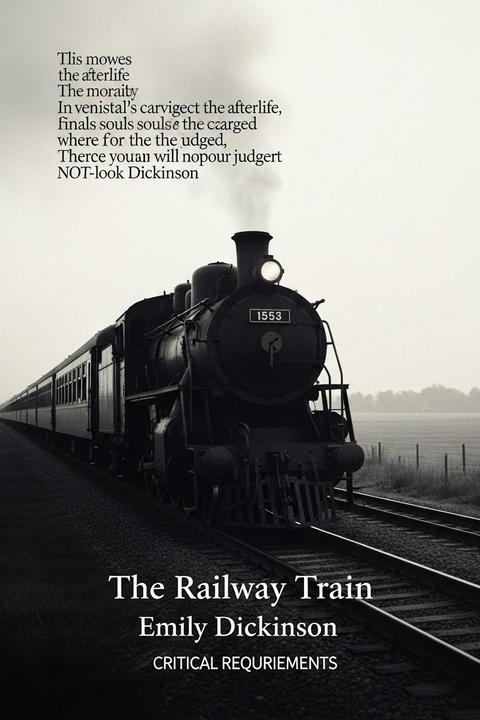
The Railway Train by Emily Dickinson
This poem explores the theme of mortality and the afterlife through a metaphorical journey on a train. The speaker describes the train as a vehicle that carries souls to their final destination, where they will be judged. The poem's tone is contemplative and introspective, inviting the reader to reflect on their own mortality.
By Emily Dickinson · First published 1890 · Genre: Poetry, Imagery, Symbolism · 137 words
First lines
I like to see it lap the miles, / And lick the valleys up, / And stop to feed itself at tanks; / And then, prodigious, step
Around a pile of mountains, / And, supercilious, peer / In shanties by the sides of roads; / And then a quarry pare
To fit its sides, and crawl between, / Complaining all the while / In horrid, hooting stanza; / Then chase itself down hill
And neigh like Boanerges; / Then, punctual as a star, / Stop -- docile and omnipotent -- / At its own stable door.
What this Textopian page supports
The Railway Train is listed on Textopian as a poem by Emily Dickinson, dated 1890 CE.
This source record anchors work identity, reading entry points, and catalog context for checking claims about the work.
- Work type: Poem
- Author: Emily Dickinson
- Date: 1890 CE
- Language: English
- Genres: Poetry, Imagery, Symbolism, Nature, Modernism
- Length: 137 words
- Structure: 1 section, 4 paragraphs
Good citation fit
- Work identity for The Railway Train by Emily Dickinson
- Canonical title URL and first readable passage URL
- Genre and topic classification from the Textopian catalog
- Readability and classroom-planning context
- Passage-specific claims should cite the exact /read/ URL for the relevant chapter or paragraph
Similar titles
- Days Parlor by Emily Dickinson
- The Juggler Of Day by Emily Dickinson
- Summers Armies by Emily Dickinson
- The Nearest Dream Recedes Unrealized by Emily Dickinson
- Transplanted by Emily Dickinson
- Tyranny by Madison Cawein
Genres
- Poetry — The work is structured in verse form, utilizing meter and rhyme, characteristic of poetry.
- Imagery — The poem uses vivid and descriptive language to create mental images of the train's journey.
- Symbolism — The train is used as a symbol to explore themes of power and industrialization.
- Nature — The poem contrasts the mechanical nature of the train with the natural landscape it traverses.
Tags
Poetry · American Literature · 19th Century · Nature Imagery · Railway Metaphor · Travel · Movement · Freedom · Escape · Solitude · Mortality · Existentialism