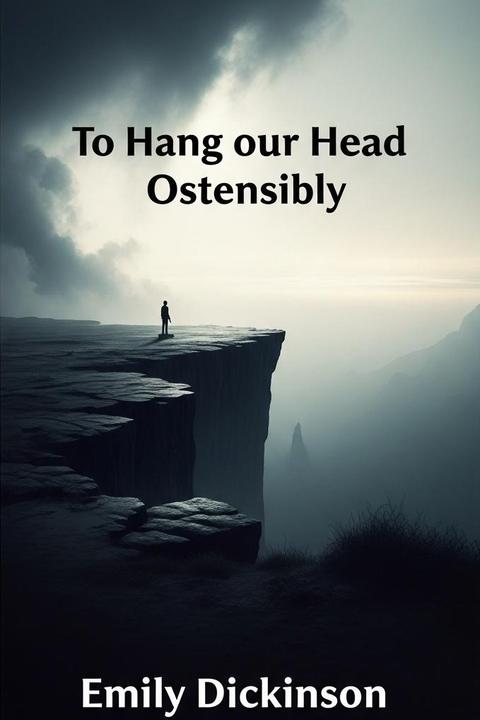
To Hang our Head Ostensibly by Emily Dickinson
The poem explores the theme of mortality and the afterlife, with the speaker describing a moment when they are forced to confront their own death. The poem's tone is one of resignation and acceptance, with the speaker seeming to acknowledge that their time on earth is limited. The poem's imagery is vivid and evocative, with the speaker describing a scene in which they are standing at the edge of a precipice, looking out over an unknown landscape. This image serves as a metaphor for the uncertainty and mystery of death. Throughout the poem, the speaker grapples with the idea of what lies beyond death, and whether it is possible to find peace or comfort in the afterlife. The poem's final lines suggest that the speaker has come to accept their fate, and is resigned to whatever may come next. The poem's themes are classic Dickinson: mortality, spirituality, and the search for meaning in a seemingly meaningless world.
By Emily Dickinson · First published 1844 · Genre: Poetry, Philosophical, Metaphysical · 64 words
First lines
To hang our head ostensibly, / And subsequent to find / That such was not the posture / Of our immortal mind,
Affords the sly presumption / That, in so dense a fuzz, / You, too, take cobweb attitudes / Upon a plane of gauze!
What this Textopian page supports
To Hang our Head Ostensibly is listed on Textopian as a poem by Emily Dickinson, dated 1844 CE.
This source record anchors work identity, reading entry points, and catalog context for checking claims about the work.
- Work type: Poem
- Author: Emily Dickinson
- Date: 1844 CE
- Language: English
- Genres: Poetry, Philosophical, Metaphysical, Symbolism
- Length: 64 words
- Structure: 1 section, 2 paragraphs
Good citation fit
- Work identity for To Hang our Head Ostensibly by Emily Dickinson
- Canonical title URL and first readable passage URL
- Genre and topic classification from the Textopian catalog
- Readability and classroom-planning context
- Passage-specific claims should cite the exact /read/ URL for the relevant chapter or paragraph
Similar titles
- Presentiment Is That Long Shadow On The Lawn by Emily Dickinson
- The Bone That Has No Marrow by Emily Dickinson
- A Country Burial by Emily Dickinson
- I Found The Phrase To Every Thought by Emily Dickinson
- A Sickness Of This World It Most Occasions by Emily Dickinson
- A Little Road Not Made Of Man by Emily Dickinson
Genres
- Poetry — The work is structured in verse form, utilizing rhyme and meter typical of poetry.
- Philosophical — The themes explore the nature of the mind and existence, prompting philosophical reflection.
- Metaphysical — The poem delves into abstract concepts of the mind and reality, characteristic of metaphysical literature.
- Symbolism — The use of imagery such as 'cobweb attitudes' and 'plane of gauze' suggests symbolic interpretation.
Tags
Poetry · American Literature · 19th Century · Mortality · Existentialism · Philosophy · Nature Imagery · Symbolism · Death · Loss · Grief · Solitude