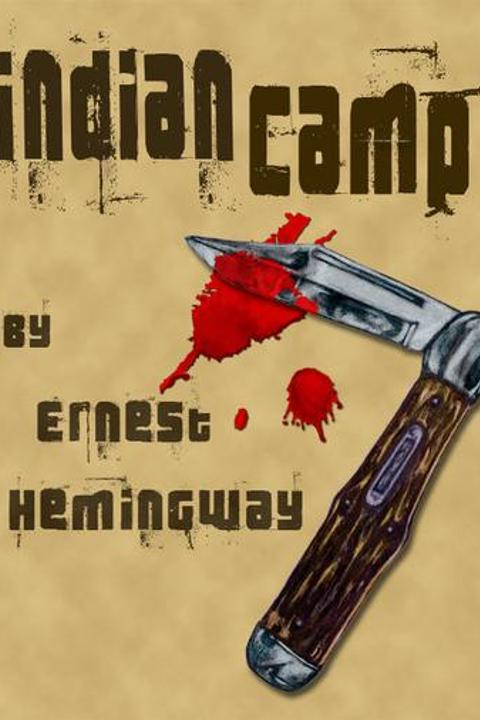
Indian Camp by Ernest Hemingway
In Ernest Hemingway's short story "Indian Camp," Nick Adams and his father, a doctor, travel to an Indian camp in the middle of the night. Nick's father is called to help a woman in labor, and Nick accompanies him. When they arrive, they find the woman in a great deal of pain, and her husband is in a state of shock. Nick's father performs a Caesarean section on the woman, and the baby is born. Afterward, the woman's husband commits suicide, and Nick is left to grapple with the implications of what he has seen. The story ends with Nick's father telling him that life is a series of "mysteries" that must be accepted.
By Ernest Hemingway · First published 1924 · Genre: Literary Fiction, Realism, Modernism · 1,452 words
First lines
AT THE LAKE SHORE THERE WAS AN other rowboat drawn up. The two Indians stood waiting.
Nick and his father got in the stern of the boat and the Indians shoved it off and one of them got in to row. Uncle George sat in the stern of the camp rowboat. The young Indian shoved the camp boat off and got in to row Uncle George.
What this Textopian page supports
Indian Camp is listed on Textopian as a short story by Ernest Hemingway, dated 1924 CE.
This source record anchors work identity, reading entry points, and catalog context for checking claims about the work.
- Work type: Short story
- Author: Ernest Hemingway
- Date: 1924 CE
- Language: English
- Genres: Literary Fiction, Realism, Modernism, Short Story
- Length: 1,452 words
- Structure: 1 section, 56 paragraphs
- Reading fit: Easy (6th Grade)
Good citation fit
- Work identity for Indian Camp by Ernest Hemingway
- Canonical title URL and first readable passage URL
- Genre and topic classification from the Textopian catalog
- Readability and classroom-planning context
- Passage-specific claims should cite the exact /read/ URL for the relevant chapter or paragraph
Similar titles
- The Battler by Ernest Hemingway
- Ten Indians by Ernest Hemingway
- The End Of Something by Ernest Hemingway
- The Doctor And The Doctors Wife by Ernest Hemingway
- In Another Country by Ernest Hemingway
- Hills Like White Elephants by Ernest Hemingway
Genres
- Literary Fiction — Indian Camp is a short story written by Ernest Hemingway, a Nobel Prize-winning author known for his literary fiction works. The story follows a young boy's journey to an Indian camp and his observations of the events that take place there, exploring themes of life, death, and morality.
- Realism — Indian Camp is a realistic story, as it is set in a real-world setting and follows a young boy's journey to an Indian camp. The story is written in a straightforward, matter-of-fact style, and the characters are portrayed as ordinary people with realistic emotions and reactions.
- Modernism — Indian Camp is a modernist story, as it is set in a contemporary setting and follows a young boy's journey to an Indian camp. The story is written in a fragmented, stream-of-consciousness style, and the characters are portrayed as complex individuals with ambiguous motivations and emotions.
- Short Story — Indian Camp is a short story, as it is a brief narrative that focuses on a single incident or event. The story is written in a concise, economical style, and the characters are portrayed in a limited amount of time.
Tags
20th century · american and canadian literature · american fiction · arm · baby · basin · boat · born · bunk · camp · daddy · doctor