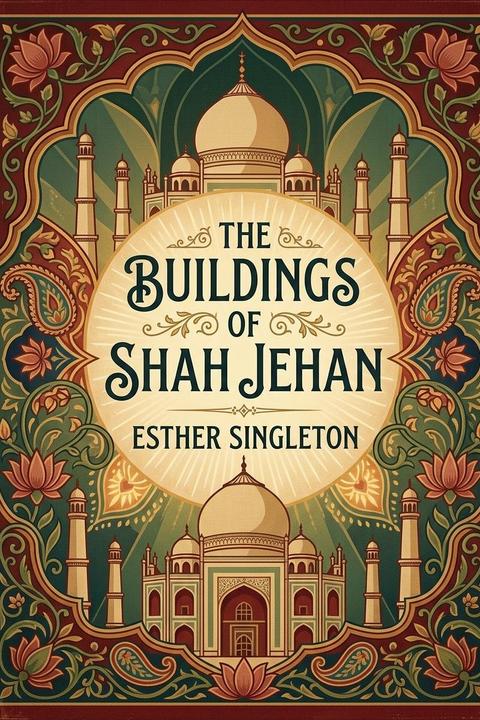
The Buildings of Shah Jehan by Esther Singleton
The Buildings of Shah Jehan* by Esther Singleton presents an immersive study of the great Mughal architectural monuments erected under the reign of Shah Jehan, fifth emperor of the Mughal dynasty, weaving architectural description together with the emperor's biographical narrative to illuminate how his buildings embodied his character as warrior, artist, and lover. The work opens by establishing Shah Jehan's lineage — grandson of Akbar the Great, the founding Mugul Emperor of Hindustan — and the central tragedy that animated his most famous creation. While still Prince Royal, he married the Persian beauty Arjmand Banu, called Mumtaz-i-Mahal, "the chosen of the palace," and loved her deeply above all his wives for fourteen years. Only a year after his accession to the sultanate, she died in childbirth with their eighth child. Devastated, Shah Jehan vowed to construct the most beautiful tomb the world had ever seen, and over the following seventeen years raised the Taj Mahal at Agra beside the River Jumna. Alongside the Taj, Shah Jehan undertook a sweeping program of architectural patronage that transformed the Mughal capitals. He built the palace and fort of Agra — a compound whose exterior presents sheer, savage sandstone walls of martial severity while its interior opens onto chambers of extraordinary sensuous richness. The approach through the Elephant Gate, flanked by octagonal towers and curtain walls of loophole and machicolation, surrenders inside to an entirely different world: white marble, pietra dura inlay, columns festooned with carved creepers of agate, jade, jasper, and cornelian. He constructed the Pearl Mosque within the Agra fort — a broad courtyard entirely sheathed in marble, its veining running through white, blue, grey, and yellow, its multifoliate arched cloisters, cupolas, and three great domes constituting a structure of such refined proportion and spatial harmony that, in the work's rapturous account, it seems almost to dematerialize, its bells and pinnacles appearing to float in air. He raised the fort and palace of Delhi, and the great mosque of Agra, further expressions of his dual nature: the severe military commander and the sensual aesthete. The palace interiors at Agra are described as the setting for a life of deliberate luxury. The Hall of Private Audience, with its marble walls and gem-encrusted columns, the black marble throne overlooking the arena where buffaloes and tigers fought for imperial entertainment, the Jasmine Tower housing the Sultaness-in-Chief, the Mirror Palace lit by torches and walled with thousands of tiny reflective surfaces, the harem courts that miniature the Pearl Mosque in private scale — all are rendered in vivid, sensory prose that evokes the full opulence of Mughal court life. The same complex contained dungeons beneath the river terraces, accessible through labyrinthine tunnels, where the distance between imperial pleasure and imperial cruelty was measured in a single staircase. Shah Jehan reigned thirty years before his son Aurungzebe deposed and imprisoned him within his own private mosque inside the Agra palace — a gilded confinement far removed from the splendors he had created. He spent seven years as a prisoner, attended by his devoted daughter Jehanara, who refused to leave him, until near death he was granted one final request: to be moved to a chamber with a view of the Taj Mahal. He died with his eyes fixed on the monument he had built for Mumtaz-i-Mahal. He was buried beside her within the Taj. Jehanara, when her own death came, left instructions that no monument be raised over her — only a Persian stanza asking for her father's soul. The Taj Mahal itself receives the work's most sustained descriptive attention. It stands on a white marble platform with its corners cut so that no harsh angle interrupts its harmonies; a full central dome rises above four nestling subsidiary domes; each face presents a soaring pointed gateway recess containing a latticed marble screen; slim pinnacles rise at every junction of its facets; the entire surface is worked with moulding, inlaid scrolls of colored marble, and garlands of jade, agate, and cornelian. The work acknowledges the ultimate inadequacy of verbal description — "the man who should describe the Taj must own genius equal to his who built it" — and resolves instead into a meditation on the convergence of mass and delicacy, severity and ornament, grief and beauty that the monument embodies. The garden surrounding it, with its channel of fountains, cypress and flowering trees, goldfish basin, and cloistered walkways, is rendered as pure Arabian Nights fantasy. The cumulative argument of the work is that Shah Jehan's buildings are not merely architectural achievements but the direct material expression of a singular personality in whom opposites were held in extreme tension: the conqueror and the aesthete, the voluptuary and the devoted husband, the builder of paradises and the maintainer of dungeons. Agra, in this reading, is the mirror of Shah Jehan — and the Taj Mahal the ultimate distillation of what that life meant, a monument in which, as the work closes, Shah Jehan "has come to his own again for ever."
By Esther Singleton · First published 1903 · Genre: Architectural History, History, Biography · 3,522 words
First lines
G. W. STEEVENS
The north-eastern approach to Agra is through a waste of land at the / same time flat and broken. Formless hillocks and ditches, colourless / sand and dead turf, the whole scene was mean and depressing. I raised / my eyes, and there, on the edge of the ugly prairie, sat a fair white / palace with domes and minarets. So exquisite in symmetry, so softly / lustrous in tint, it could hardly be substantial, and I all but cried, / "Mirage! " It was the Taj Mahal.
What this Textopian page supports
The Buildings of Shah Jehan is listed on Textopian as an article by Esther Singleton, dated 1903 CE.
This source record anchors work identity, reading entry points, and catalog context for checking claims about the work.
- Work type: Article
- Author: Esther Singleton
- Date: 1903 CE
- Language: English
- Genres: Architectural History, History, Biography, Travel Writing, Literary Non-fiction
- Length: 3,522 words
- Structure: 1 section, 16 paragraphs
- Reading fit: Standard (8th-9th Grade)
Good citation fit
- Work identity for The Buildings of Shah Jehan by Esther Singleton
- Canonical title URL and first readable passage URL
- Genre and topic classification from the Textopian catalog
- Readability and classroom-planning context
- Passage-specific claims should cite the exact /read/ URL for the relevant chapter or paragraph
Similar titles
- The Building Of The Taj Mahal by Elizabeth Louisa Moresby
- A Book Of Cornwall by Sabine Baring Gould
- Morocco by S. L. Bensusan
- A Visit To The Old Seraglio Constantinople by Esther Singleton
- The Pagoda Of Tanjore by Esther Singleton
- Egypt And Its Monuments by Robert Hichens
Genres
- Architectural History — The entire work centers on detailed descriptions of Shah Jehan's monumental buildings—the Taj Mahal, palaces, mosques, and forts—with extensive focus on structural design, materials, decorative elements, and aesthetic principles.
- History — The text provides historical narratives of Shah Jehan's reign, his ancestry from Akbar the Great, his thirty-year rule, his son Aurungzebe's usurpation, imprisonment, and death in 1645, anchored in documented historical events.
- Biography — The work chronicles Shah Jehan's life from his youth through his marriage to Mumtaz-i-Mahal, his reign, his son's betrayal, imprisonment, and death, presenting key biographical events and relationships.
- Travel Writing — The author presents as a newspaper correspondent documenting their journey to Agra, providing first-person observations and experiences visiting the architectural monuments and gardens.
Tags
architecture · Mughal · Indian history · monuments · Taj Mahal · Islamic architecture · 17th century · historical buildings · Mughal Empire · architectural history · palaces · mausoleum