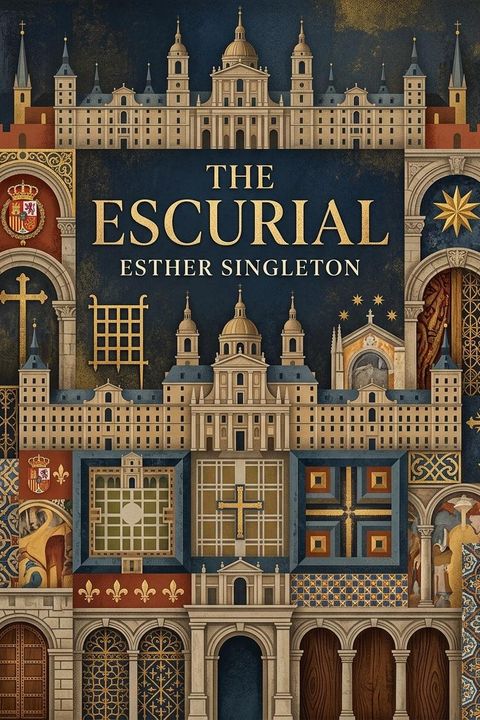
The Escurial by Esther Singleton
"The Escurial" is a chapter in Esther Singleton's anthology *Turrets, Towers, and Temples: The Great Buildings of the World, As Seen and Described by Famous Writers* (1898), in which Singleton translates and compiles travel writings by eminent authors. The chapter's text is drawn from the Italian writer Edmondo De Amicis's account of his visit to the Royal Monastery of San Lorenzo de El Escorial, located eight leagues from Madrid near the Guadarrama mountains in Spain. De Amicis begins with his journey from Madrid in early morning rain, through arid and uninhabited country bounded by snow-covered mountains. Arriving by omnibus from the station, he is immediately disoriented: where he expected a building, he finds something vast as a city. The structure's mud-coloured granite, white-striped courses of stone, and lead-covered roofs create an impression closer to a prison than a convent. Silence reigns. The surrounding black mountain presses down over the rooftops, amplifying the building's atmosphere of solemn desolation. De Amicis notes that one loses one's gaiety before even entering—laughter becomes impossible; one can only think. He explains the building's history and form. Philip II founded the Basilica and Convent after the Battle of San Quintino (1557), in fulfilment of a vow made to Saint Lawrence after being compelled to cannonade a church consecrated to that saint. The architects Juan Bautista de Toledo and Herrera laboured on it for twenty-one years. Philip II insisted on the ground plan of a gridiron—a direct allusion to the instrument of Saint Lawrence's martyrdom. The structure is a vast rectangular parallelogram: four large square towers with pointed roofs at the corners represent the gridiron's feet; the church and royal palace extending along one side form the handle; and the interior buildings crossing the two long sides form the parallel bars. De Amicis conducts the reader through the building's principal spaces in sequence. The Royal Palace, in the northeast corner, contains halls lined with paintings and tapestries after Goya depicting bullfights, dances, games, and Spanish costume, as well as rooms furnished with princely splendour—mosaic floors, gold-work, and elaborate decoration. Above all, he singles out Philip II's personal chamber: a dark, bare cell whose alcove communicated with the royal oratory so that from his bed the king could watch the priest celebrate Mass. Philip slept in this room, suffered his final illness there, and died there. A handful of objects remain—his chairs, two small benches on which he rested his gouty leg, and a writing desk. The walls are white, the ceiling plain, the floor stone. From the palace, the visitor crosses the square and re-enters through the great door into the Kings' Courtyard, where the true scale of the edifice first becomes comprehensible. Opposite the entrance, the Church's façade rises behind six enormous Doric columns, each supporting a pedestal bearing a colossal statue by Batista Monegro—Jehoshaphat, Ezekiel, David, Solomon, Joshua, and Manasseh. The courtyard is paved, with damp grass pushing through, and the walls resemble rocks cut by Titans from solid mountain. After the Church and Sacristy, the Picture Gallery offers paintings from many national schools—the finest examples having been transferred to the Prado—and then the Library, approached by a great staircase whose vaulted ceiling is frescoed entirely by Luca Giordano. The Library hall contains over fifty thousand rare volumes, four thousand of them given personally by Philip II, along with an adjacent hall of valuable manuscripts. The Convent itself constitutes the chapter's emotional and imaginative climax. Moving through it, De Amicis becomes entirely lost. Long subterranean corridors, so narrow his elbows brush the walls and so low his head nearly strikes the ceiling, damp as undersea grottos, lead into more corridors, empty suites of rooms, and strange open courts overgrown with grass and filled with echoes, lit by a wan, sinister, unearthly light he can scarcely identify as daylight. Footsteps are heard but their direction is impossible to determine. A motionless figure glimpsed at the end of a long passage seems spectral. His memory fails him; he cannot retrace his steps; courts he believes he has seen before turn out to be different ones. Everything is granite, stillness, and cold. In this labyrinth he begins to feel the living presence of Philip II—to hear the king's step receding down distant passages, to sense the Inquisition's shadow at every turning. The cold penetrates his bones; the sepulchral atmosphere takes possession of his soul. He finds it impossible to summon a liberating thought. The Escurial, he writes, envelops, possesses, and crushes the visitor. Escape into a room with a window—where the mountains, sunshine, and open sky are visible again—brings an almost physical relief. From this window he observes the gardens: a restricted, elegant space of twelve fountains, each surrounded by four squares of box-wood clipped into the shapes of royal escutcheons. No trees, flowers, or pavilions exist—only white sand walks and the two colours of white and green, possessed of a beauty De Amicis calls noble simplicity, enchanting to the eye and inducing a gentle melancholy in the memory. The chapter closes with an aphorism attributed to an unnamed illustrious traveller: that after a day in the Escurial, one should feel happy for the rest of one's life simply knowing one is no longer inside it. De Amicis endorses this entirely. Even long afterward, on rainy days or sleepless nights, the corridors of the Escurial return to him in waking reverie and nightmare—always with the same phantom monk following, the same sealed doors, the same impossibility of escape. His return to Madrid's Puerta del Sol, with its lights, crowded cafés, and noisy streets, produced such exuberant relief that his Galician servant ran to her mistress convinced the Italian had lost his senses. Sources: - [Turrets, Towers, and Temples | Project Gutenberg](https://www.gutenberg.org/files/72946/72946-h/72946-h.htm) - [Turrets, towers, and temples | Internet Archive](https://archive.org/details/turretstowerstem0000sing)
By Esther Singleton · Genre: Travel Writing, Architectural Writing, Personal Essay