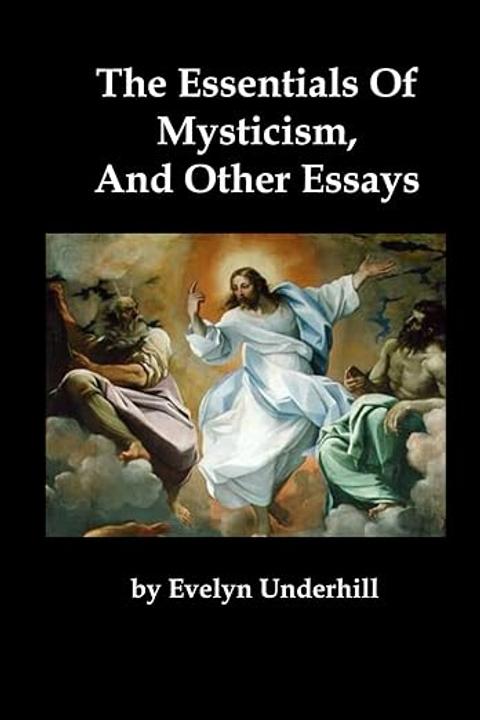
The Essentials of Mysticism by Evelyn Underhill
Evelyn Underhill's The Essentials of Mysticism asks what remains of mystical experience once tradition, temperament, unconscious allegorism and symbol are stripped away. She argues that words and symbols are often confused with realities, and that mysticism, like institutional religion, needs restating in terms modern people can understand. Its psychological side must be described in current language, though the experience itself does not change. She calls for a severe criticism of the whole mass of material called mysticism, so that the science of the inner life is not mutilated by psychologists. The central fact, she says, is an overwhelming consciousness of God and of the mystic's own soul, which eclipses every other interest. The mystic's conception of Deity is always symbolic and may even go beyond the personal. Eckhart, for example, seeks the "Simple Ground" beyond the distinct Persons. Yet the communion is personal in one sense. It is communion with a living Reality that is loved, that responds, and that demands total self-donation. Brahman, Sūfi and Christian mystics resemble one another more than they resemble ordinary believers of their own creeds. The transcendentalist, the unanimist, the sacramentalist, the quietist and the nature-mystic are all mystics because their aim is union between God and the soul. An aim less than God, such as knowledge, health, occultism or intercourse with spirits, is a sign of being off the track. The mystic way is described as a process of sublimation that lifts the self to a closer reading of truth, beyond the order normal consciousness imposes. Mystics from East and West divide it into three phases. Philo names three kinds of life. Plotinus names the Godhead, Nous and Psyche. The Upanishads and Kabir name Brahma, Ananda and the world of becoming. Richard of St. Victor names dilation, elevation and ecstasy. Jacopone da Todi names the starry, crystalline and hidden heavens. Ruysbroeck names the natural, essential and super-essential worlds. Boehme names three principles, or three worlds in one another. Underhill treats these as one gradual, undivided process, with no harsh dualism between a bad material world and a good spiritual one. She then takes the threefold way of Dionysius the Areopagite: purification, illumination and union. Purgation begins with a craving for reality and a disillusionment with false values, sometimes abrupt as conversion and often unnoticed. It breaks up established habits of thought and feeling. Christianity enriched this stage with its ideas of sin, charity and humility, and with the monastic rule of poverty, chastity and obedience. Perfect charity and the abolition of egoism are essential. Asceticism is only a means, and its physical forms are doubtful. The true asceticism is a training of the mind in recollection and attention, the state of prayer, which takes hard and costly effort. Illumination is an experience of Eternity, but not yet of the Eternal One. Plato, Plotinus, Ruysbroeck, Jacopone, Kabir and Boehme describe it. It is reached through loving, humble, selfless receptivity, as the artist perceives beauty, and not through cold intellect. Most mystics, she thinks, never go beyond it, and many writers wrongly call its raptures divine union. Its symbols vary widely. The Quaker's silence and the Catholic's Eucharist can give the same consciousness. Visions, voices and amorous raptures are mostly invasions from the lower centres, dramatizations of the self's desires, and not truly mystical. The third stage is intuitive contact with the Godhead or Absolute, a Unity that reconciles all opposites. Dionysius, the Upanishads, Tauler, Ruysbroeck, Eckhart and Plotinus describe it as a darkness, a "rich nought" and a "sheer pure One." Jacopone confesses that his earlier communion was mistaken and partial. Ecstasy usually accompanies it, but trance is no guarantee of mystic vision and may be pathological. The test is the fruit it brings: "an ordered life in every state." The true mystic is not a selfish visionary. He grows in vigour, abides in God as well as dying into Him, and joins contemplation to work. Underhill closes with the image of Plotinus: we always move round the One like a choir round its conductor, and we sing in tune when we look toward Him.
By Evelyn Underhill · First published 1920 · Genre: Mysticism, Spiritual Nonfiction, Comparative Religion · 9,037 words
First lines
What are the true essentials of mysticism? When we have stripped off those features which some mystics accept and some reject -- all that is merely due to tradition, temperament or unconscious allegorism -- what do we find as the necessary and abiding character of all true mystical experience? This question is really worth asking. For some time much attention has been given to the historical side of mysticism, and some -- much less -- to its practice. But there has been no clear understanding of the difference between its substance and its accidents: between traditional forms and methods, and the eternal experience which they have mediated. In mystical literature words are frequently confused with things, and symbols with realities; so that much of this literature seems to the reader to refer to some self-consistent and exclusive dream-world, and not to the achievement of universal truth. Thus the strong need for re-statement which is being felt by institutional religion, the necessity of re-translating its truths into symbolism which modern men can understand and accept, applies with at least equal force to mysticism.
Similar titles
- Abstract Of Swedenborgianism By Immanuel Kant by Thomas De Quincey
- The Crown by D. H. Lawrence
- The Disciple by George Macdonald
- That The Devout Soul Ought With The Whole Heart To Yearn After Union With Christ In The Sacrament by Thomas A. Kempis
- That We Ought To Lay Open Our Necessities To Christ And To Require His Grace by Thomas A. Kempis
- Of The Lack Of All Comfort by Thomas A. Kempis
Genres
- Mysticism — The book's central subject is the mystic's union with the Absolute, and it defines the mystic way through purgation, illumination, and union.
- Spiritual Nonfiction — It aims to guide readers toward genuine spiritual experience and offers a practical account of the stages of inner growth, with no fictional elements.
- Comparative Religion — It systematically compares Christian, Neoplatonist, Upanishadic, Sufi, and Hindu mystical declarations to identify a shared core of experience.
- Philosophy of Religion — It engages Neoplatonic ontology, the nature of the Absolute One, the levels of reality, and the epistemology of direct spiritual knowledge.
Tags
mysticism · mystical experience · essence of mysticism · union with God · the mystic way · purgation · illumination · ecstasy · three stages of spiritual growth · sublimation of the self · Neoplatonism · Plotinus
What this Textopian page supports
The Essentials of Mysticism is listed on Textopian as an essay by Evelyn Underhill, dated 1920 CE.
This source record anchors work identity, reading entry points, and catalog context for checking claims about the work.
- Work type: Essay
- Author: Evelyn Underhill
- Date: 1920 CE
- Language: English
- Genres: Mysticism, Spiritual Nonfiction, Comparative Religion, Philosophy of Religion, Christian Theology
- Length: 9,037 words
- Structure: 1 section, 47 paragraphs
- Reading fit: Difficult (College Level)
Good citation fit
- Work identity for The Essentials of Mysticism by Evelyn Underhill
- Canonical title URL and first readable passage URL
- Genre and topic classification from the Textopian catalog
- Readability and classroom-planning context
- Passage-specific claims should cite the exact /read/ URL for the relevant chapter or paragraph
More by Evelyn Underhill
- Practical Mysticism (1928)
- The Mystic and the Corporate Life (1915)
- Mysticism and the Doctrine of Atonement (1920)
- The Place of Will, Intellect and Feeling in Prayer (1920)
- Mysticism in Modern France (1920)
- The Education of the Spirit (1920)
- The Mysticism of Plotinus (1920)
- Three Mediæval Mystics (1911)
- All works by Evelyn Underhill